
Kite bird scarers do work, but with important caveats. UK Air Navigation Order / CAA guidance (airspace limits and kite/balloon restrictions) notes that Civil aviation authorities (example: UK Air Navigation Order / CAA guidance and kite code of practice) set explicit height/distance limits for kite/balloon operations near aerodromes (e.g., restrictions on flying kites above certain heights within 3–5 km of airfields) and advise seeking permission from the aerodrome/CAA for higher or closer operations. In the right conditions, a raptor-shaped kite flying above a garden, field, or rooftop can cut bird pressure significantly. A 1984 field experiment found hawk-kites reduced red-winged blackbird damage to cornfields by around 83%, and a USDA-backed trial recorded gull numbers on a treated pond dropping from over 400 birds to fewer than one. Those are real results. The catch is that birds habituate quickly, sometimes within days, so a kite left flying in the same spot without any changes will stop working. They also need wind to move convincingly, and their effectiveness varies a lot by species. Used correctly as part of a broader deterrent strategy, they are one of the more cost-effective visual tools available.
Do Kite Bird Scarers Work? Guide for Homeowners & Farms Today

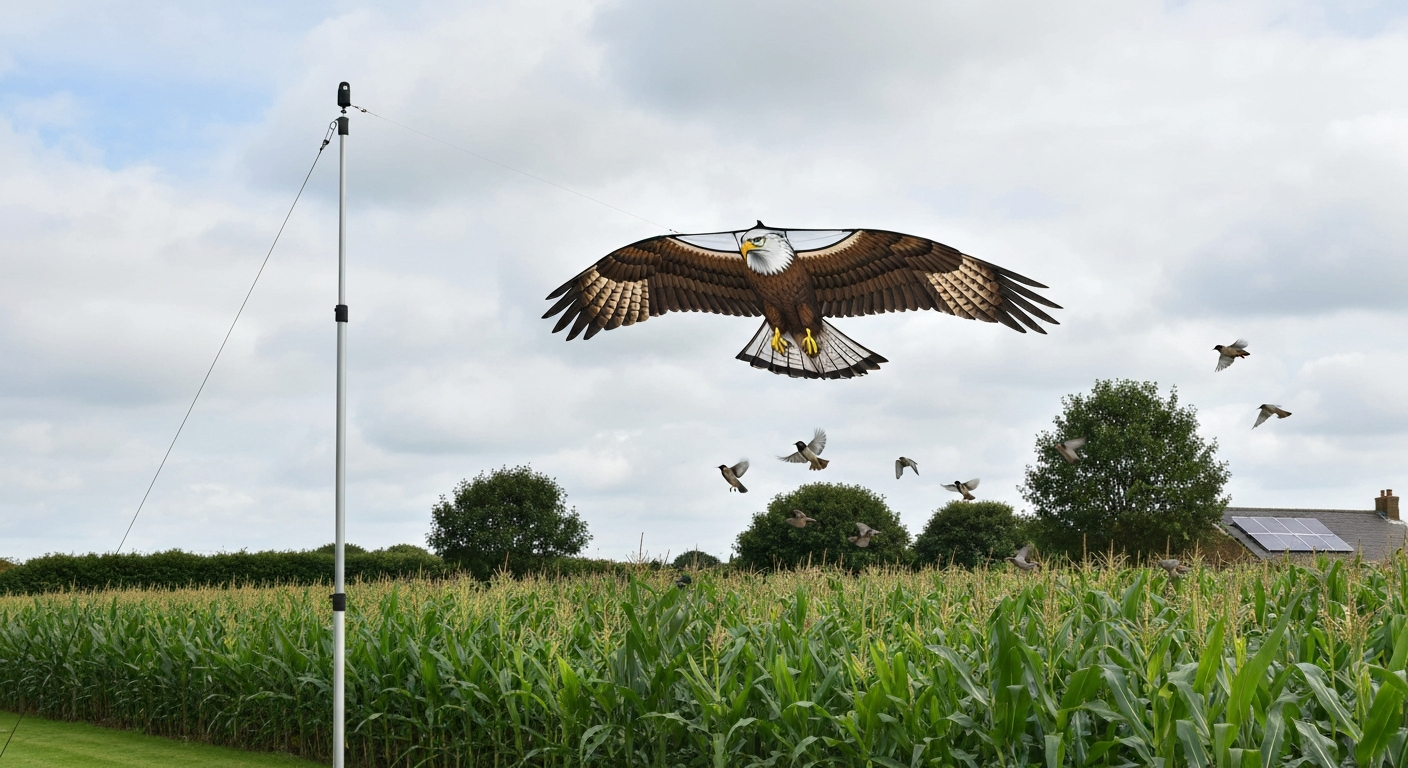
How kite bird scarers actually deter birds
The core principle is predator mimicry. Birds that are prey species, including starlings, sparrows, pigeons, and gulls, have a hard-wired flight response to the silhouette and movement of raptors overhead. A kite shaped like a hawk or eagle triggers the same visual signal that would make a real bird scatter if a peregrine appeared above it.
Movement is what makes a kite more effective than a static decoy. When wind catches a kite, it tilts, swoops, and pivots in a way that resembles the soaring behaviour of a bird of prey. This unpredictable, three-dimensional motion keeps the stimulus alive. Research on active predator replicas, including the RobotFalcon experiments, confirms that continuous and varied movement dramatically reduces habituation compared with still or repetitive motion.
Some kites incorporate additional visual cues: high-contrast eye patterns, undersurface markings that mimic wing and tail banding, or reflective panels. These details reinforce the raptor signal rather than relying on silhouette alone. The combination of shape, movement, and contrast is what separates a well-designed kite from a simple flag or spinner.
What the evidence actually shows
The supporting evidence comes from a mix of controlled field trials, peer-reviewed reviews, and practitioner case reports. None of these sources are marketing material, and taken together they paint a consistent picture: short-term effectiveness is real, long-term effectiveness requires active management.
The 1984 Conover study in the Journal of Wildlife Management compared hawk-kites against propane exploders and a chemical repellent (Avitrol) in cornfields. Hawk-kites produced an 83% reduction in blackbird damage and delivered the best cost-benefit ratio of the three methods. The USDA NWRC trials of Allsopp Helikites (a balloon-kite hybrid) at a treated pond saw mean ring-billed and herring gull numbers fall from around 421 to fewer than one bird per count. A 2023 fisheries study tested a falcon-shaped kite on fishing vessels and found it could meaningfully reduce seabird interactions with gear.
A 2021 systematic review in the journal Crop Protection is the most balanced summary available. It concluded that predator-mimic frightening devices, including hawk-kites, can reduce crop damage in some contexts, but that evidence is often short-term and site-specific. The review and USDA/APHIS handbooks both flag habituation as the primary limitation, recommending regular rotation and combining kites with other deterrents for sustained results.
Which species and settings they work for (and where they fall short)
Kite scarers perform best against small to medium-sized prey birds with a natural fear response to raptors. They work less reliably against large, bold species that have few natural predators or that quickly learn a threat is not real.
Settings where kites tend to be effective
- Gardens and allotments: good for deterring pigeons, starlings, and sparrows from soft fruit, brassicas, and seedbeds
- Patios and outdoor dining areas: useful against gulls and corvids scavenging food waste
- Agricultural fields: evidence-backed for blackbirds, starlings, and some gull species in crop protection
- Fishing vessels and aquaculture sites: field-tested for seabird deterrence around gear and pens
- Ponds and water features: USDA trials showed strong short-term results against loafing gulls
- Solar panels and flat roofs: airflow on elevated surfaces gives good kite movement and discourages perching birds
- Swimming pools: deters diving birds like cormorants and herons when combined with other methods
Settings and species where they are less reliable
- Large waterfowl such as geese and cranes: these species do not reliably perceive Buteo or Accipiter silhouettes as predators and tend to habituate quickly or ignore kites altogether
- Calm, sheltered locations: without consistent wind, the kite hangs limp and provides no deterrent value
- Dense urban environments with very high bird pressure: pigeons and corvids in city centres accustom themselves rapidly to novel stimuli
- Airfields: kites can contribute to short-term hazing but are only one component of an integrated wildlife hazard management programme; see the note on aviation safety below
Types of kite scarers and the design features that matter
Not all kite scarers are equivalent. The design choices made at the manufacturing stage have a direct effect on how convincingly a kite mimics a raptor and how long it holds up in field conditions.
| Type | Key design features | Best use case | Limitations |
|---|---|---|---|
| Raptor-shaped fabric kite | Hawk or eagle silhouette, ripstop nylon, wingspan typically 1–2 m, flown on a telescopic pole (5–7 m) | Gardens, fields, patios, rooftops | Needs consistent wind; fades and tears over time |
| Helikite (balloon-kite hybrid) | Inflatable helium balloon with kite fins; flies in both wind and still air; used in research trials | Ponds, airfields, large open fields | Higher cost; helium refill required; regulatory considerations at height |
| Inflatable/parafoil kite | Soft-body inflatable; self-inflates in moderate wind; no rigid frame | Agricultural fields, coastal sites | Less realistic silhouette; performance in low wind is poor |
| Reflective/mylar kite | Highly reflective panels; light and movement create additional visual stimulus | Gardens, vineyards, fruit cages | Effect fades once birds learn it poses no real threat |
| Eye-patterned kite | High-contrast eye spots and wing markings reinforce raptor realism | Seabird deterrence, fishing, ponds | More expensive; same habituation risks as other passive devices |
Size matters more than most product descriptions suggest. A commercially available 7-metre eagle kite is claimed to cover around 0.5 to 1 hectare depending on wind conditions, which is broadly consistent with field experience. Smaller kites with wingspans under 1 metre are less convincing at the distances birds typically assess threats from above. Ripstop nylon is the standard material for fabric kites because it handles UV exposure and repeated flexing better than plain nylon or polyester.
Deployment best practices
How you deploy a kite matters as much as which kite you buy. The biggest mistake is setting it up once and leaving it in the same spot. Birds are observant and will notice that nothing bad ever happens when the kite is there. Within a few days to a couple of weeks, it becomes part of the scenery.
Placement and height
Position the kite so it flies above the area you want to protect, not beside it. A telescopic fiberglass or carbon-fiber pole of 5 to 7 metres is the standard approach for gardens and rooftops. The kite should be visible from multiple approach angles, which means central placement in an open area works better than siting it against a wall or fence line. For ponds and pools, mount the pole at the water's edge so the kite hovers directly over the surface.
Anchoring and motion
The pole must be anchored firmly. Ground spike mounts, weighted base plates, and railing mounts are the common options. A kite that topples in a gust, or droops because the pole flexes, loses its deterrent effect immediately. Use a swivel connector between the pole top and the kite's line so the kite can rotate freely and track the wind without tangling.
Rotation schedule to prevent habituation
Move the kite to a different position every one to three days. If you have a large site, use two or three kites and rotate them across different positions on a schedule. Taking the kite down for a day or two and then redeploying it can also reset the novelty. Research consistently recommends this as the single most effective tactic for extending the useful life of any visual deterrent, including kite scarers, scare balloons, and owl decoys.
Timing
Deploy the kite before birds establish a feeding or roosting routine at a site. Once birds have settled into a pattern, displacing them takes more effort. For seasonal crops, put the kite up two to three weeks before the crop becomes attractive. For persistent year-round pressure, plan a rotation schedule in advance rather than reacting after problems develop.
How kite scarers compare with other visual deterrents
Kites are one of several visual deterrent options. Scare balloons and owl or raptor decoys are the most common alternatives. For more on scare balloons, see our article 'do bird scare balloons work' for guidance on effectiveness and suitable uses. Each has different strengths, and understanding those differences helps you choose the right tool or combination.
| Deterrent | Movement | Habituation risk | Effective range | Approximate cost | Best for |
|---|---|---|---|---|---|
| Hawk-kite (fabric, pole-mounted) | High (wind-driven, unpredictable) | Moderate (manageable with rotation) | 0.5–1 ha per unit | £20–£80 depending on size | Fields, gardens, patios, rooftops |
| Scare balloon (eye-patterned inflatable) | Low-moderate (sways in wind) | High (birds habituate within days) | Limited to immediate area | £10–£40 | Fruit cages, small plots, patios |
| Owl/raptor decoy (static) | None unless manually moved | Very high (becomes ignored quickly) | Very limited (2–5 m) | £10–£60 | Windowsills, ledges, very small areas |
The kite has a clear advantage in movement quality. A well-designed raptor kite in moderate wind behaves more like a real hunting bird than any static decoy, and movement is the key factor in delaying habituation. If you need to choose just one visual deterrent, a kite is generally the stronger option for open or exposed sites. For confined or sheltered areas with little wind, scare balloons may be more practical, though they habituate faster. Owl and raptor decoys work only for very short periods and only in small, targeted spots. Combining a kite with a reflective tape or audio deterrent tends to produce better results than any single method alone.
DIY installation and monitoring: step by step
Installing a basic pole-mounted kite scarer is straightforward. Here is how to do it properly.
What you will need
- Raptor-shaped kite (ripstop nylon, minimum 1-metre wingspan for small areas; 2 metres or larger for fields)
- Telescopic fiberglass or carbon-fiber pole, 5–7 metres
- Ground spike anchor or weighted base plate
- Swivel connector (prevents line twist)
- Guy ropes or guy stakes if the site is very exposed
- Cable ties or clips to secure the pole sections
- Notebook or phone to log bird activity for monitoring
Setup checklist
- Choose your initial position: central to the protected area, in a spot with good wind exposure and clear sightlines from multiple directions
- Drive the ground spike firmly into the soil (minimum 30 cm depth) or secure the base plate with ballast; check it cannot be pulled out by hand
- Assemble the telescopic pole sections and lock each section according to the manufacturer's instruction; a loose section will collapse in wind
- Attach the swivel connector to the top of the pole
- Connect the kite's bridle line to the swivel; allow enough line so the kite can fly 1–2 metres above the pole top for maximum visibility
- Launch the kite into the wind by hand and confirm it flies stably before releasing; adjust the bridle if it spins or dives repeatedly
- Check the anchor after the first hour and again after the first windy period; tighten or re-spike if there is any movement
- Record a baseline count of bird activity at the site before deployment, then recount at the same time each day for the first two weeks
Monitoring and knowing when to rotate
Your daily bird counts are the most reliable measure of whether the kite is still working. If bird numbers at the site begin creeping back up toward the baseline after starting low, that is the habituation signal. Move the kite to a new position or combine it with a different deterrent before the birds fully re-establish. Most practitioners find that counts start rising again within 5 to 14 days if the kite stays in one place. Rotating positions every three to five days proactively, rather than waiting for the count to rise, keeps the effect stronger for longer.
Maintenance, lifespan, costs, and weather
Kite scarers are low-maintenance compared with electronic deterrents, but they do degrade with outdoor use and need periodic attention.
Weather and durability
Ripstop nylon kites are UV-resistant to a degree, but prolonged sun exposure fades colours and weakens the fabric over a season. In practice, a quality kite used from early spring through harvest (roughly five to seven months) will show wear: faded markings, small tears along seams, and fraying at attachment points. In high winds above approximately 15 metres per second, take the kite down to prevent damage and to avoid anchor stress. Most pole-mounted kites are not designed for storms or gale conditions.
Routine maintenance
- Inspect the bridle and line weekly for fraying or UV damage; replace if you see any thinning
- Check the swivel connector for corrosion and smooth operation; a seized swivel stops the kite tracking the wind properly
- Examine the pole sections and locking mechanisms after each period of strong wind
- Wash the kite fabric with mild soap and water if it becomes dirty; grime can reduce contrast and visibility
- Remove and store the kite during prolonged periods of rain or high wind to extend its service life
Expected lifespan and costs
A good-quality 7-metre ripstop-nylon raptor kite with pole and anchor retails for roughly £50 to £80 (or the euro equivalent; commercial examples are available around €80). Budget kites in the £15 to £30 range tend to fade and tear within a single season. With proper storage during winter and off-season, a mid-range kite should last two to three seasons before the fabric loses enough visual contrast to be worth replacing. The pole and anchor hardware typically outlasts multiple kites. Running costs are minimal: occasional line or swivel replacement, plus your own time for repositioning.
How long to keep kites deployed
The right duration depends on why you deployed the kite in the first place. For seasonal crop protection, deploy for the period the crop is at risk and remove once harvest is complete. For persistent nuisance birds around a patio or roof, use the kite as a rotating element in a broader programme rather than as a permanent fixture. Leaving any visual deterrent in place indefinitely without rotation or supplementary methods reduces it to decoration. See guidance on how long are bird scarers used for for typical deployment durations and recommended rotation schedules. If you are combining a kite with other deterrents, such as reflective tape, netting, or an audio device, you can often reduce the intensity of kite deployment once initial pressure is broken.
Aviation safety and legal considerations
If you are deploying a kite near an airfield or in controlled airspace, you have regulatory obligations you cannot ignore. In the US, the FAA treats tethered kites and moored balloons as objects that must be coordinated with air traffic control facilities and covered by a NOTAM (Notice to Air Missions) when operated in airspace requiring authorisation. FAA Part 101 sets out the requirements, and FAA Order JO 7210.3 and Advisory Circular 70/7460-1 specify marking and lighting requirements for tethered objects that present an aviation hazard.
In the UK, the Air Navigation Order and CAA guidance set explicit height and distance restrictions for kite operations near aerodromes. Generally, kites may not be flown above certain heights within a 3 to 5 kilometre radius of an airfield without permission from the aerodrome operator and possibly the CAA. If you are an airfield wildlife manager, work through your established wildlife hazard management programme and coordinate with your air traffic authority before deploying any tethered device.
On the wildlife law side, using a kite to scare or haze birds does not usually require a federal permit in the US. The USFWS Migratory Bird Permit rules generally exempt non-lethal hazing of most migratory birds from permit requirements. Eagles and ESA-listed species are exceptions, and any activity involving lethal take, active nest destruction, or similar actions requires a Migratory Bird Depredation Permit (Form 3-200-13) coordinated with USFWS and state authorities. See U.S. Fish & Wildlife Service, Migratory Bird Permit Types (including Depredation permits 3‑200‑13) for guidance on permit requirements and coordination procedures U.S. Fish & Wildlife Service — Migratory Bird Permit Types (including Depredation permits 3‑200‑13).
Dealing with neighbour complaints
Kite scarers are generally quiet and visually unobtrusive compared with gas-powered propane exploders or sonic devices, so complaints are less common. If a neighbour objects, the first step is a direct conversation explaining that the kite is a non-harmful visual deterrent. If the kite is on agricultural land, check whether your local authority or agricultural body has any specific guidance on use duration or siting. Keep a record of when you deployed the kite and any communications about complaints. If you are in doubt about the applicable rules in your area, your local council environmental health team can advise on nuisance thresholds.
When to combine with other methods or call a professional
A kite scarer is rarely the complete answer on its own for persistent or high-density bird pressure. For situations where birds are actively nesting on a structure, physical exclusion through netting or spikes is the only reliable long-term solution, and a kite will not override an established nesting drive. Solar panel installations attract nesting birds that need physical barriers rather than visual deterrents. On rooftops with heavy fouling, physical deterrents should be the primary approach, with a kite used temporarily during the transition period.
For airfields and large commercial properties, the evidence base is clear: no single visual device is sufficient. Integrated wildlife management programmes that combine habitat modification, regular active hazing, audio deterrents, and exclusion where appropriate consistently outperform any single tool. If bird pressure is causing property damage, health hazards, or aviation risk that a kite is not resolving within two to three weeks of proper deployment, the situation warrants a professional wildlife management assessment.
If you are deciding between a kite and a related product, bear in mind that scare balloons tend to habituate faster and have a shorter practical range, while owl decoys are best reserved for very specific, small-scale situations. The kite occupies a useful middle ground: more dynamic than a decoy, simpler to operate than an electronic system, and supported by better field evidence than most passive visual options.
FAQ
Quick answer: do kite bird scarers work (including “do bird scarer kites work”)?
Short verdict: Yes — under specific conditions. Evidence from field trials, agency reports and reviews shows raptor‑shaped/eye‑pattern kites can produce substantial short‑term reductions in bird presence or crop damage for some species and sites. However effectiveness is species‑ and site‑specific, often short lived because of habituation, and usually works best as part of an integrated program rather than as a sole long‑term solution.
How do kite bird scarers deter birds (mechanism of action)?
They work primarily as visual stimuli: predator silhouette/presence (predator mimicry), motion in wind, conspicuous eye/looming patterns, and contrast against the sky. Movement and biologically salient shapes trigger avoidance or vigilance in some birds. Scientific support comes from controlled field trials and behavioural studies showing reduced bird use around devices that mimic predators or present looming cues.
Which bird species and settings are kite scarers most likely to work for?
More effective for social or medium‑sized species that avoid raptors (starlings, blackbirds, many gulls, pigeons in some contexts). Proven useful for small fields, ponds, marinas, rooftops, gardens, pools and around solar arrays for some species. Less effective for large waterfowl (geese, swans), some cranes and species that don’t perceive Buteo/Accipiter silhouettes as threats.
Where are kite scarers usually ineffective or unreliable?
Ineffective alone for: large geese/ducks/cranes, colonial nesting seabirds at breeding sites, areas with abundant alternate perches/food, and heavily habituated populations. Also unreliable in highly variable wind conditions (no wind or extreme storms), or where legal/airspace restrictions prevent proper placement.
What types of kite scarers and design features matter?
Useful features: raptor‑shaped silhouettes, high‑contrast eye patterns/looming eyes, durable ripstop fabrics, sizes and heights appropriate to coverage (5–7 m poles common), and rigs allowing motion (flexible tails, articulated heads). Inflatable/helium hybrid (helikite) platforms provide extended deployment and stable flight in higher winds. Unpredictable motion and 3‑D shape outperform flat static silhouettes.
Practical deployment best practices (placement, anchoring, motion, timing)?
Place kites at perimeter and interior risk points (fields edges, above solar arrays, roof ridges) on 3–10 m poles or appropriately tethered helikites. Anchor securely with ground stakes or ballast; keep them moving by using flexible tail/tether or mounting on swivel heads. Deploy at dawn before peak bird activity and keep up through peak periods. Use multiple units spaced to cover the site (manufacturer guidelines: larger kites cover up to ~0.5–1 ha depending on wind and height). Rotate locations and designs frequently to reduce habituation.