If a bird scarer near your home or business is disrupting your life, you can complain through several official channels: start with a direct conversation with the operator, then escalate to your local council's environmental health team if the problem continues. Sharing Skies: Guide to Management of Wildlife Hazards – Transport Canada (TP‑13549) notes that Transport Canada and Canadian Aviation Regulations include airport wildlife planning/management (AWMP) provisions and guidance (TP‑13549 'Sharing Skies' and TP‑1247 land‑use guidance) requiring airport operators to manage on‑ and off‑airport bird attractants and coordinate with local landowners. In the UK, noise from bird-scaring devices can be investigated as a statutory nuisance under Part III of the Environmental Protection Act 1990, which means councils have real powers to act. The key is to build a solid evidence log before you contact anyone official, because a complaint backed by dates, times, durations, and recorded impacts will be taken far more seriously than a verbal account.
How to Complain About Bird Scarers: Step-by-Step Guide and Templates

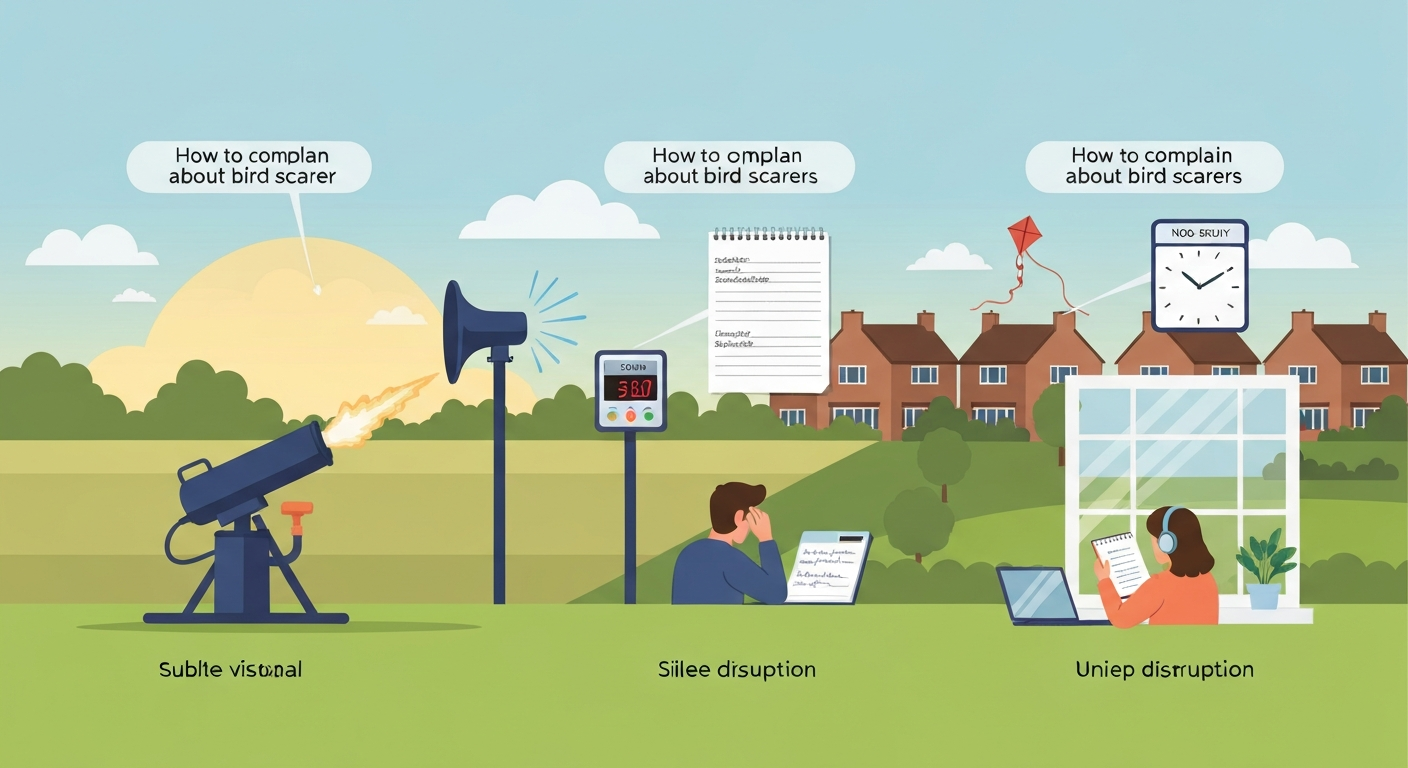
What bird scarers are and why complaints arise
Bird scarers are devices used to drive birds away from an area, most commonly crops, airfields, fish farms, orchards, and commercial buildings. They work by creating stimuli that birds find threatening or uncomfortable, whether that is a loud bang, a distress call, a reflective flash, or a looming silhouette. Common types include gas-powered cannons (the loudest), electronic sonic emitters, rotating kites, owl decoys, and scare balloons. Each type works differently and raises different concerns for nearby residents.
Complaints arise mainly because the people operating bird scarers and the people living next to them have entirely different priorities. A farmer firing a propane cannon every ten minutes at dawn to protect a cereal crop is following standard agricultural practice. The family 300 metres away being woken up at 5 a.m. every morning for six weeks has a legitimate grievance. Neither party is necessarily wrong in what they are doing, which is why understanding the complaint process, and the law behind it, matters.
Who this guide is for
This article is written for anyone on the receiving end of bird-scarer noise or other impacts. That includes:
- Residents in rural, semi-rural, or urban areas disturbed by gas cannons, sonic emitters, or other devices on neighbouring land
- Business owners and their employees whose working environment or customer experience is affected
- Property managers dealing with tenant complaints about nearby bird control operations
- People living near airports or airfields where bird-scaring devices are used as part of a Wildlife Hazard Management Plan
- Community groups representing multiple households affected by the same installation
The process is broadly the same for all of these groups, though airport neighbours face a specific regulatory layer (covered in the official contacts section below) and community groups may want to coordinate their evidence collection to demonstrate wider impact.
When is a complaint actually reasonable?
Not every bird scarer justifies a formal complaint. Before you go down the official route, it helps to assess whether the device is genuinely causing unreasonable impact. Here are the main thresholds to consider.
Noise
Gas cannons are the most frequently complained-about type because they can produce peaks of 150–160 dB at close range, audible at 1 km or more. Statutory nuisance law in England and Wales does not set a fixed decibel limit for bird scarers, but environmental health officers assess impact by comparing the device noise against background levels using methods such as BS 4142:2014+A1:2019. A complaint is likely to be reasonable if the cannon fires repeatedly during early morning hours (before 7 a.m. is a common flashpoint), if the device is positioned closer to homes than the NFU's recommended minimum distances, or if the noise is so frequent that you cannot use your garden or sleep with windows open.
Visual impact
Kite bird scarers, scare balloons, and reflective tape are generally low-harm visually, but large or numerous installations on commercial premises can raise planning concerns if they were installed without permission and change the character of the site. Visual impact alone rarely meets the statutory nuisance threshold, but it can support a planning enforcement complaint.
Safety
Propane-powered cannons involve compressed gas cylinders. If a device is positioned near footpaths, bridleways, or public spaces without adequate barriers, that is a safety issue worth raising with the landowner and potentially the council. Dogs, horses, and livestock can also be startled by sudden loud bangs, which may create a separate complaint route through animal welfare authorities.
Wildlife welfare
The Wildlife and Countryside Act 1981 makes it an offence to intentionally kill, injure, or take most wild birds, or to damage their nests or eggs. If you believe a bird-scaring method is causing direct harm to birds rather than simply deterring them, for example, a net combined with a cannon that is trapping birds, or a device operating in a location where Schedule 1 species are nesting, that is a matter for the statutory wildlife agency, Natural England in England, NatureScot in Scotland, or Natural Resources Wales. You can report suspected offences directly to these bodies or through the police wildlife crime officer for your area.
How to assess and quantify the problem before you complain
A complaint with numbers attached carries far more weight than one without. Before you contact anyone, spend one to two weeks recording exactly what you are experiencing. Note the frequency of events (how many bangs or alarm calls per hour), the duration of each event or session, the times of day, and the impact on your daily life. Impacts worth recording include: sleep disruption, inability to work from home, inability to use outdoor spaces, stress or anxiety, and any effect on pets or animals you keep.
If you can, use a calibrated sound-level meter to record peak and average noise levels. Environmental health officers conducting formal investigations will use instruments that comply with IEC 61672 Class 1 or Class 2 standards. Smartphone apps are not accepted for formal enforcement purposes, so while they can give you a rough guide for your own assessment, do not rely on them as evidence in a formal complaint.
Also check the timing against agricultural seasons in your area. Bird scarers are most commonly used during crop establishment and harvest periods. Knowing whether the device is seasonal (and how long that season typically runs) helps you judge whether informal pressure or formal enforcement is the more proportionate response.
Evidence checklist
Collect as much of the following as you can before making a formal complaint. You do not need every item, but the more you have, the stronger your position.
- Photographs of the device(s): location, orientation, distance from your property, any signage
- Video recordings showing the device operating and capturing the sound it produces
- Audio recordings that illustrate the character of the noise (note that these are for context, not formal measurement)
- A written noise diary: date, time, duration, number of events, and the specific impact on you at that moment
- Witness statements from neighbours, family members, or colleagues who have been affected
- Any medical or professional records if the disturbance has caused a measurable health impact (poor sleep, anxiety) — discuss this with your GP
- Measured noise data from a calibrated sound-level meter complying with IEC 61672, if you can access one
- Records of any previous informal contact with the operator, including dates and what was said
- Details of the device manufacturer and model if you can identify them, which helps when assessing whether it is being used within manufacturer guidelines
Who to contact first: the informal route
Before you escalate to any official body, approach the person responsible for the device directly. This is not just good etiquette, it is often the fastest solution, and some councils will ask whether you have tried this before they open an investigation.
The NFU's Bird Scarer Code of Practice advises farmers and landowners on placement, timing, rotation, and neighbour coordination. Many operators are simply unaware of how far the noise carries or that their device is pointing towards a residential area. A polite, factual conversation, or a written note describing the times and impact, often results in the cannon being repositioned or set to a less disruptive schedule. Keep a written record of any approach you make, even if it is just a note to yourself of the date, how you contacted them, and what response you received.
If the operator is a business rather than a farmer, for example, a commercial estate using sonic emitters or scare balloons, ask to speak with the site or facilities manager. If the installation is at or near an airport, the airport's bird control team is the first point of contact; they operate under a formal Wildlife Hazard Management Plan and will have a process for fielding public concerns.
Official contacts and regulators
If informal contact fails or is refused, the following authorities can investigate and, where appropriate, take enforcement action.
Local council environmental health
In England and Wales, your first official stop is the environmental health team at your district or borough council. Under Part III of the Environmental Protection Act 1990, councils are required to investigate complaints that may constitute a statutory nuisance. If they determine a nuisance exists, they can issue a noise abatement notice requiring the operator to stop or limit the activity. Many councils publish noise diary templates on their websites (Leeds City Council and East Cambridgeshire District Council, for example, both publish specific bird scarer guidance), and most will acknowledge a complaint within a defined window, commonly five to ten working days, before beginning their investigation.
Local council planning department
If the device has been installed on a structure that required planning permission, or if its installation has materially changed the use of the land, the planning enforcement team is the right contact. Enforcement powers under the Town and Country Planning Act 1990 include enforcement notices and stop notices. Bear in mind that local planning authorities have discretion over whether to investigate and act, so a planning complaint is most effective when combined with clear evidence of an unauthorised structure or change of use.
Statutory wildlife agencies
If your concern is that the device is harming or disturbing wild birds, including Schedule 1 species on or near their nests, contact Natural England (England), NatureScot (Scotland), or Natural Resources Wales. These bodies issue and monitor licences for bird control, and they can investigate where an operator appears to be causing harm in excess of what a licence permits. You can also report wildlife crime through your local police wildlife crime officer.
Airport authorities
Airports in the UK are regulated by the Civil Aviation Authority under CAP 772 (Bird Control on Aerodromes), which requires licence holders to manage bird-strike risk through a Wildlife Hazard Management Plan. In the US, certificated airports must comply with 14 CFR §139.337. If you live near an airport and are affected by bird-scaring devices used on airport land, contact the airport's community relations or environmental team. If their response is unsatisfactory, the CAA (UK) or FAA (US) can receive formal representations about how an airport manages its environmental obligations. Canada's equivalent framework is governed by Transport Canada's TP-13549 guidance.
Manufacturers
If you can identify the manufacturer of the device, it is worth checking whether it is being used in accordance with the manufacturer's own guidelines on placement distance, operating hours, and rotation. Manufacturers do not have enforcement powers, but a complaint to them can prompt them to remind their customers of correct use, and their guidelines may support your case to the council.
Ombudsmen and adjudicators
If you have exhausted the council complaint process and are not satisfied with the outcome, you can escalate to the Local Government and Social Care Ombudsman (England) or the equivalent body in your nation. The Ombudsman investigates complaints about how councils handle complaints, not the original nuisance itself, so this route is about process failures rather than relitigating the noise issue. For airport-related complaints in the UK, the Independent Commission on Civil Aviation Noise (ICCAN) and relevant airport noise action plans may provide an additional route for communities.
Step-by-step complaint process
The process below follows a logical escalation from informal to formal, with approximate timings. Working through the stages in order gives you the best chance of a quick resolution and builds a documented trail if you need to escalate.
- Start your evidence log immediately (week 1 onward): record every incident with date, time, duration, frequency, and impact. Use a physical notebook or a spreadsheet. Keep any photographs and recordings in a dated folder.
- Make informal contact with the operator (week 1 or 2): approach the farmer, landowner, site manager, or airport bird control team. Be factual, not confrontational. Put your concern in writing — a short email or letter — so you have a record. State clearly what the problem is, when it occurs, and what you are asking them to change.
- Allow a reasonable response window (1–2 weeks): give the operator time to respond and, if they agree to change their practice, monitor whether the change is actually made. Some councils suggest a 14-day response window before treating a complaint as unresolved.
- Contact your local council environmental health team if the problem continues (week 3–4): submit your diary, photographs, and any recordings. Ask for written acknowledgement. Most councils acknowledge within 5–10 working days and will explain their investigation process.
- Support the council investigation (weeks 4–8 or longer): the environmental health officer may visit your property, install monitoring equipment, or contact the operator themselves. Continue your diary throughout this period. The timeline for a formal investigation varies by council but expect several weeks before a decision is made.
- If a statutory nuisance is confirmed, the council issues an abatement notice: the operator must comply within the timeframe specified. If they do not, the council can prosecute. You should receive written notification of the outcome.
- Escalate to planning enforcement (if relevant): if the device involves an unauthorised structure or planning breach, submit a parallel complaint to the planning enforcement team. Include photographs showing the structure and its location.
- Consider mediation if the dispute is between you and a neighbour: many councils offer free or subsidised mediation services that can resolve disputes faster and with less friction than statutory enforcement. This is especially useful where you have an ongoing relationship with the operator.
- Take civil action as a last resort: if the nuisance continues after all other routes are exhausted, you may be able to bring a claim in the civil courts as a private nuisance. This is a significant step and you should take legal advice before proceeding. Keep all your diary records and correspondence as they will form the basis of any claim.
- Escalate to the Local Government Ombudsman if the council's process was flawed: if you believe the council has failed to investigate properly or has not followed its own procedures, submit a complaint to the Local Government and Social Care Ombudsman (England) or the equivalent body in Scotland, Wales, or Northern Ireland.
Sample letter template for initial informal contact
Keep your initial letter short and factual. Here is a template you can adapt:
"Dear [Name / 'The Farm Manager' / 'The Site Manager'], I am writing to let you know that the bird-scaring device(s) operating on your land at [approximate location] are causing significant disturbance to my household at [your address]. The device fires approximately [X] times per hour, beginning at around [time], including during the early morning. This has been affecting [describe impact: sleep, ability to work at home, use of garden, etc.]. I would be grateful if you could review the positioning, timing, and frequency of the device(s) in line with the NFU Bird Scarer Code of Practice. I am happy to discuss this with you directly. Please contact me at [contact details]. I would appreciate a response within 14 days. Yours sincerely, [Your name and address]."
Sample complaint summary for environmental health
When submitting to your council, include a covering summary like this: "I am making a formal complaint under Part III of the Environmental Protection Act 1990 regarding noise from a bird-scaring device at [location]. The device has been operating since [date]. I have attempted to resolve this informally with the operator on [date] and received [no response / an unsatisfactory response]. I am providing a noise diary covering [date range], photographs of the device, and [any other evidence]. The disturbance occurs primarily between [times] and is causing [specific impacts]. I request that the council investigates this complaint and takes action where appropriate."
Complaint process and approximate timings at a glance
| Stage | Action | Who is responsible | Approximate timeline |
|---|---|---|---|
| 1 | Start evidence log | You | Ongoing from day 1 |
| 2 | Informal contact with operator | You | Week 1–2 |
| 3 | Await operator response | Operator | 14 days suggested |
| 4 | Submit formal complaint to council environmental health | You | Week 3–4 if unresolved |
| 5 | Council acknowledges complaint | Council environmental health | 5–10 working days |
| 6 | Council investigation (site visit, monitoring, operator contact) | Council environmental health | 4–8 weeks typical |
| 7 | Abatement notice issued (if nuisance confirmed) | Council | Varies; notice will specify compliance window |
| 8 | Planning enforcement complaint (if applicable) | You / council planning team | Parallel to stage 4–7 |
| 9 | Mediation (if neighbour dispute) | Mediation service | Weeks to months |
| 10 | Local Government Ombudsman (process failure only) | You | After council process exhausted |
Legal and regulatory background worth knowing
You do not need to be a lawyer to make a complaint, but understanding the basic legal framework helps you use the right language and contact the right people. Here is a plain-English summary of the key rules in the UK context.
| Issue | Relevant law or guidance | Who enforces it |
|---|---|---|
| Noise nuisance from bird scarers | Environmental Protection Act 1990, Part III (statutory nuisance) | Local council environmental health |
| Unauthorised structures / change of use | Town and Country Planning Act 1990 | Local planning authority |
| Harm or disturbance to wild birds | Wildlife and Countryside Act 1981 | Natural England, NatureScot, Natural Resources Wales, police |
| Licences for bird control | Natural England general and individual licences | Natural England and devolved bodies |
| Airport bird control (UK) | CAP 772 (CAA guidance) | Civil Aviation Authority |
| Airport bird control (US) | 14 CFR §139.337 | Federal Aviation Administration |
| Airport bird control (Canada) | Transport Canada TP-13549 | Transport Canada |
| NFU best practice guidance (farms) | NFU Bird Scarer Code of Practice | No statutory force, but informs council assessments |
What to expect from operators when you complain
Farmers and commercial operators who use bird scarers lawfully will often respond positively to a well-worded informal complaint, particularly if they were unaware of the impact. The most common adjustments are: repositioning the cannon away from residential boundaries, adding a timer to prevent firing before 7 a.m. or after dusk, reducing the frequency of firing cycles, and rotating the device to different parts of the farm to spread and reduce the cumulative impact on any one household.
Some operators will push back on the grounds that bird control is essential to their livelihood or that their operation is licensed. Both can be true, and still the method of operation may need to change. The NFU Code of Practice is a useful reference point here because it gives operators a recognised standard to work to, and it gives you a basis for arguing that current practice falls below that standard.
Airport operators are less flexible because bird control is a safety requirement rather than a choice. However, airports do have discretion over the types of device used and when. Raising concerns with the community relations team can prompt a review of whether quieter or less intrusive alternatives, such as visual deterrents or trained falconry, can be used in areas adjacent to residential zones.
Thinking about alternatives: what might work instead
One of the most productive things you can do when raising a complaint is to come with a suggestion, not just a grievance. Proposing alternatives shows good faith and can move the conversation forward faster. It also helps to understand which types of bird deterrent are actually effective, so that you are not suggesting something that will not work for the operator's situation.
Visual deterrents such as kite bird scarers and scare balloons are much quieter than gas cannons and can be effective for some bird species and locations. Owl decoy scarers are another low-noise option used in gardens and some agricultural settings. Each of these has real-world effectiveness limits that are worth understanding before you propose them as alternatives, a large arable field with a starling murmuration problem is a very different scenario from a small market garden with a pigeon problem. For guidance on whether owl bird scarers work in different settings, see do owl bird scarers work. For more detail on their real-world effectiveness, see our guide on do kite bird scarers work (internal reference: 83d4ba51-3e6a-4c81-88dc-2748e41bab31).
How long bird scarers are typically used is also relevant context for your complaint. For more detail on typical operating windows and seasonal durations, see guidance on how long are bird scarers used for. Devices tied to specific crop protection windows may only be in operation for a few weeks at a time, which changes how you weigh the disruption against the effort of a formal complaint. Knowing the typical duration of use can help you decide whether a short-term tolerance agreement with the operator is a more practical outcome than months of official process.
Practical follow-up after your complaint is resolved
Once you have reached an agreement or an abatement notice has been issued, keep monitoring. Continue your diary for at least a few weeks after the agreed change to confirm compliance. If the problem resumes, you have fresh evidence and a much shorter path back to the environmental health team because the investigation groundwork is already done.
If the agreed change reduces but does not eliminate the problem, decide whether the remaining impact is tolerable. Statutory nuisance law deals with unreasonable interference, not every minor annoyance, and environmental health officers do weigh both the impact on you and the legitimate need for the activity. A farmer using a cannon twice a morning from 7 a.m. onwards during a three-week harvest is unlikely to meet the statutory nuisance threshold even if it is inconvenient, whereas one firing every ten minutes from 5 a.m. through a residential summer almost certainly would.
Finally, if you live in an area where agricultural bird scarers are a recurring seasonal issue, it may be worth engaging with your parish or town council to develop a local agreement. Several local authorities in England have published their own bird scarer guidelines (building on the NFU Code of Practice) that set out recommended operating hours, minimum distances from homes, and rotation requirements. Supporting or lobbying for such a document in your area creates a shared standard that benefits everyone and takes the heat out of individual disputes.
FAQ
When is it reasonable to complain about bird scarers?
Complain when devices cause significant adverse impacts beyond occasional, short-term disturbance. Reasonable grounds include repeated loud noise at anti-social times, persistent visual intrusion (flashing/balloons/kites) affecting amenity or business use, safety risks (aviation/confusing lights), wildlife welfare concerns (nest destruction, unlawful disturbance of protected species), or when devices breach planning or licence conditions. Consider frequency, duration, time of day, proximity, and whether the operator has taken mitigation/rotation steps.
Who should I contact first about a bird scarer complaint?
Start by contacting the landowner/operator or on-site manager — many problems can be resolved informally. If that fails or is inappropriate, contact your local council environmental health team for noise/statutory nuisance issues and planning enforcement for land-use breaches. For airports, contact the aerodrome authority/airport operations and the CAA or national aviation body if safety or licensing issues arise. For wildlife concerns, contact Natural England (or devolved body) or the relevant statutory wildlife agency. Keep copies of all communications.
What evidence should I collect before filing a formal complaint?
Collect: clear photos showing device location and line-of-sight; videos with date/time stamps showing operation and context; audio recordings of the sound (note device type and times); a contemporaneous noise diary/log listing dates, times, duration and impacts; witness contact details; measured noise data from calibrated equipment if available (Class 1/2 sound level meter) or request council measurement; records of any property or business impacts (loss of custom, sleep disturbance, health effects); copies of prior communications with the operator.
Is a noise diary enough evidence? What else strengthens a case?
A noise diary is essential and commonly requested. Strengthen the case with corroborating witness statements, photographic/video evidence, precise time-stamped audio, and, where possible, calibrated sound measurements following IEC 61672 standards. Reference to background/noise ratings using BS 4142 or ISO 1996 principles helps council assessment. For aviation or wildlife cases, include location maps and any expert reports or statutory licence breaches.
What legal and regulatory checks apply in the UK?
Key checks: statutory nuisance law under the Environmental Protection Act 1990 (local councils investigate noise nuisances); planning controls under the Town and Country Planning Act 1990 (local planning authorities enforce unauthorised development/use); wildlife protection under the Wildlife and Countryside Act 1981 (protected birds/nests); licensing and general licences from Natural England for wildlife management; airport obligations under CAA guidance (CAP 772) and ICAO WHMP expectations. Check whether the device is on permitted land (e.g., farmland or an aerodrome) and whether any statutory licences or planning conditions limit use.
What are typical operator responses to complaints?
Operators may: explain the purpose and legal basis for devices, show licence/WHMP compliance, alter timing/positioning/rotation of devices, reduce operating hours or use quieter alternatives, provide evidence of risk (e.g., crop loss or birdstrike data), or refuse citing permitted agricultural/airport activities. Keep records of their response and any mitigation offered; if inadequate, escalate formally.
How to Avoid Bird Attack Drone: Practical Safety Checklist
Practical, humane steps to reduce bird–drone collisions: preflight checks, deterrents, tactics, and legal guidance.