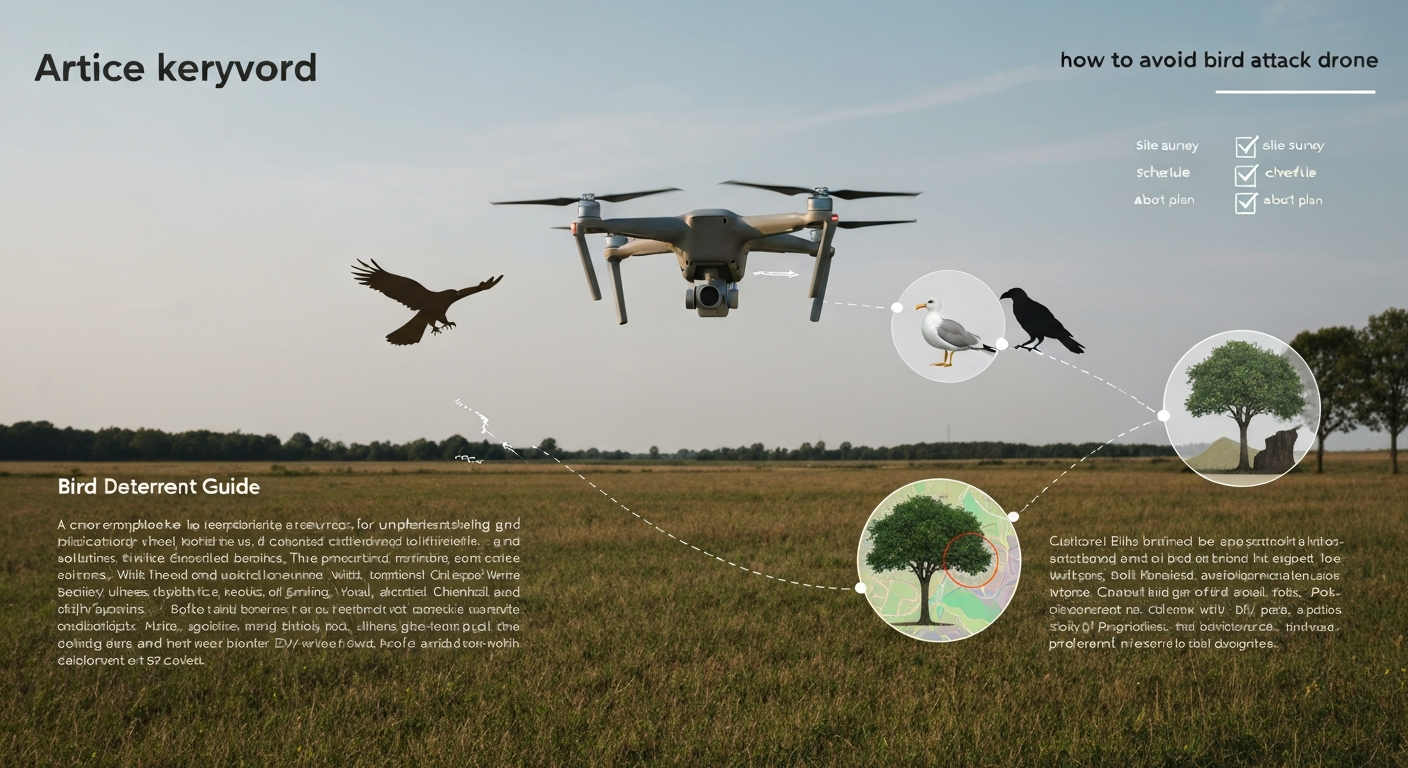
The most reliable way to avoid a bird attack on your drone is to plan around birds before you ever take off. That means checking for nesting activity at your site, scheduling flights outside peak territorial windows, staying below or above common flight corridors depending on species present, and having a clear abort plan the moment a bird shows aggressive interest. Equipment choices and in-flight tactics matter too, but pre-flight planning removes most of the risk before it starts.
How to Avoid Bird Attack Drone: Practical Safety Checklist

Marcus Weatherby
20 Jul 2026
Who this guide is for and the legal baseline
This article is written for hobbyist drone pilots, commercial UAS operators running inspection, mapping, or delivery missions, facility managers overseeing rooftop or solar-panel surveys, and safety officers who need repeatable procedures. Whatever your use case, two things do not change: the goal is to avoid harming birds, not just to protect your equipment, and there are real legal limits on what you can do to or around birds.
In the United States, the Migratory Bird Treaty Act (MBTA) makes it unlawful to take, pursue, or kill most wild birds without authorization. The Bald and Golden Eagle Protection Act adds a separate layer of protection for those two species, including disturbance of nests. The U.S. Fish and Wildlife Service (USFWS) has explicitly stated that using a drone to harass or pursue wildlife on National Wildlife Refuges is prohibited, and many refuges ban drone launches and landings entirely. Tips for Responsible Drone Use, U.S. Fish & Wildlife Service (refuge guidance) states that UAS operations that harass or disturb wildlife on National Wildlife Refuges are prohibited and many refuges ban drone launches and landings Tips for Responsible Drone Use — U.S. Fish & Wildlife Service (refuge guidance). Harassing birds during breeding or nesting season can constitute a violation regardless of whether any bird is physically injured. Before you fly near sensitive habitat, check the specific rules for the land you are operating over.
Why birds attack or interact with drones
Birds do not perceive drones the way we do. A systematic review published in PLOS ONE (Mulero-Pázmány et al., 2017) categorized wildlife responses to UAS into three groups: no response, alert (vigilance without fleeing), and active response, which includes both escape and direct attack. Active attacks are most common among raptors, corvids (crows, ravens, magpies), and gulls. These birds are intelligent, territorial, and quick to escalate from warning calls to physical contact.
The triggers vary. During breeding and nesting season, many species treat any large moving object near their nest as a predator or rival and will mob it repeatedly. Raptors and corvids often follow the drone, dive at it, or make physical contact with rotors. Outside nesting season, interactions are less common but still happen, particularly with gulls near coastlines, crows near food sources, and large raptors defending foraging territories. UAS size, engine noise, and flight pattern all influence how strongly a bird responds, which means your choices about how you fly matter, not just where.
Risk factors that increase bird-drone interactions
Not all flights carry the same risk. Several factors stack together to raise or lower your exposure.
- Species present: Raptors (red-tailed hawks, ospreys, golden eagles), corvids, and large gulls consistently show the highest rates of active attack in field studies and environmental assessments. Smaller songbirds rarely make physical contact with drones.
- Nesting and breeding season: Spring through midsummer is the highest-risk window in most of North America. Territorial behavior peaks when eggs or chicks are present. A bird that ignored your drone in January may attack it in May.
- Time of day: Dawn and dusk are periods of peak bird activity, including feeding and territorial patrols. Midday flights during hot weather often coincide with reduced bird activity in open terrain.
- Habitat type: Cliffs, riparian corridors, coastal areas, woodlands with large canopy trees, and areas with visible nests or roosts are higher-risk environments than open agricultural fields or urban hardscape.
- Altitude and flight route: Flying directly over or close to a nest site is the single fastest way to trigger an attack. BirdCast and Cornell Lab weather-radar analyses confirm that migrating birds concentrate at low altitudes near stopover and roost sites, particularly at dawn, dusk, and during favorable tailwind nights.
- Weather: Overcast, windy days increase bird movement at lower altitudes. During active migration events, bird density at UAS-relevant altitudes (below 400 ft AGL) can be significantly higher than baseline.
- Drone noise and size: Louder, larger drones provoke stronger responses. Gas-powered or high-pitched electric UAS draw more attention than quiet brushless systems at equivalent distances.
Pre-flight risk assessment and planning
A good pre-flight assessment takes maybe 20 minutes the first time you fly a site, and five minutes after that. It is one of the most effective things you can do to avoid problems.
Site survey
Walk the site before you launch. Look for nests in trees, on ledges, on structures, or on the ground. Listen for alarm calls, which are distinct rapid-fire vocalizations that most birds make when a predator or intruder is nearby. Note any circling or hovering raptors, which may indicate a nest or active territory below. Check e-bird.org or similar citizen-science platforms to see what species have been reported at or near the location. During spring and early summer, if you find any nest with eggs or chicks within the site or within a few hundred feet, seriously consider rescheduling.
USFWS buffer-zone guidance gives a useful benchmark: for golden eagles, regional guidance in California and the Great Basin recommends a one-mile no-disturbance buffer in many contexts. The USFWS California–Great Basin guidance (Recommended Buffer Zones for Ground‑based Human Activities around Nesting Sites of Golden Eagles, USFWS California‑Great Basin, May 2021) recommends a one‑mile no‑disturbance buffer for golden eagles in many contexts blank" rel="noopener noreferrer">Recommended Buffer Zones for Ground‑based Human Activities around Nesting Sites of Golden Eagles — USFWS California‑Great Basin (May 2021). For bald eagles, thresholds commonly cited in USFWS and National Bald Eagle Management Guidelines range from roughly 330 to 660 feet depending on activity and vegetation screening. These numbers apply to ground-based human activity, but they give you a reasonable floor for drone operations near those species.
Timing your flight
Schedule flights during the middle of the day when bird activity is lowest for your habitat type. Avoid the weeks between mid-April and mid-July if your site has confirmed nesting activity nearby. Use BirdCast migration alerts to identify nights with heavy migration traffic, and avoid flying at dawn the morning after those nights when birds are landing and congregating near stopover habitat. The National Park Service's UAS Best Practices document explicitly recommends scheduling missions to avoid peak sensitivity periods for wildlife.
Route and altitude planning
Plan your route to maximize horizontal distance from identified nests, roosts, and active territorial birds. Fly at a consistent altitude rather than making abrupt climbs or descents near wildlife, which can trigger escape or attack responses. In general, staying above 200 feet AGL reduces interactions in open habitat, but directly overflying an active nest at any altitude can trigger a response. If your mission requires flying at lower altitudes near sensitive areas, use the shortest possible exposure time, and plan your departure route away from identified bird activity.
Go or no-go: decision rules before you launch
Clear go/no-go rules remove ambiguity in the field. Before every flight at an unfamiliar or sensitive site, run through the following criteria. If any condition triggers a no-go, postpone or relocate the flight.
- No-go: You have identified an active nest with eggs or chicks within 660 feet of your planned route for raptors or large colonial species, or within 200 feet for smaller territorial birds.
- No-go: A raptor or corvid is actively circling, diving, or alarm-calling in your intended flight zone before launch.
- No-go: It is peak nesting season (mid-April through mid-July in most of North America) and site conditions have not been assessed.
- No-go: BirdCast or equivalent tool shows a high-intensity migration event in progress and your mission is below 400 feet AGL near coastal, wetland, or woodland stopover habitat.
- No-go: Weather conditions (heavy overcast, strong tailwinds from the south or southwest during spring) indicate elevated migration traffic at low altitudes.
- Proceed with caution: You have observed birds in the area but no nesting activity; assign a dedicated visual observer to monitor bird behavior throughout the flight.
- Proceed: Site survey complete, no nests identified, low bird activity, wind calm to light, flight route planned away from known perch or roost sites.
Drone design and passive protections
Passive design choices can reduce both the likelihood of a serious collision and the damage if one happens. They do not prevent birds from attacking, but they change the outcome when contact occurs.
Propeller guards
Propeller guards are the most widely available passive protection. They reduce the chance that a bird's wing or foot becomes entangled in a spinning rotor and they absorb some impact energy. DJI and other manufacturers offer model-specific guards, including 360-degree cage designs for some models. The tradeoff is real: DJI's product data shows that propeller guards add weight and reduce propulsion efficiency, resulting in shorter flight times and lower top speeds. For most short inspection or photography missions, that tradeoff is acceptable. For long-endurance or high-payload commercial missions, evaluate whether a cage or guard on your specific model leaves enough performance margin for the job.
Visual contrast and markings
There is some evidence that high-contrast markings or bright colors on drone arms and bodies make the drone more conspicuous to birds, giving them more time to avoid it rather than collide with it accidentally. This matters most for large, fast-moving raptors that may not identify the drone as a solid object until close range. Applying high-visibility tape or colored decals to propeller arms costs almost nothing and adds no meaningful weight. It is not a guaranteed deterrent, but it is a low-cost step worth taking.
Structural durability and design tradeoffs
Engineering analyses of UAS collision scenarios have noted that hard components like motors and batteries change impact dynamics compared to soft-bodied birds. A mid-flight collision with a raptor can damage propellers, motor mounts, and arms. Carbon-fiber frames offer better stiffness-to-weight ratios than plastic, which can help a drone survive a glancing blow and maintain control. However, there is no universally adopted FAA standard for propeller-guard bird-strike protection for small UAS. If you are operating under a waiver or COA and need to document means of compliance for over-people or dense-urban operations, consult the FAA waiver process for your specific design.
| Protection type | What it does | Main tradeoff | Best for |
|---|---|---|---|
| Propeller guards | Prevents rotor-bird entanglement, absorbs some impact | Adds weight, reduces flight time and speed | Hobbyist and short-range commercial missions |
| 360-degree cage | Full rotor enclosure, maximum entanglement protection | Significant weight and drag penalty | Low-speed, short-duration work near sensitive habitat |
| High-contrast markings | Improves drone visibility to birds, may reduce accidental collision | None meaningful | Any mission, minimal cost |
| Carbon-fiber frame | Better structural survival of glancing blows | Higher cost than plastic | Professional/commercial platforms |
| Frangible/breakaway components | Absorbs impact energy, reduces damage propagation | Design complexity, may require custom builds | Research-grade or specialized commercial UAS |
Active deterrents and detection systems
Active deterrents try to discourage birds from approaching your drone or operating area before or during flight. Detection systems tell you when birds are present so you can react. Both categories come with important caveats about effectiveness, species specificity, and legal limits.
Visual markers and lights
Flashing lights or high-contrast patterns on the drone itself can increase conspicuity during low-light conditions. Some operators report reduced approaches when using strobing LEDs, though controlled data is limited for this specific application. Laser deterrents have been studied in airfield and wind-energy contexts and show mixed results: they can trigger avoidance in some raptor species, but effectiveness varies by species, ambient light, and habituation. Critically, lasers pose real human-safety risks and their use near airports or populated areas is heavily regulated. Do not use handheld lasers as a bird deterrent around drones without fully understanding local and federal restrictions.
Non-harmful sonic deterrents
Broadcast sonic deterrents (distress calls, predator calls, or species-specific alarm calls played through a portable speaker at the launch site) can temporarily displace birds from an area before you fly. These work best in open terrain where sound carries well and when birds are not highly habituated to the specific call. Ultrasonic devices marketed for general bird deterrence have limited peer-reviewed support for outdoor, open-air use. Any sonic deterrent should be used at levels that deter without causing injury or chronic stress, which means moderate volume, short deployment windows, and rotating call types to reduce habituation.
Radar and AI-based detection systems
The most sophisticated approach borrows directly from airport and wind-turbine programs. Avian radar systems (short-range, commercially available units from companies like DeTect and Robin Radar) can detect approaching birds and provide bearing and altitude data to operators. In wind-energy applications, radar-linked shutdown-on-demand (curtailment) systems have documented reductions in bird collision risk in peer-reviewed technical reports. For drone operations, a portable radar or camera-based AI detection system feeding real-time alerts to the ground-control station allows the operator to take evasive action before a bird reaches the aircraft. These systems are still relatively expensive and are primarily used by commercial and research operators, but the technology is maturing and costs are falling.
AI-based computer vision systems trained on bird detection can be integrated with drone flight controllers to provide automatic collision-avoidance commands, similar in concept to the obstacle-avoidance systems already standard on many consumer drones. The NPS, FAA environmental assessments for delivery UAS operations (such as those filed for Wing and Amazon delivery programs), and academic field studies all point to route-and-altitude modification as the most consistently effective in-mission response when birds are detected, regardless of whether the trigger is a human observer or an automated system.
What active deterrents cannot do
No deterrent makes a drone attack-proof. Birds habituate to repeated stimuli, so a deterrent that works on day one may lose effectiveness by day five. Active deterrents also do not remove the legal obligations described earlier: displacing a nesting bird using loud noise or visual harassment can itself constitute unlawful disturbance under the MBTA. Always prioritize spatial and temporal avoidance over active deterrence when nesting birds are involved.
In-flight tactics and emergency maneuvers
Even well-planned flights encounter unexpected birds. Knowing what to do in the moment prevents a single bird encounter from turning into a crash or a lost drone.
Evasive flying
If a bird approaches, your first move is a smooth lateral displacement: change your horizontal position away from the bird's flight path without abrupt altitude changes. Sudden climbs or descents can trigger chase behavior. Moving laterally at moderate speed gives the bird an off-ramp without looking like a fleeing prey item. If the bird continues to close, descend gradually and find a landing area. Prolonged attempts to outfly an aggressive territorial bird rarely end well and increase the risk of the bird making contact with the rotors.
A peer-reviewed MDPI field study reported more than 100 flights over dense seabird aggregations without collisions when operators used conservative altitudes, dedicated spotters, and short exposure times. The spotters were the key variable: a second set of eyes monitoring bird behavior from the ground gave the pilot real-time situational awareness that camera feeds alone cannot provide.
When to abort and land immediately
Abort and land if any of these conditions occur mid-flight: a bird makes physical contact with the drone; a raptor or corvid is actively pursuing the drone and not breaking off; you lose visual line of sight with the drone because birds are obscuring it; or you hear or see a change in motor tone suggesting a strike to a propeller. Landing promptly in an open area is always preferable to attempting to complete a mission under active attack.
In-flight emergency checklist
- Announce: Call out 'bird engagement' to your ground crew or observer so everyone is aware and tracking.
- Displace laterally: Move the drone smoothly away from the bird's approach vector at moderate speed.
- Check telemetry: Look at altitude, battery, and motor data for any anomaly indicating a strike has already occurred.
- Assign a spotter: If you have a second person, task them exclusively with tracking the bird and warning you of approach angles you cannot see on screen.
- Evaluate mission status: If the bird breaks off and telemetry is clean, you may continue with a modified route at greater distance from the area.
- Abort criteria met: If the bird makes contact, pursues without breaking, or telemetry shows abnormal motor behavior, initiate a controlled descent to the nearest safe landing area.
- Land and assess: Once on the ground, do not relaunch until you have inspected all propellers, arms, and the camera for damage.
- Document: Note the species (if identifiable), time, GPS coordinates, behavior observed, and any physical contact or damage.
What to do after an incident
After any bird-drone contact event, there are practical and legal steps to work through. Start with a full physical inspection of the drone: check propeller blades for nicks or cracks, examine motor mounts for stress fractures, test all motors for vibration before attempting another flight, and review your flight log data for any anomalous sensor readings during the incident.
For reporting, the FAA maintains a National Wildlife Strike Database and provides an online portal for voluntary strike reporting. Airport wildlife-hazard programs and FAA environmental assessments for UAS operations both note that reporting observed bird-drone interactions helps build the data record used for future risk assessment. While voluntary for most hobbyist incidents, reporting is professionally responsible and supports the broader UAS safety community.
If a bird was visibly injured or killed during the incident, the situation may trigger reporting obligations under the MBTA or BGEPA depending on the species. Contact your regional USFWS office if you are uncertain about your obligations. Commercial operators should also notify their insurance carrier and document the incident in detail, including photographs of any damage and your pre-flight risk assessment records, which demonstrate good-faith efforts to comply with best practices.
If you are operating repeatedly at the same site and bird interactions are occurring regularly, this is a signal to consult a wildlife biologist or contact your regional USFWS office for site-specific guidance. A professional habitat assessment can identify nesting activity you may have missed and help you develop a site-specific flight protocol that keeps your operations both legal and effective.
Lessons from airports and wind farms that apply to drones
Airport wildlife hazard management and wind-turbine bird-strike mitigation are the two most developed fields for reducing bird-human infrastructure conflicts, and both offer transferable practices for drone operators. Airports use a combination of habitat management (removing food sources and attractive roosting spots), active hazing (pyrotechnics, trained falconry, vehicle patrols), avian radar, and predictive tools like the Avian Hazard Advisory System (AHAS) and BirdCast to reduce strike risk. See what is already being done to prevent bird collisions for examples from airports, wind farms, and UAS programs. For more detail on how airports prevent bird strikes, see guidance on how do airports prevent bird strikes. For broader strategies used to reduce bird strikes on manned aircraft, see guidance on how to prevent bird strikes on aircraft. For drone operators, the most directly transferable lesson is the value of temporal and spatial situational awareness: knowing when and where birds are concentrated before the mission starts, rather than discovering it in the air.
Wind-turbine programs increasingly use radar or camera detection linked to automatic shutdown or curtailment during migration and nesting. The principle scales directly to drone operations: automated bird detection feeding real-time alerts to a pilot is functionally similar to shutdown-on-demand, but the response is a route change or abort rather than a turbine stop. Radar-assisted curtailment has documented effectiveness in peer-reviewed and technical reports from the wind-energy sector, reinforcing the case for investing in detection technology as commercial UAS operations scale. These topics connect closely to airport-level bird management strategies and broader questions about what engineering and operational controls have the best evidence base.
Practical summary: what actually moves the needle
Most drone-bird incidents are preventable with basic pre-flight discipline. See our guide to the best bird strike prevention for recommended equipment, detection systems, and site-specific protocols. Walk the site, check the season, use BirdCast during migration windows, keep buffers from identified nests, assign a spotter for any flight in higher-risk habitat, and have a clear abort plan. For more detailed strategies, see the guide on how to prevent bird strikes. Prop guards and high-contrast markings add another layer for minimal cost. Detection technology is worth exploring for commercial operators who fly regularly in sensitive areas. Active deterrents are a supplementary tool, not a substitute for planning, and must always be used within the legal framework protecting wild birds.
FAQ
Why do birds attack or collide with drones?
Birds respond to drones for several reasons: territorial defense (especially near nests), mobbing of perceived predators (raptors, corvids, gulls), alarm responses from aggregations (roosts, colonies), and simple collision because the drone is unexpected in their flight path. Response strength depends on bird species, life‑history stage (breeding, migration), group density, and UAS attributes (size, shape, noise, flight behavior). Studies show corvids, gulls and raptors most commonly exhibit active attacks or pursuits.
How do I assess pre‑flight risk of bird interactions at a site?
Do a systematic pre‑flight risk check: 1) Site history: note known roosts, colonies, migratory stopovers, landfill/coastal/river sites, and recent bird strike reports. 2) Timing: avoid breeding season, dawn/dusk migration windows, and peak foraging times. 3) Weather/conditions: migration intensity, low cloud/poor visibility and strong winds can lower bird avoidance. 4) Visual survey: scan for perched birds, nesting behavior, alarm calls, and circling raptors. 5) Ask stakeholders: facility managers, local bird/wildlife officers, airport NOTAMs. Decision rule: cancel or postpone if you observe active nesting/large aggregations within operational area, persistent territorial birds, or migration waves expected during planned flight windows.
What checklists should I use before a flight to reduce bird risk?
Pre‑flight bird‑risk checklist: 1) Confirm no known nests/roosts within mission area or established buffer distances. 2) Check local wildlife advisories, NOTAMs, and seasonal guidance. 3) Choose flight window outside dawn/dusk migration peaks and high‑bird activity. 4) Set conservative altitudes and routes that skirt known bird habitat. 5) Assign trained visual spotter(s) to watch for bird approaches. 6) Equip drone with guards/shielding when feasible. 7) Plan abort/land‑out sites and emergency descent procedures. 8) Have communications and incident reporting steps ready.
What are practical altitude and routing rules to reduce interactions?
Use conservative altitude and route rules: 1) Avoid flying directly over roosts, colonies, or known nest buffers (follow local/regional buffer guidance; some raptors have 100–200 m buffer recommendations). 2) Fly higher than local bird flight bands when practical, but remember many birds (especially migrants or near shorelines/stopovers) can occupy low altitudes—use local intel. 3) Use straight, predictable transit legs for brief periods rather than slow loitering over habitat. 4) When operating near infrastructure (solar fields, roofs) maintain lateral separation from known perches and use corridor routes that reduce time near perching/foraging zones.
What drone design or passive protections reduce bird collisions or attacks?
Passive protections: 1) Prop guards / shrouds / 360° cages reduce exposed blade contact and risk of bird injury; note they add weight and reduce flight time/performance. 2) Durable but lightweight shielding around motors and leading edges can prevent damage from pecks and small strikes. 3) High‑contrast markings or predator‑mimic patterns can sometimes increase or decrease attention—use caution and local testing. 4) Choose the quietest effective UAS model and minimize unnecessary hover/loiter time to reduce disturbance. 5) Ensure structural redundancy for critical components to tolerate minor impacts; however, recognize UAS materials can change impact dynamics compared to bird strikes on manned aircraft.
What active deterrents and sensing options are available for drones?
Active options include: 1) Visual deterrents (bright contrasting patterning on the vehicle, flags at landing sites) — species and context dependent. 2) Non‑harmful sonic deterrents (short bursts of predator/repellent sounds) — mixed evidence, may habituate and can disturb non‑target wildlife or people; check local rules. 3) Short‑range radar, vision, or AI‑based bird detection systems that alert pilots and trigger automated evasive action or mission abort. 4) Integration with ground‑based avian radars or migration forecasts (BirdCast/NEXRAD) for planning. Caveats: effectiveness varies by species, habituation occurs, lasers and high‑power lights pose safety risks, and deterrents must comply with wildlife protection laws and local human‑safety rules.
Next Article
What Is Already Being Done to Prevent Bird Collisions
Learn what’s already used to prevent bird collisions, from airport safeguards to building glass and humane deterrents, p