
Bird scaring methods range from simple plastic owls you can hang in an afternoon to professional falconry programs that run year-round at commercial airports. The right choice depends on your site, the species causing problems, your budget, and how much disruption you can tolerate. This guide walks through every practical option, physical barriers, visual and sonic deterrents, lasers, chemical repellents, biological controls, and habitat modification, with honest assessments of what actually works, what tends to fail, and when it is worth calling a professional.
Bird Scaring Methods: Guide for Homes, Solar & Airports

Marcus Weatherby
12 Aug 2026
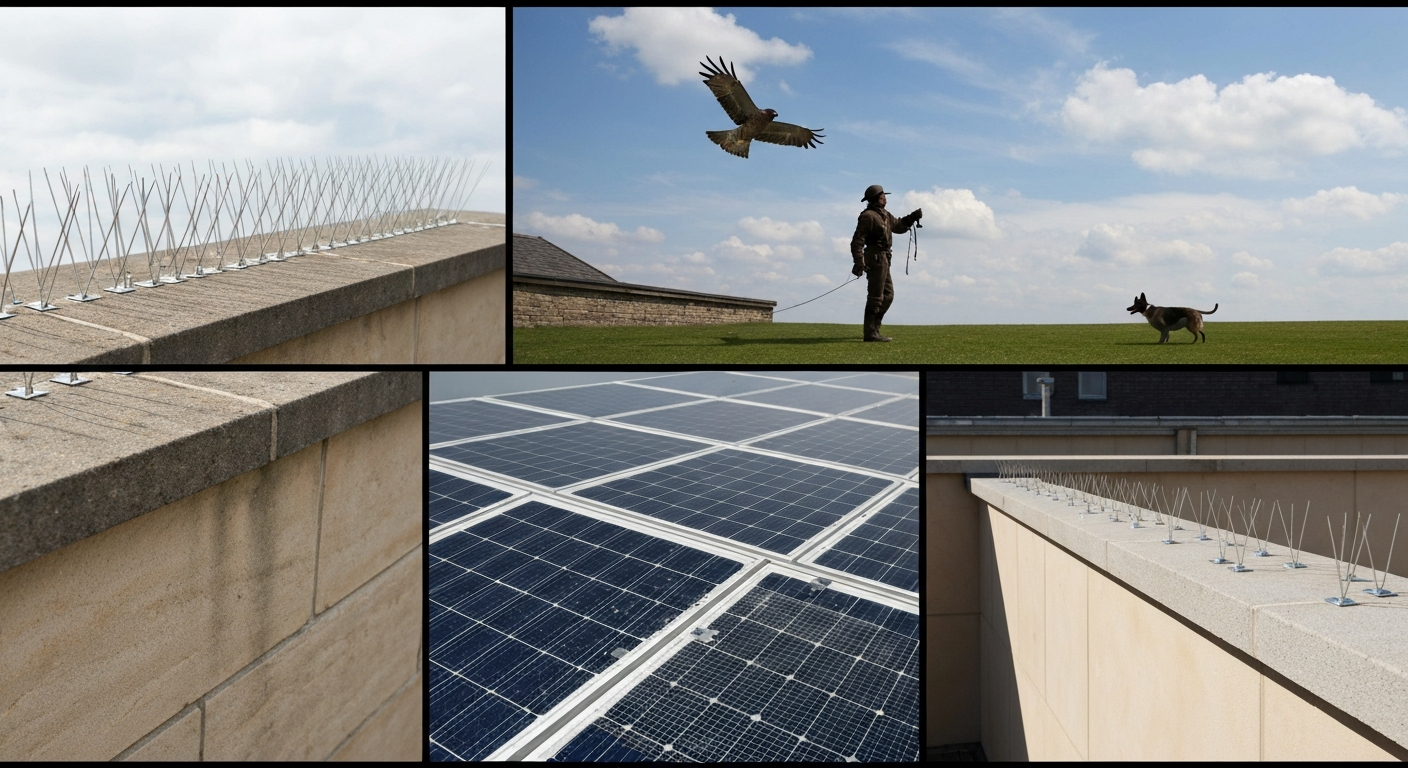
Who this guide is for and how to use it
This article is written for four main audiences: homeowners dealing with pigeons on ledges or starlings under solar panels; property managers protecting commercial roofs, HVAC equipment, and loading docks; solar and roofing operators who need under-panel exclusion without voiding module warranties; and airport wildlife managers required to maintain FAA-compliant Wildlife Hazard Management Plans. Each section is labeled with the scenarios it covers most directly, so you can skip to what is relevant without reading everything. That said, the decision framework in the next section is worth reading regardless of context, it will save you time and money by pointing you toward the most appropriate tool before you spend anything.
The Bird Safety Pyramid: start here before choosing any method
The bird safety pyramid is a decision framework used by wildlife managers to prioritize interventions from the least harmful to the most intrusive. It mirrors the hierarchy used in occupational safety, eliminate the hazard first, then reduce it, then manage what remains. In practical bird control, that means you assess and modify habitat before you deploy any active deterrent, and you exhaust non-lethal options before considering lethal ones. This approach aligns with the legal requirements of the Migratory Bird Treaty Act, which prohibits taking, possessing, or disturbing most wild bird species without a federal permit, even when those birds are causing property damage. Working up the pyramid keeps you on the right side of that law and usually produces more durable results.
- Level 1 — Habitat modification: remove food sources, water, nesting material, and roosting surfaces that attract birds in the first place.
- Level 2 — Physical exclusion: install spikes, netting, screens, or wire to deny access to specific surfaces.
- Level 3 — Sensory deterrents: deploy visual decoys, lasers, lights, sonic, or ultrasonic devices to discourage birds from landing.
- Level 4 — Chemical repellents: apply registered repellents (methyl anthranilate, anthraquinone, polybutene gels) to feeding or roosting areas.
- Level 5 — Biological control: use trained raptors (falconry), trained dogs, or encourage natural predators to disperse flocks.
- Level 6 — Active harassment and lethal control: pyrotechnics, propane cannons, and permitted lethal removal — generally reserved for airports and high-risk agriculture under agency authorization.
For most homeowners and property managers, Levels 1 through 3 will resolve the problem. Levels 4 and 5 become relevant when persistent species like European starlings or Canada geese resist passive methods. Level 6 is almost exclusively an airport and large-scale agricultural concern, requiring USDA Wildlife Services coordination and, in many cases, federal depredation permits from the U.S. Fish and Wildlife Service.
Quick decision checklist: prevention, DIY, or professional help?
Before spending money on hardware, run through this checklist to calibrate the scale of the response you actually need.
- Are birds roosting or nesting, or just passing through? Transient birds rarely need deterrents — wait a week before acting.
- Is there an active nest with eggs or chicks present? If yes, do not disturb it. Most species are protected under the MBTA during active nesting. Contact a licensed wildlife rehabilitator or your state wildlife agency.
- Can you identify the species? Starlings and house sparrows are not protected under the MBTA and allow more flexible management. Native songbirds, raptors, and waterfowl require permits for active disturbance.
- Is the problem confined to a single surface (one ledge, one panel row)? DIY physical exclusion is likely sufficient.
- Does the problem span a whole roof, large courtyard, or multiple building faces? Professional assessment and installation will give better long-term results.
- Is the site a Part 139 certificated airport or a site with aviation approach paths? Escalate immediately to a qualified wildlife biologist and review FAA Advisory Circular AC 150/5200-36B requirements.
- Have you already tried two or more deterrent methods without success over a full season? That is the threshold at which most wildlife managers recommend a professional site assessment.
Overview of bird scaring method categories
There are five broad categories of bird scaring methods, each working through a different mechanism. Understanding the mechanism helps you predict whether a given tool will hold up over time or whether birds will habituate to it within days. See bird prevention methods for a detailed guide to selecting and implementing specific techniques.
Physical barriers
Spikes, netting, wire tensioning systems, and mesh screens deny birds physical access to a surface. They work regardless of whether the bird has habituated to other deterrents, which makes them the most reliably durable category when correctly specified and installed. They do not scare birds, they exclude them.
Sensory deterrents
Visual decoys (owl and hawk silhouettes, reflective tape, predator kites), laser devices, strobe lights, sonic broadcasters playing distress or predator calls, and ultrasonic emitters all work by triggering a threat response. The core weakness of every sensory deterrent is habituation: birds quickly learn that a stationary plastic owl or a repeating alarm call poses no real danger. Effectiveness drops sharply within days to weeks unless the stimulus is varied or moved.
Chemical repellents
Registered chemical repellents fall into three groups: taste aversives (methyl anthranilate, anthraquinone), contact irritants (capsaicin-based products), and tactile deterrents (polybutene sticky gels). All must be used according to EPA-registered label directions. Methyl anthranilate is derived from grape extract and is used on turf, crops, and water surfaces. Anthraquinone is widely used in agriculture to deter waterfowl. Polybutene gels make surfaces uncomfortable to land on but require seasonal reapplication and can trap small non-target birds if over-applied.
Biological control
Falconry programs use trained raptors flown regularly over a site to establish a genuine predator presence that birds cannot habituate to. Trained border collies are used to disperse Canada geese from turf areas including golf courses and airport perimeters. Both approaches require sustained effort, the deterrent effect largely disappears when the program stops. Some site managers also encourage insectivorous birds (swallows, martins, certain woodpeckers) that naturally control timber and crop pest insects, making deterrence counterproductive in those contexts.
Habitat modification
Removing or reducing what attracts birds is the most cost-effective long-term strategy and the correct first step in the safety pyramid. This includes eliminating standing water, securing waste containers, trimming fruiting trees, removing nesting substrate, and modifying structural features (overhangs, ledge angles, roof penetrations) that provide sheltered roost sites.
Comparing all methods: effectiveness, cost, and best use
| Method | Effectiveness (long-term) | Humane rating | Typical DIY cost | Maintenance burden | Best use case |
|---|---|---|---|---|---|
| Habitat modification | High when root cause removed | Excellent | $0–$200 | Low (one-time changes) | All sites — first step always |
| Bird spikes | High for ledges/beams | Good (must be installed correctly) | $1–$5 per linear foot (materials) | Low — inspect annually | Ledges, parapets, beams, sign tops |
| Exclusion netting | Very high for large areas | Excellent | $0.10–$0.50 per sq ft (materials) | Moderate — check for gaps every 6 months | Courtyards, loading docks, under solar panels |
| Tensioned wire systems | Moderate-high for pigeons | Good | $3–$8 per linear foot (materials) | Low — re-tension annually | Wide ledges, beams, bridge sections |
| Visual decoys (static) | Low — rapid habituation | Excellent | $10–$60 per unit | High — must be moved every 2–3 days | Temporary/supplemental use only |
| Reflective tape / flash tape | Low-moderate | Excellent | $5–$20 per roll | Moderate — replace when worn | Gardens, window areas, boat docks |
| Predator kites / balloons | Low-moderate | Excellent | $15–$80 per unit | Moderate — must be repositioned | Open areas: fields, ponds, flat roofs |
| Laser devices (handheld) | Moderate-high when actively used | Good (requires safe use) | $30–$500 per unit | High — requires trained operator | Airports, large open roofs, warehouses |
| Automated laser systems | High with varied patterns | Good (safety protocols required) | $3,000–$15,000+ installed | Low-moderate — software updates, lens cleaning | Airports, large commercial roofs, vineyards |
| Sonic distress/predator call | Moderate — habituation within days | Good | $50–$400 per unit | High — must vary calls and timing | Open outdoor areas away from neighbors |
| Ultrasonic emitters | Low — limited evidence | Good | $20–$200 per unit | Low (set-and-forget, but ineffective) | Not recommended as primary method |
| Propane cannons | Moderate — habituation risk | Acceptable outdoors | $400–$2,000 per unit | Moderate — fuel refills, timer changes | Agriculture, airport perimeters — not residential |
| Methyl anthranilate (liquid) | Moderate on turf/water | Excellent | $30–$150 per application | High — reapply after rain | Turf areas, ponds, roof surfaces (registered uses) |
| Polybutene sticky gel | Moderate for ledges | Moderate — small bird entrapment risk | $20–$80 per tube | High — reapply 2–4x per year | Ledges, pipes, small surface areas |
| Falconry program | High while active | Excellent | $500–$5,000+ per month (professional) | Very high — continuous operation needed | Airports, large campuses, events |
| Trained dogs (border collies) | High for geese on turf | Excellent | $2,000–$6,000+ per month (professional) | Very high — daily presence required | Airports, golf courses, parks |
Physical barriers: spikes, netting, screens, and wires
Physical exclusion is the workhorse of professional bird control. When a ledge is covered in stainless steel spikes or a courtyard is enclosed in UV-stabilized HDPE netting, birds simply cannot land or nest there, no amount of habituation changes that. The key is matching the product to the species and the surface.
Bird spikes
Spike strips are polycarbonate or stainless steel rods mounted on a base that is glued or screwed to a surface. They prevent large birds (pigeons, gulls, crows) from landing by making the surface physically uncomfortable. Stainless steel spikes (such as the Bird B Gone Enviro Spike available at major hardware retailers) are more durable than polycarbonate in UV-exposed environments and resist corrosion near coastal sites. Retail material costs run approximately $1 to $5 per linear foot depending on spike width and material; professional installation adds labor, typically bringing installed costs to $8 to $20 per linear foot based on municipal procurement records for similar projects. Spikes are not effective against small birds like house sparrows, which can nest between the tines.
Exclusion netting
Heavy-duty HDPE netting with UV stabilization is used for large-area exclusion: enclosed courtyards, building facades, under-eave zones, and under solar panel arrays. Quality products carry UV resistance ratings of 10 years or more from the manufacturer. Mesh aperture must be matched to the target species: 3/4-inch mesh excludes sparrows and starlings; 2-inch mesh is sufficient for pigeons and larger birds. Material costs run roughly $0.10 to $0.50 per square foot, with professional installation adding $1 to $3 per square foot depending on access difficulty and anchor complexity. Netting should be inspected every six months for tears, sagging, or anchor failure.
Tensioned wire systems
Stainless steel wire strung at approximately 2 to 3 inches above a ledge surface forces pigeons and gulls to work to land, which they generally avoid. Wire systems are less visually intrusive than spikes and work well on wide architectural ledges where spikes would look obtrusive. They require re-tensioning annually as wires stretch and lose effectiveness. Material costs are typically $3 to $8 per linear foot.
Humane and safety considerations for physical barriers
All physical barrier products must be installed without blocking active nests. Spike strips installed incorrectly, too sparse, or on a wide surface without full coverage, can actually trap nesting material and create sheltered nest sites between the spikes, which is the opposite of the intended outcome. Polybutene gels present an entrapment risk for small non-target birds and should not be used in areas where small songbirds are present. For solar panel installations, check your module's installation manual before attaching any hardware. Trina Solar's installation guide, for example, explicitly states that drilling additional holes in any part of the module voids the warranty, use frame-clip or channel-mount systems instead.
Installing physical barriers: step-by-step for common sites
Ledges and parapets
- Clean the surface thoroughly — remove droppings, feathers, and old nesting material. Wear gloves, an N95 respirator, and eye protection; dry bird droppings can carry Histoplasma capsulatum and Cryptococcus neoformans.
- Allow the surface to dry completely before applying any adhesive.
- Cut spike strips to length using tin snips or an angle grinder for stainless steel.
- Apply exterior-grade construction adhesive (or use the supplied screws for masonry anchors) every 6 to 8 inches along the base of the strip.
- Press firmly and allow 24 hours of cure time before exposing to heavy rain.
- Overlap strip ends by at least 1 inch to eliminate gap-landing spots.
- Inspect annually — adhesive can fail on porous stone or painted surfaces exposed to thermal cycling.
Eaves and enclosed spaces
- Confirm no active nests are present before sealing any enclosed space.
- Use 3/4-inch or 1/2-inch hardware cloth (galvanized steel mesh) to block open eave gaps, gable vents, and fascia gaps.
- Attach with stainless steel staples or screws into solid wood framing — avoid stapling into rotten wood.
- For open eaves with a wide gap, install a rigid mesh panel rather than draped netting, which can sag and create new roost points.
- Check all penetrations — pipe exits, conduit runs, and utility entries — and seal gaps larger than 1/2 inch.
Patios and pergolas
- Map the perimeter anchor points (rafters, beams, or wall plate) before ordering netting — measure accurately to avoid gaps at corners.
- Install screw-in eye bolts at each anchor point; use stainless steel hardware in coastal or humid environments.
- Run a tensioned perimeter cable between eye bolts before attaching the net — this prevents the netting from sagging under its own weight or after rain.
- Attach the net to the perimeter cable using UV-stable cable ties or the manufacturer's supplied clips.
- Leave a removable access panel if you need to clean the patio or service overhead lights.
Solar panels
- Do not drill the panel frame — use dedicated solar mesh clip systems that attach to the existing frame rail without any penetration.
- Choose a mesh with an aperture of 1/2 inch for sparrow exclusion or 1 inch for pigeon exclusion.
- Attach the mesh to frame clips around the full perimeter of the array, pulling it taut to prevent birds from pushing underneath.
- Inspect clips and mesh every 12 months; UV-degraded clips can fail and allow re-entry.
- Check with your module manufacturer that the clip system you select is compatible with their frame profile before installation — compatibility varies between panel brands and mounting systems.
- Comply with NEC Article 690 requirements: do not obstruct required maintenance access points for the PV system.
Sensory deterrents: visual decoys, lasers, and lights
Visual deterrents are the most commonly purchased bird control products and, with a few important exceptions, the least reliably effective over time. Understanding why helps you decide when they are worth deploying.
Static visual decoys
Plastic owls, hawk silhouettes, and inflatable predator balloons trigger a fear response on first encounter. Birds typically habituate to stationary decoys within 3 to 7 days. To extend effectiveness, move decoys to a new position every 2 to 3 days, combine them with an auditory component (a sonic broadcaster playing predator calls), and use moving decoys (kites or balloons that move in wind) rather than rigid static ones. These tools work best as temporary supplemental deterrents during a high-pressure period, around harvest, nesting season, or shortly after installation of physical barriers, rather than as standalone permanent solutions.
Reflective and flash tape
Reflective mylar tape and holographic flash tape disturb birds through unpredictable light reflections and movement. Cost is very low ($5 to $20 per roll) and installation requires no tools. Effectiveness is limited to open areas where the tape moves freely in air currents, enclosed or low-wind areas neutralize the effect. Tape degrades in UV light within one to two seasons and must be replaced. It is most useful in gardens, on boat docks, or around window strike zones where a low-cost, non-intrusive option is preferred.
Window collision deterrents
Bird-window collisions are a significant mortality source, particularly during spring and fall migration. External window films with UV-reflective patterns (visible to birds, largely invisible to humans), closely spaced external cords or screens, and ABC BirdTape applied in 2-inch spacing patterns all reduce strikes by breaking up the reflective glass surface. This is an area where the goal is protection of birds rather than deterrence of them, an important distinction particularly during migration periods.
Laser deterrents
Green laser beams (typically 532 nm) are perceived by many bird species as an approaching physical threat, triggering a flushing response. Unlike static visual decoys, birds do not habituate quickly to a moving laser beam because the stimulus is never in exactly the same position. Handheld lasers in the $30 to $500 range can be effective for trained operators dispersing roosting birds from warehouses or rooftops at dusk. Automated laser systems (costing $3,000 to $15,000 or more installed) use rotating mirrors and programmable patterns to cover large areas such as airport aprons, vineyards, and flat commercial roofs.
Laser use carries serious safety obligations. The USDA APHIS directive on laser use for avian harassment and FAA Advisory Circular AC 70-1B on outdoor laser operations both require operators to conduct a site hazard assessment, notify relevant aviation authorities before operating near any airspace, establish controlled exclusion zones, and use Class II (under 1 mW) or Class IIIb devices only with trained operators using appropriate eye protection. Never aim any laser toward aircraft, roads, or areas where people might be present. ANSI Z136 series standards and OSHA laser hazard guidance define required PPE, training, and signage for Class IIIb and Class IV devices. Failure to comply with these requirements creates both safety and legal liability.
Seasonal and migration considerations for visual deterrents
Visual deterrents are less effective during spring and fall migration when bird pressure from transient species peaks sharply. Migratory birds encountering a new site have not had time to habituate to its deterrents, which can temporarily improve effectiveness, but volumes can also overwhelm any passive deterrent system. Seasonal adjustment of deterrent types, positions, and activation schedules improves outcomes. During active migration periods, prioritizing window collision prevention (external screens, UV-pattern films) protects both birds and property.
Sensory deterrents: sonic and ultrasonic devices
Sonic and ultrasonic deterrents are widely sold but unevenly effective, and the evidence base matters a great deal when choosing between them.
Sonic broadcasters: distress and predator calls
Devices that broadcast recorded bird distress calls or predator vocalizations can be effective in open outdoor areas for a limited period. Species-specific distress calls work better than generic alarm sounds, a starling distress call is more effective at dispersing starlings than a generic raptor screech. Habituation is the primary limitation: studies and field reviews (including classic work from the Vertebrate Pest Conference literature) consistently show that birds respond well initially but learn to ignore repeated calls within days to a few weeks. Rotating between multiple call types and varying the broadcast schedule slows but does not eliminate habituation. These units are not appropriate in residential areas where the broadcast volume (typically 80 to 120 dB at source) will disturb neighbors. Most units draw between 10 and 30 watts and can run on solar-charged battery systems for remote deployment.
Propane cannons
Propane-powered exploders produce random-interval explosive reports (similar to a gunshot) that reliably startle birds in agricultural and airport perimeter contexts. They are effective for crop protection and large open areas but are inappropriate for residential, suburban, or noise-sensitive commercial settings. Habituation occurs within one to three weeks of continuous use; moving the cannon to different positions within the site significantly extends effectiveness. Units cost $400 to $2,000 and require regular propane refills and timer adjustments.
Ultrasonic devices: the evidence is weak
Ultrasonic emitters claim to repel birds using frequencies above human hearing range (typically above 20 kHz). The problem is that most bird species have hearing sensitivity that peaks in the 1 to 4 kHz range, well within the human audible spectrum, and have limited sensitivity to ultrasound. Reviews of the available evidence, including meta-analyses of acoustic deterrent studies, consistently find little to no reliable deterrent effect from ultrasonic devices alone. They are not recommended as a primary or standalone bird control method. The exception is enclosed spaces shared with bats and rodents, where ultrasonic emitters may have limited effect on those non-bird targets.
Troubleshooting sonic deterrents
- If birds return within 48 hours of first use: switch call type and reposition the speaker — do not simply increase volume.
- If birds are landing on or near the speaker unit: the unit's coverage radius may be insufficient for the site area; add a second unit or switch to a physical barrier for that specific landing spot.
- If the problem persists after 3 weeks of daily use with varied calls: sonic deterrents alone will not solve this problem — escalate to physical exclusion or a professional assessment.
- If neighbor complaints arise: reduce operating hours to dawn and dusk only, or switch to a laser or physical deterrent to avoid noise conflict.
- For airport operations: confirm that all sonic and pyrotechnic dispersal activities are logged in the wildlife activity log per your Wildlife Hazard Management Plan, as required under FAA Part 139.
Chemical repellents: what is registered and how to use them
Chemical bird repellents must be applied according to their EPA-registered label, the label is legally binding. Verify regulatory status, approved uses, restrictions, application methods, and required PPE in the U.S. EPA pesticide registration and label notification database (for example, the Birds bird repellent label record) before applying any chemical bird repellent blank" rel="noopener noreferrer">EPA pesticide registration / label notification (example: 'The Birds' bird repellent label record). Using a product on a surface, in a concentration, or for a species not listed on the label is a federal violation. Always read the full label before purchase.
Methyl anthranilate (MA) is derived from concord grape and irritates the trigeminal nerve in birds when ingested or inhaled. It is registered for use on turf, water surfaces, crops, and some roof surfaces depending on the product label. It is one of the safest registered repellents for non-target species and is generally considered humane. Anthraquinone is used primarily in agriculture to deter waterfowl and blackbirds from seed treatments and crop areas. Polybutene sticky gels are contact deterrents that make surfaces unpleasant to land on; they require seasonal reapplication (two to four times per year) and must not be over-applied in areas frequented by small songbirds due to entrapment risk. Some botanical products qualify as minimum-risk pesticides under EPA's 25(b) exemption and do not require full registration, but their evidence base for bird control is thinner.
Biological control: falconry, dogs, and beneficial birds
Falconry programs use trained Harris's hawks, peregrine falcons, or other raptors flown daily or multiple times per day over a site. Because the predator is real and unpredictable, birds cannot habituate to it the way they do to static visual decoys. USDA APHIS field reports and Vertebrate Pest Conference case studies document effectiveness at airports, landfills, vineyards, and large commercial facilities, but consistent results require daily flights, not occasional visits. The deterrent effect drops rapidly when flights stop. Professional falconry services for bird control typically cost $500 to $5,000 or more per month depending on site size and species pressure.
Trained border collies are highly effective at clearing Canada geese from turf areas. Geese recognize dogs as predators and will relocate from sites that receive regular dog patrols. This approach is widely used at airports, golf courses, corporate campuses, and parks. Like falconry, it requires sustained daily presence, a once-a-week patrol is not enough to produce lasting results.
Not all bird activity on a property is a problem. Some species provide genuine pest-control services worth encouraging rather than deterring. Several woodpecker species, nuthatches, and brown creepers actively feed on wood-boring beetles and bark-dwelling insects that damage timber structures and trees. In forest and orchard contexts, encouraging these insectivorous species through nest box installation and habitat retention can reduce timber pest pressure meaningfully. Understanding which birds help with pest control in specific environments is worthwhile before deploying broad-spectrum deterrents that might displace them.
Habitat modification: the step you should do first
Habitat modification addresses why birds are at your site rather than just making it temporarily uncomfortable. It produces the most durable results and costs the least in the long run.
- Remove food sources: secure waste bins with tight-fitting lids, clean up spilled seed from feeders, remove fallen fruit, and eliminate standing water in gutters and on flat roofs.
- Modify roosting surfaces: install sloped roof inserts (45-degree angled boards or commercial products) on wide horizontal ledges to remove flat landing platforms.
- Trim vegetation: cut back overhanging branches that provide cover adjacent to buildings; remove dense ground cover adjacent to building entrances where sparrows and starlings nest.
- Address structural gaps: seal soffits, eave gaps, gable vents, and unused chimney flues before birds occupy them in early spring.
- Manage water features: net ornamental ponds to reduce waterfowl attraction; install fountain agitators to break standing water surfaces that attract wading birds.
- Reduce lighting attraction: switch to fully shielded downward-directed exterior lighting to reduce insect attraction that feeds insectivorous birds near buildings; this also reduces window collision risk during migration.
Airport bird control: a separate and higher-stakes context
Airport wildlife management operates under a different regulatory framework than residential or commercial bird control. FAA Advisory Circular AC 150/5200-36B sets minimum qualification standards for wildlife biologists conducting Wildlife Hazard Assessments (WHAs) at Part 139 certificated airports. AC 150/5200-33 defines criteria triggering the requirement for a Wildlife Hazard Management Plan (WHMP). The FAA's Wildlife Strike Database (covering 1990 through 2022 and updated annually) provides the species, location, and seasonal data that should inform site-specific risk prioritization, not all bird species carry equal strike risk, and the database makes that clear.
Dispersal tools used at airports include all of the methods covered above, plus active harassment tools: pyrotechnics (shell crackers, bird bangers), propane cannons, trained raptors, trained dogs, vehicle patrols, and increasingly, unmanned aircraft systems (UAS/drones) for dispersal. For a deeper dive on airport bird control methods, see the dedicated guidance covering tools, protocols, and regulatory requirements for airfield wildlife management. FAA Part 139 CertAlert 23-08 provides specific guidance on UAS use for wildlife dispersal, including requirements for coordination with airport operations and air traffic control. All active dispersal activities must be logged systematically, with species, numbers, time, location, and response documented, as this data feeds into required monitoring and adaptive management under the WHMP. ICAO Airport Services Manual Part 3 provides equivalent guidance for international airports outside the U.S. regulatory framework.
Seasonal migration: timing your deterrents and protecting birds
Bird migration creates two distinct management challenges: a spike in bird pressure at your site as transient species pass through, and an increased risk of window strikes and entanglement for migrating birds that are unfamiliar with your site's hazards. For practical bird migration protection tips, see our dedicated guidance on timing deterrents and reducing collision risk during peak migration periods. Spring migration in North America typically peaks March through May; fall migration peaks August through October, which means right now (mid-August) is the beginning of peak fall pressure for many regions.
For deterrence purposes, migration season is actually a time when sensory deterrents have a brief window of better effectiveness against naive transient birds. Reinforce sonic and visual deterrents at the start of migration windows, vary call types more frequently, and move decoys more often. For collision prevention, this is the most important season to have external window films, screens, or ABC BirdTape patterns installed, as migratory fatalities are concentrated in these windows. Turning off or reducing unnecessary outdoor lighting during peak migration nights reduces disorientation-related mass collision events in urban areas.
Legal and environmental requirements you cannot ignore
The Migratory Bird Treaty Act protects nearly all native North American bird species, including their nests and eggs, from take, harassment, or disturbance without a federal permit. U.S. Fish & Wildlife Service, Migratory Birds (MBTA) and regulatory guidance explains MBTA protections, permit processes, and species‑specific guidance U.S. Fish & Wildlife Service — Migratory Birds (MBTA) and regulatory guidance. 'Take' under the MBTA includes not just killing but harassing in ways that disturb breeding, feeding, or sheltering. Intentional nest removal of a protected species during active nesting is a federal violation. European starlings and house sparrows are not protected under the MBTA (they are introduced, non-native species), which gives property owners more flexibility in managing them. Rock pigeons (feral pigeons) also lack MBTA protection in most management contexts.
Before deploying any lethal control, contact the U.S. Fish and Wildlife Service to confirm the species' protection status and obtain any required depredation permits. For nuisance wildlife removal of protected species, a licensed wildlife control operator with federal permits is required. Chemical repellent applications on turf areas, water bodies, or edible crops must comply with the specific product label and may require a pesticide applicator license depending on the state and application site.
Monitoring your results and knowing when to escalate
No bird control installation should be set up and forgotten. Habituation, physical wear, seasonal shifts, and species composition changes all affect performance over time. A basic monitoring routine significantly improves outcomes and reduces long-term costs.
- Log the date, location, species, and estimated number of birds observed weekly for the first month after any new deterrent installation.
- If bird pressure has not declined by at least 50% within 3 to 4 weeks, the method or deployment is not working — adjust before assuming a longer timeline will improve results.
- Inspect all physical hardware (spikes, netting, clips, wire anchors) every 6 months. Look for adhesive failure, UV degradation, mesh tears, and blocked drainage.
- Re-evaluate habitat modification steps annually — seasonal changes in nearby vegetation, waste management, or construction can introduce new attractants.
- For airport WHMPs, maintain a wildlife activity log with species, numbers, and dispersal actions taken at each patrol, per FAA requirements. This record is required for annual WHMP review and FAA audit purposes.
- If a new species appears at your site that was not previously a problem, re-run the decision checklist — the appropriate control method may differ from what is already installed.
FAQ
What types of peer-reviewed evidence are essential to quantify the effectiveness of bird scaring methods?
Systematic reviews and meta-analyses that synthesize experimental trials (before-after, randomized or controlled designs) across species and contexts are essential. These should report effect sizes, confidence intervals, and habituation rates for classes of deterrents (spikes, netting, visual decoys, lasers, sonic/ultrasonic devices, pyrotechnics, chemical repellents, falconry, habitat modification). Use global syntheses from wildlife-conflict literature and domain-specific reviews (e.g., agricultural and urban bird mitigation studies) to translate average efficacy and variability into site-specific expectations.
Which operational and field reports must be consulted to translate lab results into real-world guidance for roofs, solar arrays, airports and buildings?
Consult agency technical series and operational reports with multi-site field trials and before-after/control designs—especially USDA APHIS Wildlife Services technical publications, Wildlife Damage Management technical series, and case studies from research units. These documents often include procedural descriptions, operational constraints, safety considerations, and long-term outcomes that are critical for installation and maintenance guidance.
What aviation- and airport-specific guidance is required for an airport wildlife control section?
Use FAA advisory circulars (e.g., AC 150/5200‑36B, AC 150/5200‑33), ICAO Airport Services Manual Part 3 (Wildlife Hazard Management), FAA CertAlerts and Part 139 guidance. These define Wildlife Hazard Assessment/Management Plan requirements, approved dispersal tools, monitoring/reporting protocols, safety/training expectations, and notification procedures for devices like lasers, pyrotechnics, UAVs, and vehicle-based dispersal.
What species- and season-specific data are needed to prioritize mitigation choices and collision risk reduction?
Use national and regional strike/incident databases (e.g., FAA Wildlife Strike Report) and local wildlife monitoring data to identify high‑risk species, peak migration windows, flocking behaviours and site-specific attractants. Combine these with habitat surveys (roosting/nesting sites, food/water sources) and temporal activity patterns to match deterrent timing and type to actual risk profiles.
Which regulatory and permitting documents are necessary for legal compliance regarding lethal and non-lethal actions?
Review federal wildlife statutes (Migratory Bird Treaty Act, Endangered Species Act) and national guidance from U.S. Fish & Wildlife Service for species-specific prohibitions and permit processes. For chemical repellents, consult pesticide registration and label documents from the U.S. EPA (and equivalent national regulators) to confirm approved uses, mixing/application rates, PPE and legal restrictions. Local/state/provincial wildlife agencies and municipal bylaws also must be checked for additional constraints.
What safety and technical standards govern use of lasers, high-intensity lights and acoustic devices?
Consult FAA AC 70‑1 (Outdoor Laser Operations), APHIS laser-use directives, OSHA guidance on laser hazards, ANSI Z136 series (laser safety), IEC 60825, and device-specific FDA/CDRH rulings where applicable. These sources define device classifications, controlled-area requirements, operator training, PPE, notification/coordination requirements (notably near airports), and human/aviation safety limits.
Next Articles
How to Avoid Bird Attack Drone: Practical Safety Checklist
Practical, humane steps to reduce bird–drone collisions: preflight checks, deterrents, tactics, and legal guidance.
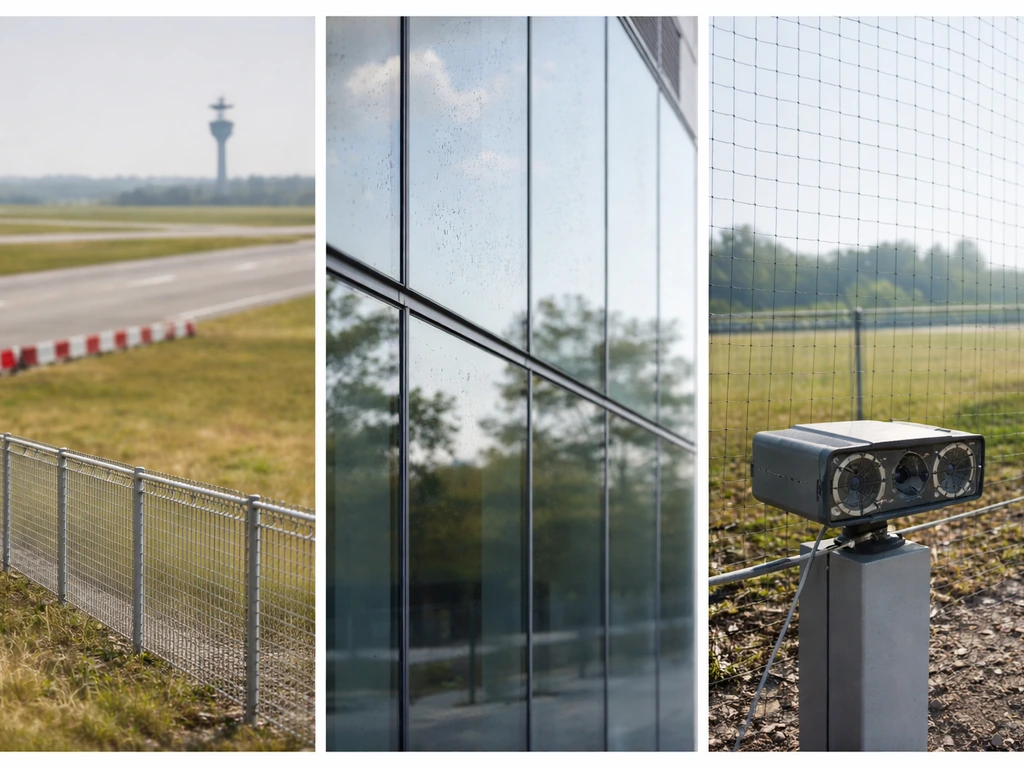
What Is Already Being Done to Prevent Bird Collisions
Learn what’s already used to prevent bird collisions, from airport safeguards to building glass and humane deterrents, p
Best Bird Strike Prevention: Practical Steps That Work
Step-by-step best bird strike prevention: remove attractants, use exclusion and deterrents correctly, and maintain resul