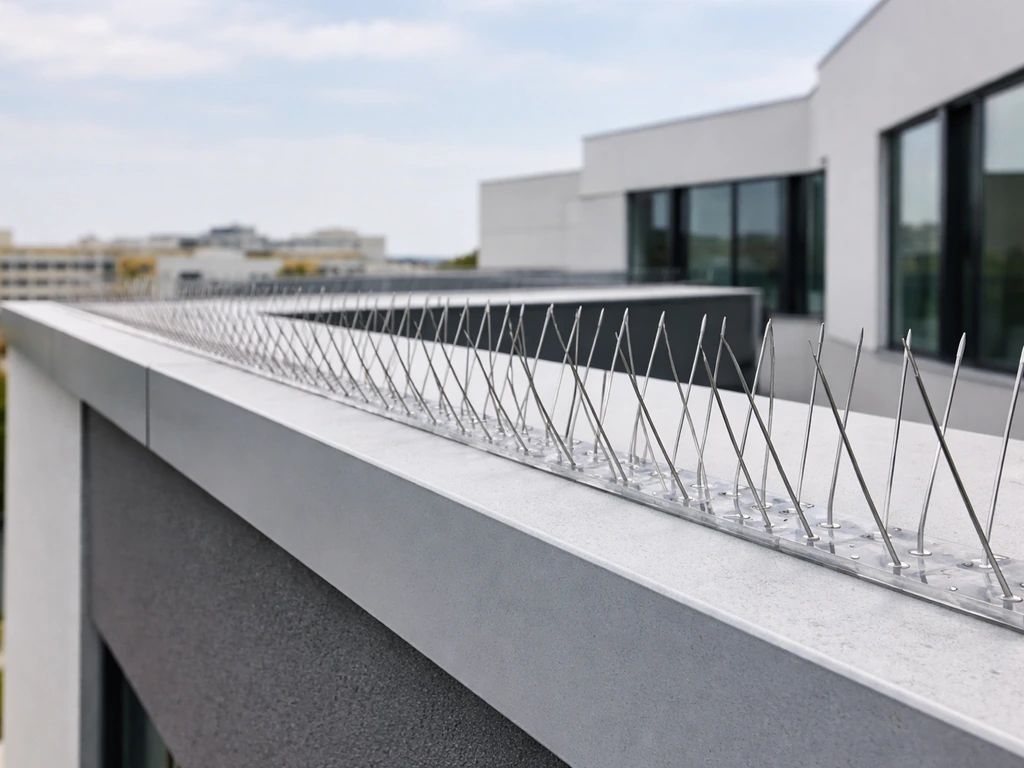
Bird spikes are physical deterrent strips fitted with rows of thin, upward-pointing rods that make it uncomfortable for birds to land or perch on a surface. They do not trap, injure, or harm birds. They simply remove the flat standing area birds need to settle, so the birds move on and find somewhere else to rest. If you have pigeons lining up on your ledge every morning or starlings crowding your roofline, spikes are one of the most straightforward and durable fixes you can put in place.
What Are Bird Spikes and How Do They Work

Marcus Weatherby
2 Apr 2026
How bird spikes actually work
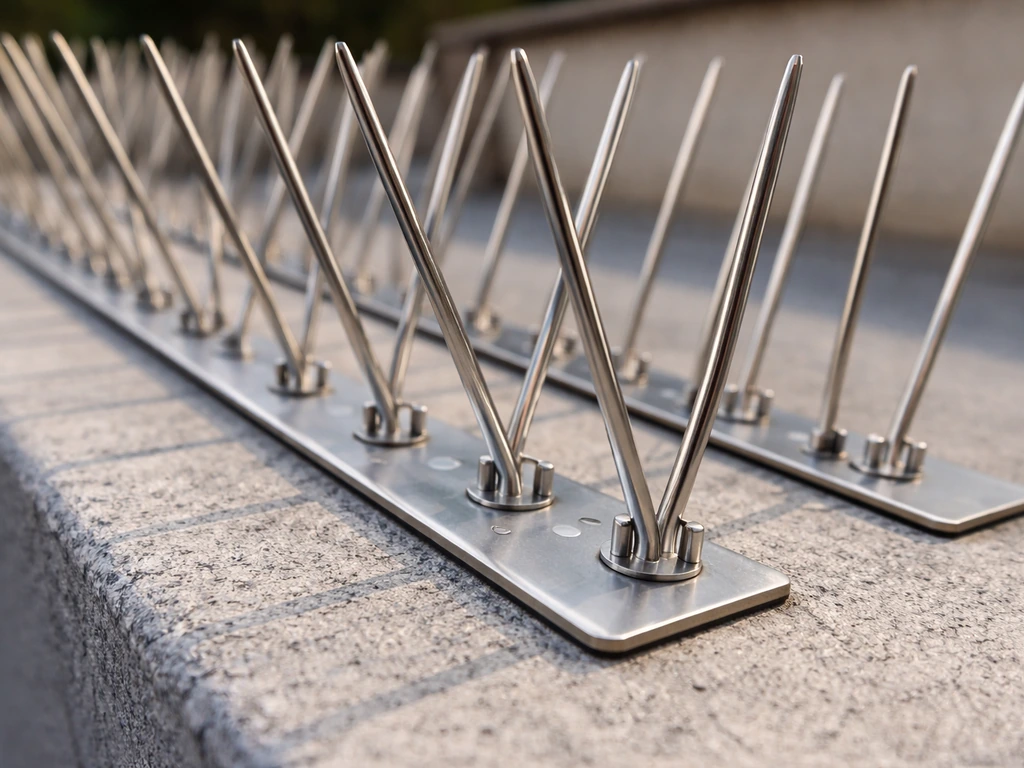
The mechanism is simple: when a bird tries to land on a spike-protected surface, its feet cannot reach the flat base. The rods make contact first, creating an unstable and uncomfortable experience. The bird gets a light prick or an off-balance feeling and leaves. There is no force, no trap, and no chemical involved. The RSPB recommends spikes as a humane way to deter pigeons, and manufacturers like Bird B Gone describe the contact as "generally not harmful" because the rods are intentionally dull and somewhat flexible.
The spikes come mounted on a flat base strip, usually around 1 to 2 feet long per section, which you connect end-to-end to cover the full length of whatever surface you are protecting. The key design goal is to eliminate every flat gap a bird could use as a foothold. Leave even a small opening and birds will find it.
You may see these called "anti bird spikes," "bird deterrent spikes," or just "bird spike" (singular). In practice, they always come and get installed as strips, so "bird spikes" is the more accurate term. If you want a deeper look at what distinguishes different spike systems from each other, the breakdown in what are anti bird spikes covers the terminology in more detail.
What people actually use bird spikes for
The three main problems spikes solve are roosting, nesting, and droppings damage. Roosting is when birds gather and rest on a surface repeatedly. Nesting is when they start building there. Droppings are the downstream consequence of both, and they are corrosive, unsightly, and a health risk on walkways, vehicles, and HVAC equipment.
Spikes work best as a preventive tool. Install them before birds establish a habit on a surface and you will rarely have an issue. Install them after birds have been roosting for weeks and you will break the habit, but it takes a little longer. If birds are already actively nesting with eggs or chicks present, spikes alone are not the right immediate move, and you need to consider legal constraints before disturbing any nest (more on that below).
Commercial properties use spikes on signage, beams, pipes, street lights, and parapet walls. Residential users put them on window sills, eaves, fence tops, and garden walls. They also appear on solar panel edges, patio covers, and balcony railings. Anywhere a flat or semi-flat horizontal surface exists at a height birds like, spikes are a candidate solution.
Where to install bird spikes
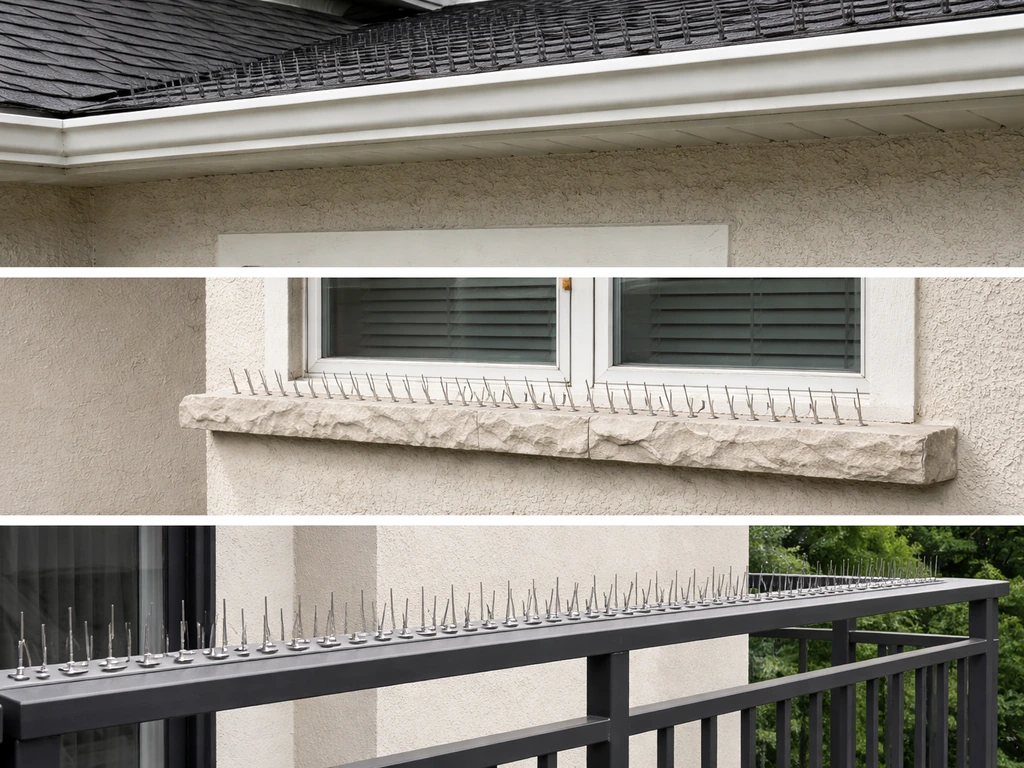
The most common installation spots are ledges and rooflines, but the list of viable surfaces is longer than most people expect. Here are the typical target areas:
- Eaves and fascia boards along rooflines
- Window sills and window ledges
- Balcony railings and balcony ledge tops
- Parapet walls and flat roof edges
- Patio covers and pergola beams
- Garden walls and fence tops
- Air conditioning units and utility pipes
- Solar panel frame edges
- Street lights, signage, and commercial beams
Placement on the ledge matters. Guidance from Defender and other manufacturers says to position spikes along the front edge of the ledge, not set back toward the wall. Birds approach from the outside and try to land at the leading edge, so that is where coverage needs to start. If the ledge is deeper than about 6 inches, you may need multiple rows of strips running side by side to eliminate the full landing area.
For ledges deeper than 5 and 7/8 inches, some systems like Bird Barrier's BirdSlide require leg extensions to bridge the extra depth. This is a detail most DIYers miss, and it is exactly the kind of gap that lets birds squeeze in and settle behind the spikes.
Choosing the right spikes for your situation
Two main material choices dominate the market: polycarbonate (plastic) and stainless steel. Both work, but they suit different situations.
| Feature | Polycarbonate (Plastic) | Stainless Steel |
|---|---|---|
| Cost | Lower upfront cost | Higher upfront cost |
| Durability | Good with UV treatment, but can become brittle over time | Excellent, resists corrosion and weathering long-term |
| Best for | Light bird pressure, budget-conscious installs, residential | Heavy-pressure sites, commercial, coastal/harsh climates |
| Weight | Lightweight, easy to handle | Heavier but still manageable |
| Appearance | Often transparent or clear, less visible | Metallic finish, more visible on some surfaces |
| Bird size range | Works for medium to large birds | Available in wider range, including narrow-tine versions for small birds |
Beyond material, you need to match the spike width and rod spacing to the bird species you are dealing with. Pigeons are large and need standard or wide-base spikes. Sparrows and starlings are much smaller and can actually nest inside standard spike strips if the gap between rods is too wide. If small birds are your problem, look specifically for narrow-tine or small-bird spike products. There is a dedicated comparison of best bird spikes for small birds if that is your situation.
Swallows are a special case. They are mud-nest builders that attach nests to vertical surfaces and undersides of eaves rather than perching on flat ledges in the traditional way. Standard spike strips aimed upward will not address them. Bird Barrier's BirdSlide system even notes that it can be installed upside down specifically for swallow protection, which tells you this is a genuinely different geometry problem. If you are dealing with swallows, check out the guide on best bird spikes for swallows before buying anything.
For a broader look at top-performing products across categories, the best bird spikes roundup covers the leading options with real-world context on where each one performs well.
Installing bird spikes: what you need to know
DIY installation basics
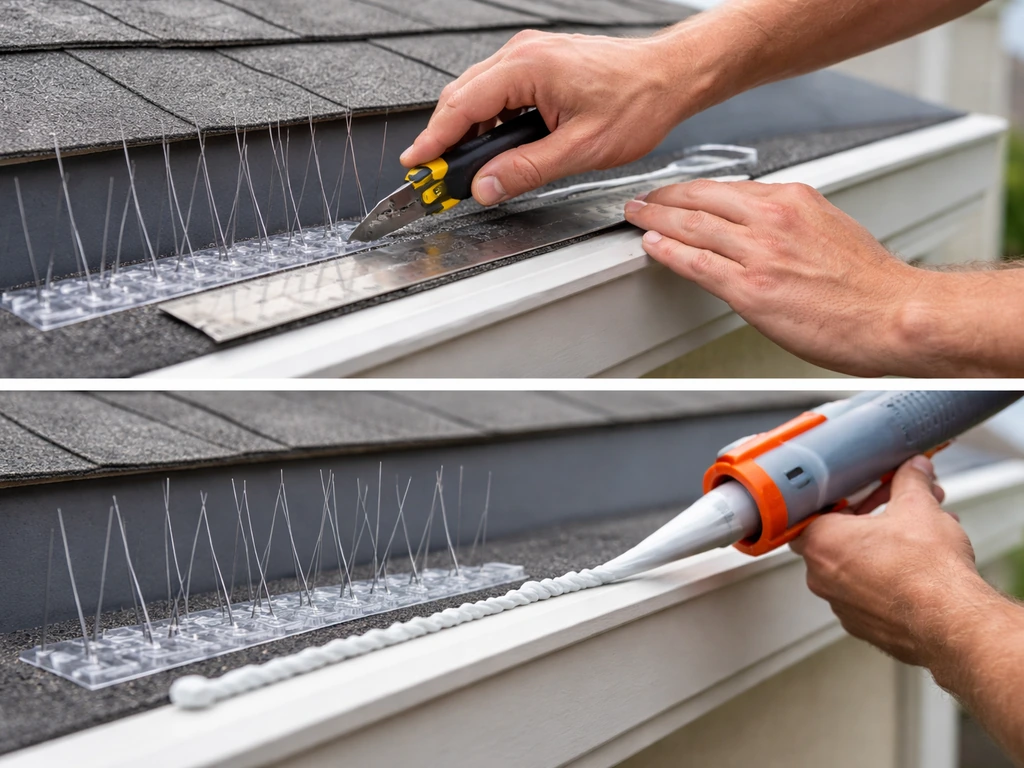
Most residential spike systems are designed for DIY installation. The general process is: clean the surface, measure and cut strips to length, then fasten them using adhesive, screws, or nails depending on the surface type. Polycarbonate strips with adhesive backing are the easiest to work with for a first-time install.
For adhesive mounting, neutral-cure silicone is a common choice. Apply a bead along the base of the strip, press it firmly onto the ledge, and hold it in place until it sets. Choosing the right product here matters more than most people think. The wrong adhesive fails outdoors within a season. The guide on best adhesive for bird spikes breaks down what actually holds up in different weather conditions.
For screw or nail mounting on harder surfaces, Bird Barrier's installation guidance for their Dura-Spike recommends nine screws per three-foot section, not one. That density is what keeps strips secure over years of wind, rain, and temperature cycling. Under-fastening is a common failure point.
The other critical rule: leave no gaps. Bird B Gone's installation instructions specify leaving no more than a 1-inch gap between strip sections. Larger gaps give birds a foothold, which defeats the whole purpose. Run strips continuously and butt sections tightly together.
When to call a professional
Tall buildings, complex rooflines, commercial signage, or surfaces that require rope access are situations where a professional bird-control installer makes sense. They also bring better diagnostic experience when the bird species or surface type is unusual. Improper selection for the application is one of the most common reasons spikes fail, according to Elite Bird Management. If you are not sure which product fits your surface and bird type, a professional assessment can save you the cost of a redo.
Safety, legality, and keeping it humane
Bird spikes are considered a humane deterrent because they do not injure birds. The rods are designed to be uncomfortable, not sharp enough to cause wounds. That said, there are important legal boundaries around bird control in the United States that you need to understand before you act.
The Migratory Bird Treaty Act (MBTA), codified at 16 U.S.C. sections 703 to 712, makes it federally unlawful to take, kill, or possess most migratory bird species or to disturb their nests and eggs without authorization. The U.S. Fish and Wildlife Service (USFWS) enforces this, and even unintentional nest disturbance can constitute a "take" under the Act. If you discover an active nest with eggs or chicks in or near the area you want to treat, stop and contact the USFWS Migratory Bird Permit Office before doing anything that might affect the nest.
In practical terms, this means: install spikes before nesting season to prevent birds from establishing nests in the first place. Do not remove an active nest or block access to one without checking your legal position. Spikes installed on a clean, empty ledge are entirely legal and cause no harm. Spikes installed over or adjacent to an active nest may create legal exposure.
From a physical safety standpoint, wear gloves when handling spike strips. The rods are not razor-sharp but they can scratch skin during installation. Work from a stable ladder or platform and follow standard height-safety protocols.
Keeping spikes working over time
Bird spikes are low-maintenance, but they are not zero-maintenance. The most common reason they stop working is debris accumulation. Leaves, dust, feathers, and even nesting material can pack in around the base and fill the gaps between rods, effectively creating a flat platform for birds to stand on. Inspect strips a couple of times a year and rinse or brush out any buildup.
Also check for loose or detached sections. Adhesive can fail after years of weather exposure, and any detached strip leaves a vulnerable gap. Re-adhere or re-fasten as needed. In coastal or industrial environments where salt air and pollution are factors, stainless steel strips hold up better long-term than plastic.
Spikes are best thought of as one layer in a broader bird-control strategy, not a standalone fix for every situation. If birds are persistently trying to roost nearby despite spikes, or if you are dealing with a species that does not respond well to physical ledge deterrents, combining spikes with other methods gives you much better results. Options include bird netting for enclosed spaces, slope barriers for wide ledges, and sonic or visual deterrents for open areas. If you are weighing whether spikes are even the right tool for your problem, the alternative to bird spikes guide covers the other approaches worth considering.
For specific product recommendations that balance performance and value across different installation scenarios, the best bird deterrent spikes guide is a good next stop. It compares options by surface type, bird size, and installation method so you can narrow down the right choice without guesswork.
FAQ
Will bird spikes stop all birds, or only certain species?
They work best on birds that try to land and perch on horizontal ledges (like pigeons and starlings). Smaller birds can sometimes exploit wide rod spacing, so you may need narrow-tine or small-bird spike products. Swallows are a different case, since they nest by mud attachment to vertical or underside surfaces, so standard upward spikes may not solve that problem.
How long do bird spikes take to work after I install them?
Most birds react immediately because the first landing attempt becomes uncomfortable. If birds already established a routine, you may still see attempts for a short period, but the habit usually breaks once there is complete, continuous coverage with no gaps.
Can I install bird spikes on a roof that has shingles or tiles?
You generally should not fasten or adhere spikes directly into damaged roofing materials or anywhere water sealing is affected. In practice, spikes are used along edges and structural ledges designed to be mounted to, so you may need a surface-appropriate system and mounting method that does not compromise the roof or create water entry points.
Do spikes require perfectly straight alignment and full coverage everywhere?
Yes, the coverage needs to be continuous at the bird landing zone. Even a small break between sections, a missing strip, or a filled-in base with debris can create a usable foothold. This is why tight section butt-joints and periodic inspection are critical.
What size gap between spike strips is acceptable?
Follow the manufacturer guidance, because the tolerance varies by product design. A common benchmark in installation instructions is keeping gaps very small (around 1 inch or less) when sections meet, since larger openings can allow birds to step onto the flat base area.
Will bird spikes work if I only protect part of the ledge?
Often they will not. Birds typically probe the easiest foothold, so leaving an untreated portion can let them land there and still roost or nest nearby. For best results, protect the full length of the ledge or the entire horizontal landing area that birds target.
How do I choose the right spike spacing for different birds?
Match spike type to bird size. If rod spacing is too wide for your target birds, smaller species may perch or nest within the strip. Look for products labeled for small birds (narrow-tine) for sparrow or similar-sized problems, and use standard or wide-base spikes for larger birds.
Can I use bird spikes near an active nest if the birds are causing damage?
Stop and assess before installing. In the US, disturbing nests or eggs of protected migratory birds can create legal exposure, even if your intent is deterrence. If you see eggs or chicks in or near the treatment area, contact the appropriate authorities (or the relevant permit office) before proceeding.
Are bird spikes safe for pets and people after installation?
The rods are designed to be uncomfortable rather than sharp, but they can still scratch or poke skin during contact. It is safest to keep kids away from treated edges and wear gloves during installation. Also ensure strips are fully secured so they do not loosen and create snag points.
What happens if debris accumulates on top of the spikes?
Debris can fill the spaces around the base and effectively recreate a flat landing surface, reducing deterrence. Clean and inspect a couple of times per year, and brush or rinse buildup so the base area does not become a perch point.
How can I tell whether my adhesive or fastening method failed?
Look for sections that lift, separate from the surface, or leave visible gaps at the base. Wind and temperature cycling commonly cause adhesive failure outdoors. If any strip has detached, re-adhere or re-fasten promptly, since even a small lifted area can become the new landing spot.
Do I need professional help if my property has a complex roofline or height restrictions?
If you cannot safely reach the installation points, or if the structure is complex (tall buildings, intricate parapets, areas requiring rope access), professional installation is usually the better option. It also helps when the bird species or mounting surface is unusual, since wrong product choice is a frequent reason spikes do not work long-term.
Are bird spikes a good first choice if birds are nesting right now?
They are usually best as a preventive measure. If birds are actively nesting with eggs or chicks present, spikes alone may not be the immediate solution due to legal constraints and ethical considerations. In that situation, pause and seek proper guidance before disturbing the nest area.
Next Article
What Is Already Being Done to Prevent Bird Collisions
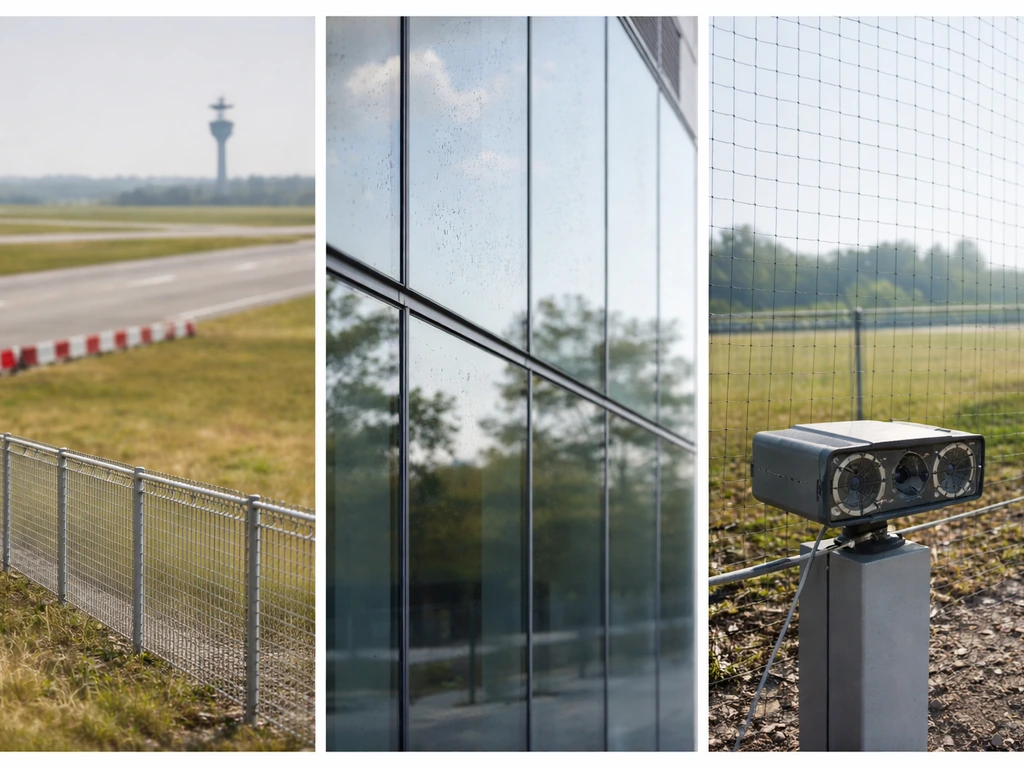
Learn what’s already used to prevent bird collisions, from airport safeguards to building glass and humane deterrents, p