If you searched 'best bird killer,' you are most likely looking for the most effective way to get birds to stop roosting on your roof, raiding your garden, dive-bombing your patio, or causing problems at a commercial property. In almost every situation, the safest, most legal, and most durable answer is not killing birds at all. It is excluding them, deterring them, or modifying the habitat so they leave on their own and stay gone.
Best Bird Killer Alternatives: Safe, Legal Control Guide
Marcus Weatherby
5 Aug 2026
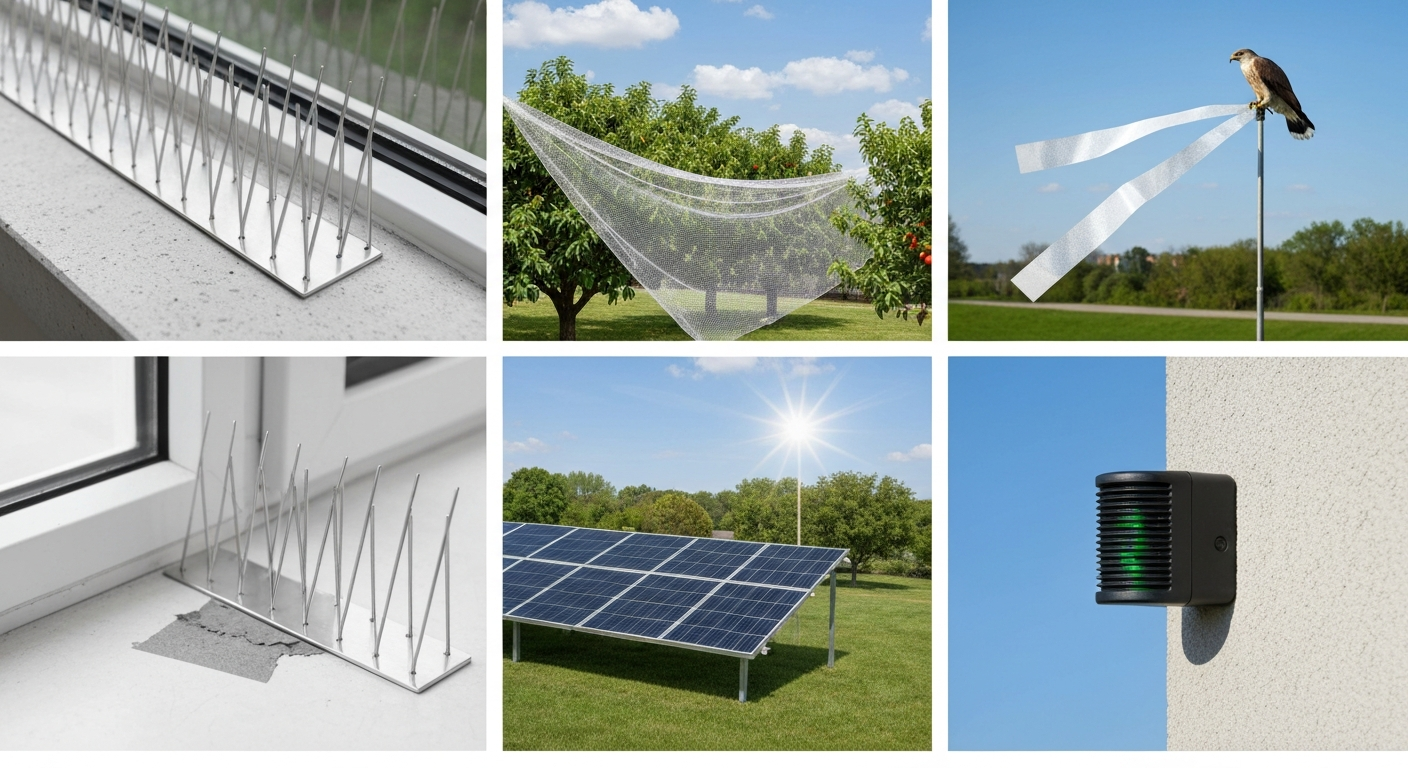
What people actually mean by 'best bird killer'
Most people who use this search phrase are frustrated. They have birds nesting in their gutters, pecking at their solar panels, fouling their pool deck, or destroying a crop. They want the problem solved, and 'killer' is the strongest word they can think of. A smaller share of searchers genuinely want lethal options, whether for pest species on a farm, nuisance birds at a commercial facility, or wildlife-strike management at an airport. This article covers both groups honestly, with priority given to non-lethal strategies because they are usually legal without a permit, safer for people and the environment, and more permanently effective.
Bird control: what it means and the lethal vs. non-lethal line
Bird control is any planned action taken to reduce or prevent damage, health risks, or safety hazards caused by birds. It sits on a spectrum from pure prevention (removing food sources, trimming trees) through physical and sensory deterrents, all the way to lethal removal. Non-lethal control leaves the birds alive and uses barriers, repellents, decoys, and habitat changes to make a site unattractive or inaccessible. Lethal control kills or chemically captures birds and is tightly regulated in the United States and most other countries.
The distinction matters legally, not just ethically. Most birds you will encounter in North America are protected under federal law, which means lethal options require permits that take time to obtain and impose strict conditions on how, where, and how many birds can be removed. Non-lethal options, by contrast, are available to anyone and can be deployed the same day you identify a problem.
The legal and ethical reality: you probably cannot just kill them
This is the most important section in this article if you are thinking about lethal solutions. The Migratory Bird Treaty Act (MBTA) of 1918 prohibits the unpermitted 'take' of virtually all native migratory birds in the United States. 'Take' means killing, capturing, possessing, transporting, or selling. The list of species covered is enormous and includes most common pest birds like starlings and house sparrows in some interpretations, along with songbirds, raptors, waterfowl, and shorebirds. Violations carry federal fines and potential criminal liability.
Bald and golden eagles receive an additional layer of protection under the Bald and Golden Eagle Protection Act, which covers disturbance as well as killing. Threatened and endangered species are protected under the Endangered Species Act (ESA), which requires separate permits or formal consultation with the U.S. Fish and Wildlife Service (USFWS) before any action that might harm a listed bird.
If you have a genuine depredation problem (birds causing documented damage or a safety hazard), the USFWS does issue Migratory Bird Depredation Permits under Form 3-200-13. These are authorized short-term measures. The USFWS is explicit that depredation permits are intended as relief while the applicant implements long-term non-lethal solutions. You must document the species, the damage, your proposed methods, and your plan for non-lethal prevention. Applying takes weeks to months. Shooting birds in your backyard without this permit, including with a BB gun or air rifle, is a federal offense if a protected species is involved.
- Do not shoot, trap, poison, or disturb nesting birds without first verifying the species and confirming you have (or do not need) a federal permit.
- Contact USFWS or your state wildlife agency if you are unsure whether a species is protected.
- For eagles, consult USFWS eagle permit guidance before any action that could disturb a roost or nest.
- For airports and large commercial operations, FAA Advisory Circular 150/5200-33A requires formal Wildlife Hazard Assessments and Wildlife Hazard Management Plans before lethal controls are deployed at scale.
- Chemical avicides such as Avitrol (4-aminopyridine) and DRC-1339 (Starlicide) are Restricted Use Pesticides. Only licensed, certified applicators can legally purchase and use them, and operational use typically falls to USDA-APHIS Wildlife Services under strict carcass-recovery protocols.
How to decide on the right approach
Before spending money on any product or service, run through a short decision process. First, identify the species. Protected or not? Migratory? Endangered? Second, assess the scale of damage and the risk: is this a nuisance or a genuine safety or economic hazard? Third, consider site type: residential, commercial, agricultural, or aviation? Each has different product options, budget realities, and regulatory requirements. Fourth, start with exclusion. Physical barriers have the strongest evidence base for durable control. Fifth, layer in deterrents as supplements, not replacements. Sixth, if lethal removal is genuinely necessary, contact USFWS and a licensed Wildlife Services professional before acting.
Non-lethal methods: the most practical starting point
Peer-reviewed field studies and practical experience consistently show that physical exclusion (netting, spikes, wire) produces the most durable results. Sensory deterrents (sound devices, visual repellents, lasers) work well short-term but suffer from habituation: birds figure out the threat is not real and return within days or weeks unless you vary the stimulus. A 2023 systematic review (Bird Deterrent Solutions for Crop Protection: Approaches, Challenges, and Opportunities (MDPI review)) finds that sensory deterrents typically cause short‑term displacement but suffer rapid habituation unless unpredictably varied or combined with reinforcement A 2023 systematic review (Bird Deterrent Solutions for Crop Protection: Approaches, Challenges, and Opportunities (MDPI review)) finds that sensory deterrents typically cause short‑term displacement but suffer rapid habituation unless unpredictably varied or combined with reinforcement.. Chemical repellents and taste deterrents are useful for medium-term suppression in gardens and on turf. The most effective programs combine at least two method types and pair them with habitat modification.
| Method | Best for | Durability | Typical cost range | Permit needed? |
|---|---|---|---|---|
| Bird spikes | Ledges, beams, signage, gutters | 5-10+ years | $1-$5 per linear foot (DIY) | No |
| Netting/exclusion | Eaves, solar panels, gardens, open structures | 5-15+ years | $0.15-$2 per sq ft (materials) | No |
| Visual deterrents | Open areas, patios, gardens | Days to weeks without rotation | $5-$50 per unit | No |
| Sonic/ultrasonic devices | Yards, open buildings, warehouses | Short-term, habituation is common | $30-$300+ | No |
| Chemical repellents | Turf, ledges, garden plants | Weeks, requires reapplication | $15-$80 per treatment area | No (retail products) |
| Laser deterrents | Warehouses, airports, large open areas | Moderate with rotation | $200-$2,000+ | No (check local laws on laser use) |
| Falconry/pyrotechnics | Airports, large farms, aviation | Effective with ongoing program | $500-$5,000+/month (service) | Often yes, site-dependent |
Bird spikes: the go-to for ledges and beams
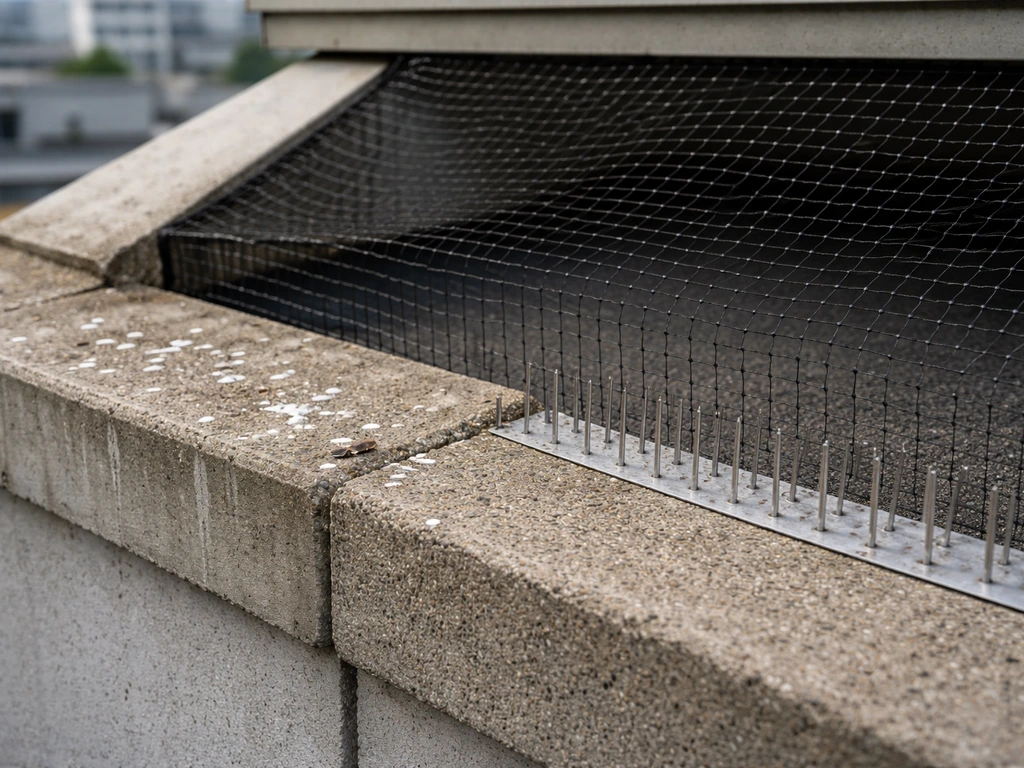
Bird spikes are strips of stainless steel or polycarbonate tines anchored to a base that you attach to any surface where birds land or roost. They do not injure birds. They simply make the surface impossible to stand on comfortably. Spikes are particularly effective for pigeons, gulls, crows, and starlings on flat ledges, window sills, signage, beams, gutters, and parapet walls.
Installation
Clean the surface thoroughly before installation. Bird droppings contain fungal spores (Histoplasma capsulatum) that are a genuine health hazard, so wear an N95 or P100 respirator, gloves, and eye protection during cleaning. Attach strips using UV-resistant adhesive, screws, or ties depending on the substrate. Cover the full width of the landing surface with no gaps wider than about 1 inch, otherwise birds will find the gap and roost there. Stainless steel spikes on a stainless or UV-stabilized polycarbonate base last the longest outdoors.
Pros, cons, and maintenance
- Pros: Long lifespan (5 to 10+ years), low maintenance, no power required, effective against large birds.
- Cons: Not suitable for active nests (remove birds first), can be circumvented by small birds on wide bases, visible and not always aesthetically desirable.
- Maintenance: Inspect twice a year. Clear debris (leaves, nesting material) that can build up and give birds a base above the spikes. Re-glue any loose sections.
Cost estimate: DIY stainless steel spike strips run roughly $1 to $3 per linear foot for standard pigeon width. Professional installation adds labor and typically brings the all-in cost to $5 to $15 per linear foot depending on accessibility and height.
Bird netting and exclusion: sealing off whole areas
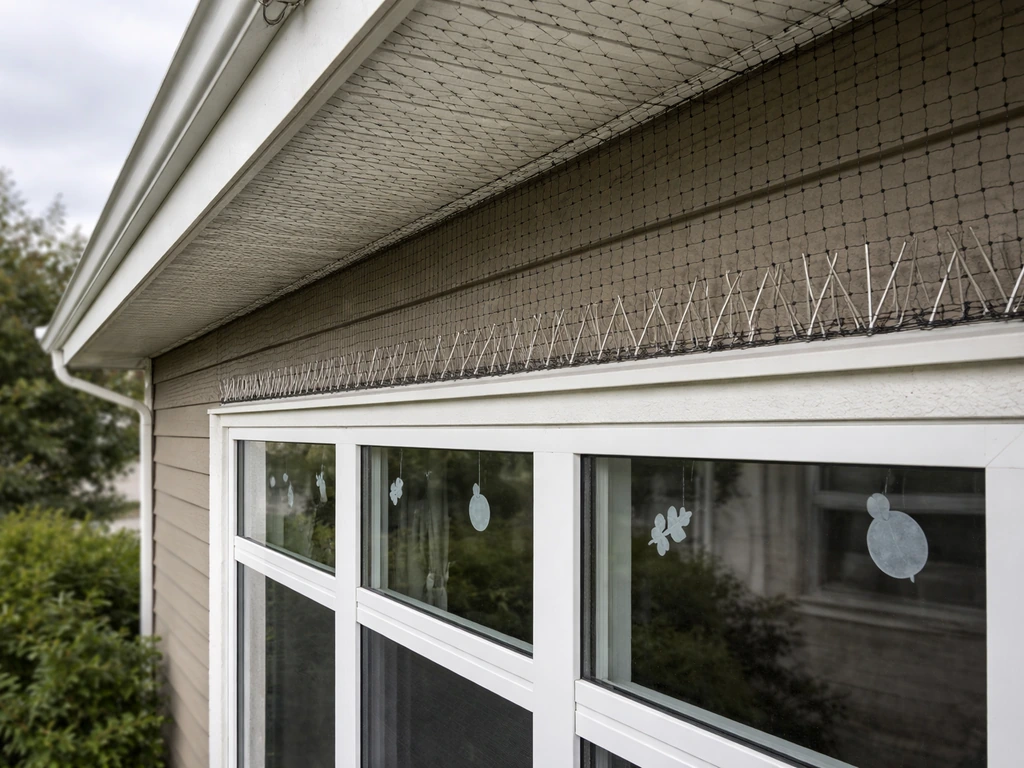
Netting physically blocks access to spaces where birds want to roost, nest, or forage. It is the most complete exclusion solution for enclosed or semi-enclosed areas: eaves and overhangs, open parking structures, fruit trees, garden rows, berry bushes, solar arrays, and attic vents. Choose mesh size carefully: 3/4-inch mesh excludes pigeons and starlings; 1/2-inch mesh excludes smaller birds like sparrows and finches. UV-stabilized polypropylene is the standard for outdoor use and typically lasts 5 to 10 years. Stainless steel mesh is used for permanent structures and high-wind areas.
Installation for structures
For building eaves and overhangs, stretch netting taut from the fascia to the wall or soffit at a 45-degree angle using wire or cable supports so birds cannot push through. Loose netting can trap birds, which creates a welfare problem and requires you to deal with live or dead birds in a confined space. Always ensure no birds are inside the exclusion zone before sealing. One-way exclusion doors can be installed for 5 to 7 days before final netting to allow birds already inside to leave.
Installation for gardens and solar arrays
For raised garden beds and fruit trees, drape netting over a lightweight PVC or metal frame so it does not contact plant foliage (contact points become entry points for birds). For solar panels, purpose-built solar panel exclusion kits include a UV-resistant mesh skirt that clips to the panel frame and prevents birds from nesting in the gap underneath. These kits run roughly $0.50 to $1.50 per linear foot of panel perimeter and are worth having a solar installer fit during a maintenance visit to avoid voiding any roof warranty.
- Pros: Most thorough exclusion available, works for all species, durable when installed correctly.
- Cons: Higher upfront cost and installation complexity than spikes, requires inspection for damage (UV degradation, wind tears, pests chewing holes), must be completely sealed to work.
- Maintenance: Inspect seasonally. Repair any holes or tears immediately. Re-tension cable systems if netting sags.
Cost estimate: Materials for polypropylene garden netting start around $0.15 to $0.40 per square foot. Professional structural netting installation (buildings, parking garages) typically runs $1 to $4 per square foot installed, more for difficult-access areas.
Visual deterrents and habitat modification
Visual deterrents include reflective tape, flash tape, predator decoys (owl and hawk silhouettes, kite hawks), holographic repeller discs, and laser devices. They work on the principle that birds will avoid areas that appear dangerous or unpredictable. The critical limitation is habituation: birds learn quickly that a motionless plastic owl is not a real threat. Studies on visual deterrents consistently find that effectiveness declines sharply within days to weeks unless the stimulus is moved or varied.
To get the best results, move decoys every two to three days, combine them with reflective elements that move in the wind, and pair them with a sound component if possible. Flash tape and reflective spirals (sometimes called bird-blinder rods) do retain some effectiveness in open areas because they flutter and create unpredictable light reflections. Cost is very low: a roll of reflective tape runs $5 to $15 and a basic owl decoy $10 to $25.
Habitat modification addresses the underlying attraction. Remove food sources (open trash, pet food left outdoors, accessible fruit). Trim trees and shrubs away from roosting structures. Drain standing water that attracts waterfowl. Cut back dense vegetation that provides nesting cover near buildings. These changes are free or low cost and have compounding benefits across all other deterrent strategies.
Sonic and ultrasonic devices: realistic expectations
Sonic devices broadcast distress calls, alarm calls, or predator sounds at frequencies humans can hear. Better units cycle through multiple species' calls and randomize the intervals. Ultrasonic devices operate above 20 kHz, outside human hearing range. The honest picture from research and field experience is that sonic devices using real bird distress calls can produce short-term dispersal, particularly for gregarious species like starlings and pigeons. Ultrasonic devices marketed for outdoor bird control have weaker evidence, because birds' hearing sensitivity in the ultrasonic range varies widely and wind quickly dissipates high-frequency sound.
Habituation is the central problem with all audio deterrents. Birds exposed to the same calls in the same location for more than a week or two begin ignoring them. Combining sonic deterrents with physical discomfort (spikes or netting) or periodic unpredictable stimuli (a person, a dog, pyrotechnic devices on large properties) significantly extends effectiveness. For closed or semi-enclosed spaces like warehouses, sonic devices work better because the sound does not dissipate as quickly.
- Pros: Easy to install, no physical maintenance, covers large open areas.
- Cons: Habituation within days to weeks, noise can disturb neighbors, ultrasonic claims are often overstated for outdoor use.
- Recommended placement: Mount at bird eye-level or above, angle speakers toward landing zones, rotate call sequences.
- Cost: Entry-level units $30 to $80, mid-range programmable units $100 to $300, professional commercial systems $500 and up.
Chemical repellents and taste/odor deterrents
Chemical bird repellents sold for residential and commercial use fall into two main categories: contact/taste repellents and sticky gels. Methyl anthranilate (a grape-derived compound) is used in liquid sprays for turf, ponds, and reflective surfaces. It irritates birds' mucous membranes and makes treated areas unpleasant without harming them. Products like Bird-X Liquid Bird Repellent and similar formulations typically need reapplication every two to four weeks or after rain. They are well-suited for lawns, golf courses, and waterfront areas where geese and waterfowl are the problem.
Sticky or tacky repellents (polybutene gels applied to ledges) create an uncomfortable sticky surface birds dislike landing on. They work, but require careful application: too thin and birds land anyway; too thick and small birds can get stuck, which is both a welfare problem and a legal issue for protected species. Sticky products also collect dust and debris, losing effectiveness within a few months, and can stain masonry. Apply in a narrow bead, not a solid coat.
Avitrol and DRC-1339 (Starlicide) are chemical avicides that can cause distress, disorientation, or death in birds. Both are EPA-registered Restricted Use Pesticides. That means only licensed, certified pesticide applicators can legally purchase and use them. In practice, USDA-APHIS Wildlife Services personnel handle most operational applications, with strict protocols for carcass recovery to prevent secondary poisoning of scavengers. These are not consumer products and cannot be recommended for DIY use under any circumstance.
Cost estimate for retail repellents: methyl anthranilate sprays run roughly $15 to $40 per quart (covering 1,000 to 4,000 sq ft depending on dilution), and polybutene gels cost approximately $20 to $50 per tube covering 10 to 20 linear feet.
Other non-lethal options worth knowing about
Aversion mats (also called bird coil, bird wire, or shock track systems) are low-profile alternatives to spikes. Bird wire systems use stainless steel wire mounted on spring-loaded posts at 1 to 2 inch heights, creating an unstable landing surface. Electric shock track systems deliver a harmless low-voltage pulse when a bird lands, conditioning the bird to avoid the area. Shock tracks are expensive (roughly $8 to $20 per linear foot installed) but very discreet, making them suitable for heritage buildings and commercial facades where spikes would be unacceptable aesthetically.
One-way exclusion devices (also called bird excluder funnels or one-way doors) are installed over active entry points such as attic vents, chimney openings, and soffit gaps. Birds can exit but cannot re-enter. After leaving for food, they find the entrance closed and disperse. Leave devices in place for five to seven days before permanently sealing the opening to ensure all birds have exited. Never seal an entry point without first confirming no birds or chicks are inside, especially during nesting season.
Falconry and pyrotechnics (bird bangers, shell crackers, screamers) are used primarily at airports, large farms, and commercial facilities. A trained falconer releasing a hawk over an airport perimeter creates genuine predator pressure that sensory deterrents cannot replicate. Pyrotechnic devices fired from a 12-gauge shotgun or launcher create loud, moving disturbance. Both require trained operators, and pyrotechnics may need local fire and noise permits. These approaches are best delivered through a contracted wildlife management service rather than DIY.
Product comparison: homeowner non-lethal solutions
| Use case | Recommended product type | Key specs to look for | Price band | Notes |
|---|---|---|---|---|
| Ledge/window sill (pigeons) | Stainless steel spikes | Stainless tines, UV base, 3-5 inch width | $1-$3/linear ft | Cover full width, no gaps |
| Roof ridge/beam | Bird wire system | Stainless wire, spring posts, 1-2 inch height | $3-$8/linear ft (DIY kit) | More discreet than spikes |
| Eaves/overhang exclusion | Polypropylene netting | UV-stabilized, 3/4-inch or 1/2-inch mesh | $0.15-$0.40/sq ft | Seal completely, use one-way doors first |
| Garden/fruit trees | Garden netting on frame | 1/2-inch mesh, UV-stabilized, framed to avoid contact | $0.20-$0.50/sq ft | Frame prevents entanglement |
| Solar panel underside | Solar panel exclusion mesh kit | Clip-on UV mesh, fits panel frame perimeter | $0.50-$1.50/linear ft | Check panel warranty before DIY |
| Patio/open area (general) | Reflective tape + decoy rotation | Holographic or flash tape, hawk kite decoy | $10-$30 kit | Move decoys every 2-3 days |
| Lawn/turf (geese, gulls) | Methyl anthranilate spray | EPA-registered, reapply every 2-4 weeks | $15-$40/quart | Safe for pets when dry |
| Open yard/warehouse (sonic) | Programmable sonic repeller | Multi-species calls, randomized intervals, weatherproof | $80-$250 | Combine with physical deterrents |
Product comparison: commercial and aviation solutions
| Method | Typical use | Scale | Typical cost indicator | Regulatory note |
|---|---|---|---|---|
| Falconry service | Airports, large farms, stadiums | Site-wide, ongoing | $500-$5,000+/month | Requires licensed falconer; some sites need USDA coordination |
| Pyrotechnics (bird bangers/shell crackers) | Airport perimeters, landfills, agriculture | Site-wide, periodic | $200-$1,000+ per kit + operator | May need local noise/fire permits; operator training required |
| Laser deterrent systems (automated) | Warehouses, large open structures, airports | Building-scale | $2,000-$15,000+ installed | Check aviation laser safety regs near runways |
| Radar-integrated bird detection | Major airports | Airport-wide | $100,000+ | FAA Wildlife Hazard Management Plan required |
| Professional netting (large structures) | Parking garages, stadiums, commercial buildings | Structural scale | $1-$4/sq ft installed | No permit for non-lethal installation |
| USDA Wildlife Services contracted removal | Nuisance birds, depredation, aviation | Site-specific | Contract-based; funded by USDA/APHIS in some programs | Federal depredation permit (Form 3-200-13) required for migratory birds |
| DRC-1339 / Avitrol application | Feedlots, airports (via WS only) | Operational, licensed applicators only | Part of WS contract; not a retail product | Restricted Use Pesticide; only USDA Wildlife Services or certified applicators |
How to choose products responsibly
Before purchasing anything, verify that the product is appropriate for the target species, the surface, and your climate. UV-stabilized materials matter outdoors. Mesh size matters for netting. Coverage width matters for spikes. Read reviews from verified purchasers in similar climates and applications, not just manufacturer claims.
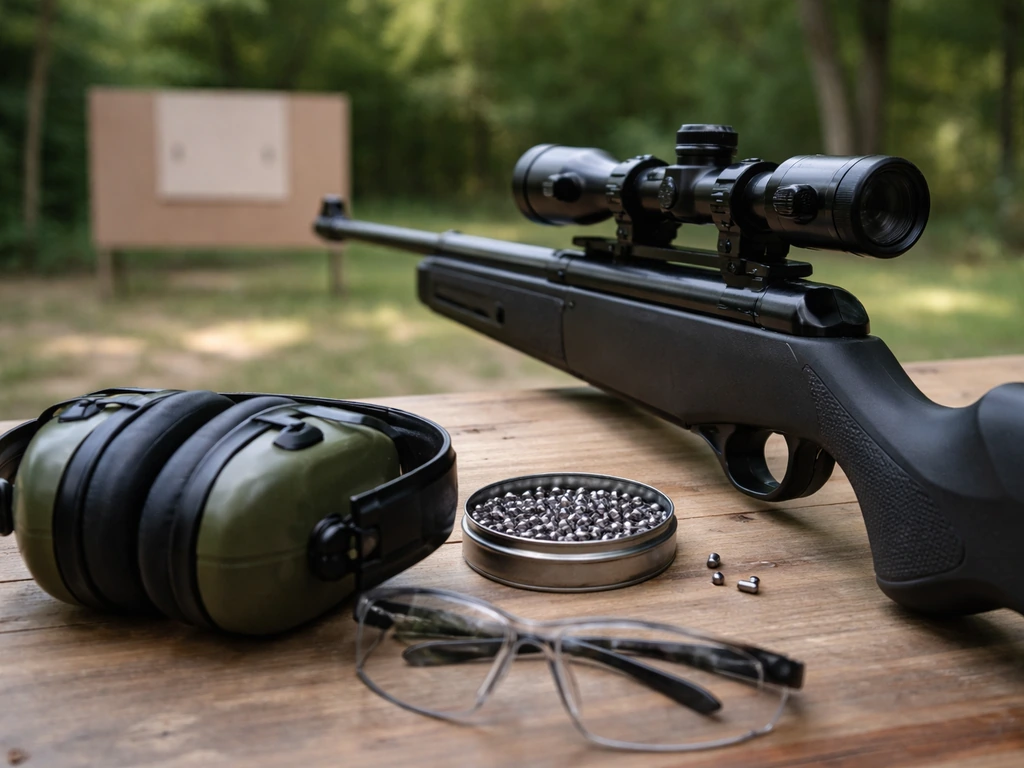
A note on weapons: BB guns, air rifles, and pellet guns are frequently suggested in online forums for bird control. Leaving aside the federal permit requirement for any protected species, shooting birds in residential areas is illegal in most municipalities regardless of species, creates serious public-safety risks, and is simply not an effective long-term strategy. The birds that remain will continue to use the site. Physical exclusion is faster, cheaper over time, and legal. The sibling topic on the best BB gun for bird control addresses this in more detail, but the short answer is that for most readers, a weapon is the wrong tool for this problem.
Key selection criteria for any non-lethal product: UV and weather resistance for outdoor use; verified mesh or tine dimensions for the target species; brand reputation and availability of replacement parts; clear installation instructions; and realistic performance claims that acknowledge habituation or reapplication requirements.
When lethal measures may legally apply
Lethal bird control is legal in a narrow set of situations. A handful of species, including European starlings, house sparrows, and rock pigeons (feral pigeons), are not native to the United States and are not protected under the MBTA, meaning lethal removal without a federal permit is not a federal offense for those species specifically. However, state laws may still apply, and local ordinances often restrict discharge of firearms or air guns in populated areas.
For all other species, the USFWS Migratory Bird Depredation Permit (Form 3-200-13) is the mechanism for authorized lethal removal. To obtain one, you document the species, the damage or safety hazard, the number of birds proposed for removal, the methods you intend to use, and your plan for implementing non-lethal prevention measures. Permits are time-limited and site-specific.
When lethal removal is authorized, humane methods matter both ethically and legally. The AVMA Guidelines for the Euthanasia of Animals are the standard reference for humane kill methods for birds. Indiscriminate or cruel methods are not acceptable under permit conditions and can expose the permit holder to separate liability. Lethal trapping, shooting by trained professionals, and chemical capture (alpha-chloralose, used by Wildlife Services for immobilization and relocation) are the permitted tools, all under professional supervision.
- Non-native, unprotected species (starlings, house sparrows, rock pigeons): lethal removal without federal permit may be legal, but check state law and local ordinances first.
- Protected migratory birds: federal depredation permit (Form 3-200-13) required before any lethal action.
- Eagles: separate USFWS eagle incidental take or disturbance permit required.
- ESA-listed birds: Section 7 consultation or incidental take permit (HCP) required.
- Avicides (Avitrol, DRC-1339): Restricted Use Pesticides, must be applied by a certified applicator, typically USDA Wildlife Services.
- All lethal methods carry risks of non-target harm, disease exposure (handling carcasses), and public-relations consequences for commercial operators.
Patios, balconies, and windows: step-by-step
Patios and balconies attract pigeons and house sparrows for two reasons: food scraps and comfortable horizontal surfaces. The fix is straightforward. First, remove the food source. Bring in pet food, clean up crumbs, and use sealed containers for outdoor waste. Second, apply spikes or bird wire to any flat surface above head height where birds land (railings, overhead beams, light fixtures). Third, hang reflective tape or a kite-style hawk decoy from the ceiling or overhang if birds persist in the open airspace. Move the decoy every few days.
For window collisions, which kill hundreds of millions of birds annually and are a separate issue from pest control, apply window films with a 2x4-inch pattern of UV-reflecting dots or stripes on the exterior surface. Tempera paint applied in a grid pattern also works seasonally. This reduces strike deaths without any impact on pest bird management.
Pools and water features: step-by-step
Geese and ducks are the most common pool problems, and they are both protected under the MBTA. Lethal options require a permit, so start with deterrents. The most effective pool-specific tool is a grid of monofilament fishing line or commercial pool protector string stretched 6 to 8 inches above the water surface on stakes around the perimeter. Geese are reluctant to enter spaces where their wings are obstructed. This costs $10 to $30 in materials and is extremely effective.
Supplement with methyl anthranilate spray on turf surrounding the pool (geese need a grass runway to approach and escape; treating the surrounding grass makes the approach unattractive). A motion-activated water sprinkler (such as the Contech ScareCrow or similar) positioned to spray toward common landing zones adds an unpredictable aversive element. For persistent problems, a trained border collie working the perimeter creates genuine predator pressure that geese respond to strongly.
Gardens and crops: exclusion and integrated strategies
For home gardens, netting is the most reliable protection. Frame your beds and drape 1/2-inch mesh netting over the frame so it does not touch plants. For fruit trees, use netting bags over individual fruit clusters or full canopy nets. For row crops, UV-stabilized polypropylene crop netting on hoops covers large areas at low cost. Make sure netting is staked at ground level to prevent birds from walking underneath.
Supplement netting with reflective tape on stakes placed throughout the crop area, and rotate the tape position weekly. Motion-activated sonic devices set to play hawk calls can reduce incoming pressure during the early morning feeding window when birds are most active. For larger agricultural operations, a combination of frightening devices (propane cannons, pyrotechnics, laser harassment at dawn and dusk) and habitat modification (removing hedgerows used as staging areas) is the evidence-based integrated approach.
Roofs, attics, and chimneys: exclusion and humane eviction
Birds accessing attic spaces, roof voids, and chimneys need to be evicted before exclusion is sealed. Never seal an entry point with birds inside, particularly during nesting season (roughly March through August for most species in North America). An active nest with eggs or chicks cannot be disturbed for protected species without a permit.
- Identify all entry points: inspect at dawn when birds are returning, or at dusk when they are leaving.
- If nesting is in progress and the species is protected, wait for the nest to be completed and fledglings to leave before acting.
- Install one-way exclusion doors or funnels over the primary entry point. Leave secondary entries temporarily open.
- After five to seven days of confirmed exit activity, remove the one-way devices and seal all openings permanently with hardware cloth (1/4-inch galvanized mesh), foam backer rod plus silicone sealant, or purpose-built chimney caps.
- Apply spikes or bird wire to roof ridge lines and any flat ledges where birds were landing.
- Clean up droppings with appropriate respiratory protection before sealing.
Chimney caps are inexpensive ($30 to $150 for standard sizes) and prevent re-entry permanently. They also keep out squirrels and rainwater, so they are a good investment regardless of the bird issue.
Solar panels: protecting your investment
The gap beneath solar panels is ideal nesting space for pigeons: warm, sheltered, and close to urban food sources. Nesting debris can block panel ventilation, reducing efficiency, and acidic droppings degrade wiring and panel frames. The solution is a solar panel exclusion kit: a UV-resistant mesh skirt that clips or screws to the panel frame and closes off the gap around the entire perimeter.
Before installing any exclusion, check whether birds are already nesting under the panels. If active nests are present and the species is protected, wait for fledglings to leave. Then have the area cleaned professionally (respirator required for dried droppings), apply the mesh kit, and inspect annually for mesh damage or new entry points. Ask your solar installer or a certified installer to fit the mesh during a scheduled maintenance visit to avoid voiding roof warranties or panel warranties through improper penetrations.
Aviation and bird-strike management
Bird strikes are a genuine aviation safety issue. The FAA Wildlife Strike Database records tens of thousands of strikes annually in the United States. The FAA maintains the national Wildlife Strike Database and publishes multi‑year wildlife‑strike reports (for example, 'Wildlife Strikes to Civil Aircraft in the United States, 1990‑2024'), which airport wildlife managers use to quantify strike frequency, species involved, and seasonal patterns blank" rel="noopener noreferrer">The FAA maintains the national Wildlife Strike Database and publishes multi‑year wildlife‑strike reports (e.g., 'Wildlife Strikes to Civil Aircraft in the United States, 1990‑2024'). FAA Advisory Circular 150/5200-33A provides the baseline guidance for certificated airports: Wildlife Hazard Assessments are required after a qualifying strike or wildlife observation event, and Wildlife Hazard Management Plans must be maintained. ACRP Report 125 provides detailed technical guidance for balancing stormwater management with bird hazard reduction, since water on airport property is a major bird attractant.
Airport wildlife management programs typically combine habitat modification (removing grass, draining standing water, eliminating food attractants near the airfield), active harassment (trained wildlife officers using pyrotechnics, falconry, and vehicle patrols), and periodic lethal removal under USDA Wildlife Services management with appropriate permits. Radar-based bird detection systems are used at larger airports to provide real-time strike risk assessment for air traffic control decisions.
If you are an airport wildlife manager or a consultant working on a new facility, the starting point is always an FAA Wildlife Hazard Assessment by a qualified wildlife biologist, followed by a formal management plan. USDA-APHIS Wildlife Services has staff and regional coordinators who work specifically with airports. Contact your FAA regional office and Wildlife Services state director for coordination.
DIY vs. professional: a decision checklist
Run through these questions before deciding whether to tackle the problem yourself or call a professional wildlife control operator or Wildlife Services.
- Species check: Do you know what species you are dealing with? If not, confirm before acting. Protected species change the rules entirely.
- Nest check: Is there an active nest with eggs or chicks? If yes and the species is protected, your options are very limited until the nest cycle completes.
- Permit check: Is the species migratory, an eagle, or ESA-listed? If any lethal action is being considered, contact USFWS before proceeding.
- Scale check: Is this a single ledge or a whole building? Single ledge or small area: DIY spikes or netting is straightforward. Multi-level building, large roof, attic infestation: professional exclusion installer is usually more cost-effective.
- Height and access check: Can you safely access the affected area with standard ladders? If not, use a licensed contractor to avoid fall risk.
- Health and safety check: Large accumulations of droppings require professional remediation due to fungal and bacterial hazards.
- Emergency check: If birds are inside a living space, inside an active chimney creating a fire risk, or a bird is injured, call a licensed wildlife rehabilitator or animal control.
Installation tips, maintenance schedules, and rough budgets
A few universal installation principles apply across all physical deterrent methods. Clean the surface first (always with respiratory protection for areas with droppings). Use UV-stable materials for any outdoor installation. Install on a dry day above 50 degrees Fahrenheit so adhesives cure properly. Cover every inch of the target surface, because birds exploit any gap or untreated area within days.
| Scenario | Recommended method | DIY budget estimate | Maintenance interval |
|---|---|---|---|
| Single window sill (pigeons) | Spike strips | $10-$25 | Inspect twice yearly |
| Roof ridge (30 linear feet) | Bird wire kit or spikes | $50-$120 | Inspect twice yearly |
| Eaves exclusion (100 sq ft) | Polypropylene netting | $30-$60 materials | Inspect seasonally, repair tears |
| Fruit tree (1 tree) | Canopy netting kit | $15-$40 | Remove and store seasonally |
| Garden beds (50 sq ft) | Netting on frame | $20-$50 | Inspect seasonally |
| Solar panels (20-panel array) | Solar exclusion mesh kit | $150-$400 | Annual inspection |
| Pool/lawn (geese) | Monofilament grid + MA spray | $30-$80 | Reapply spray every 2-4 weeks |
| Open patio (general deterrence) | Reflective tape + decoy | $20-$50 | Move decoy every 2-3 days |
| Attic entry proofing (2-3 vents) | Hardware cloth + chimney cap | $50-$150 materials | Inspect annually after storms |
Real-world scenarios: what happened and what worked
Homeowner with a pigeon problem on a terrace
A homeowner in a mid-size city had roughly 15 pigeons roosting on a third-floor terrace railing and overhead beam every morning. They had tried a plastic owl for two weeks with no result. Solution: full-coverage stainless steel spike strips on the railing and beam (about 40 linear feet, roughly $90 in materials), combined with removal of a cracked birdseed feeder nearby. Within three days the pigeons had relocated. After two years the spikes remain effective with one inspection per season.
Gardener protecting strawberry beds from starlings
A home gardener lost a substantial portion of their strawberry crop to European starlings two years running. Year three: lightweight PVC hoops over three raised beds with 1/2-inch polypropylene netting staked at ground level. Total cost under $40 per bed. The netting was removed at season end, stored, and reused the following year. No crop loss. The gardener also removed a nearby birdbath that had been concentrating bird activity near the beds.
Solar installer dealing with nesting pigeons
A solar installation company in the Southwest was receiving service calls for reduced panel output. Inspection revealed pigeon nests under roughly 30 percent of panels across multiple residential installs. The company added a standard solar exclusion mesh kit to all new installations (about $200 to $350 per residential system) and offered a retrofit service. Retrofit installs were completed during annual maintenance visits to avoid additional roof access costs. Callbacks for bird-related issues dropped significantly over the following 18 months.
Airport wildlife manager responding to a gull strike event
A regional airport experienced an engine ingestion event involving laughing gulls during summer. A Wildlife Hazard Assessment was triggered per FAA requirements. The assessment identified a stormwater retention pond 800 feet from the runway threshold as the primary attractant. The Wildlife Hazard Management Plan incorporated: modification of pond edges to reduce wading bird use, increased morning and evening harassment patrols using pyrotechnics, and a contract with a regional falconry service for high-risk seasonal periods. USDA Wildlife Services was engaged for permitted targeted removal of roosting gull populations during the peak summer season. Strike incidents involving gulls were reduced over the following two seasons.
Resources and next steps
For permit applications and species verification, the U.S. Fish and Wildlife Service is the primary federal resource. The USFWS Migratory Bird Permitting website hosts Form 3-200-13 (Depredation Permit application), the Migratory Bird Permitting Handbook (updated January 2025), and eagle permit guidance. For state-level assistance, your state wildlife agency (typically a Fish and Wildlife or Natural Resources department) can clarify whether state permits are also required.
- USFWS Migratory Bird Permit applications: fws.gov/office/migratory-bird-permits
- USFWS Form 3-200-13 (Depredation Permit): available on the USFWS permits portal
- USDA-APHIS Wildlife Services: find your state Wildlife Services director at aphis.usda.gov/wildlife-damage
- FAA Wildlife Hazard Mitigation guidance: faa.gov (search 'Wildlife Strike' or AC 150/5200-33A)
- National Wildlife Rehabilitators Association (NWRA): to find a licensed rehabilitator for injured birds
- To hire a certified professional: look for Wildlife Control Operators certified by the National Wildlife Control Operators Association (NWCOA) or a Board-Certified Wildlife Biologist (TWS)
The bottom line: start humane, stay legal, get durable results
The best bird 'killer' is usually an approach that makes birds want to leave permanently without anyone getting hurt. Physical exclusion with properly installed spikes or netting, combined with habitat modification to remove what attracted the birds in the first place, is what the evidence consistently supports for durable results. For professional installation and ongoing maintenance, consider contacting Good Life Bird Control for experienced exclusion and bird-deterrent services. See best bird control for a curated guide to non‑lethal products, installation tips, and service providers that match the recommendations above. For a quick comparison of lethal and non-lethal options, see our roundup of the top 10 bird killers for context and product examples. Sensory deterrents and repellents extend your toolkit for specific situations but work best as supplements, not standalone solutions.
If you are dealing with a protected species and a genuine safety or economic damage situation, document everything and contact USFWS before taking any lethal action. The depredation permit process exists precisely for serious situations. For most homeowners, gardeners, and small commercial properties, non-lethal exclusion will solve the problem faster, cheaper, and with zero legal risk compared to any weapon or poison.
Your immediate next steps: identify the species, inspect for active nests, choose the right physical barrier for your site from the tables above, and install it correctly the first time. That is more effective than any shortcut. If the situation is beyond a straightforward DIY fix (multi-story building, active health hazard, aviation context), bring in a certified professional from the start. The investment pays back quickly in time, effectiveness, and peace of mind.
FAQ
Is it legal to kill wild birds I find on my property in the United States?
Generally no. The Migratory Bird Treaty Act (MBTA) and other federal laws (Bald and Golden Eagle Protection Act, Endangered Species Act) prohibit unpermitted taking (killing, capturing, possessing, transporting) of most native migratory, eagle, and listed birds. Lethal measures require specific federal permits (e.g., MBTA depredation permits) and often state permits; violations can carry civil and criminal penalties. Always check federal and state agency guidance before any lethal action.
When are lethal methods legally allowed, and who can perform them?
Lethal control may be authorized when birds cause documented damage, public‑safety hazards, or when specific permits are issued (for example, USFWS Form 3‑200‑13 depredation permits). Permits require documentation of species, numbers, methods, and mitigation plans; many lethal agents (e.g., certain avicides) are Restricted Use Pesticides and must be applied by certified applicators or government wildlife professionals (USDA‑APHIS/Wildlife Services). Projects that may affect eagles or ESA‑listed species need separate permits or consultations.
What are the main differences between lethal and non‑lethal bird control approaches?
Non‑lethal methods deny access or comfort (exclusion netting, spikes, wire, habitat modification), deter sensory attraction (visual/sonic deterrents), or discourage roosting/nesting (repellents, habitat changes). Lethal methods (shooting, permitted avicides, professional euthanasia) remove birds but carry legal, ethical, and non‑target risks. Non‑lethal approaches are usually prioritized because they are sustainable, lower risk, and often required as first‑line or long‑term solutions.
Which non‑lethal methods are most effective and durable?
Physical exclusion (properly installed netting, bird spikes, birdwire/rope, sealing gaps) is the most consistently effective long‑term across species and sites. Denying food/water and removing nesting substrate are critical. Sensory deterrents (visual decoys, lasers, audio, pyrotechnics) can work short‑term or as part of an integrated program but often cause habituation unless varied and combined with active harassment. Chemical repellents can help in some localized contexts but must be used per label and are site‑specific.
How do I choose between spikes, netting, and birdwire for rooftops and solar panels?
Choose based on bird species, access routes, and the surface: - Spikes: good for narrow ledges and preventing perching by pigeons and gulls; low visibility; require secure mounting and periodic cleaning. - Netting: best for complete exclusion (e.g., under eaves, rafters, open cavities); effective for larger areas but needs tensioning, proper anchoring, and inspection to prevent entrapment. - Birdwire/rope systems: effective for wider ledges and rooflines where spikes are unsuitable; requires correct tension and multiple anchor points. For solar panels, use purpose‑built PV panel guards or screening to protect underside and wiring; consult panel manufacturer for warranty compatibility.
Are sonic or ultrasonic devices effective for bird control?
Sonic (audible) and ultrasonic devices can produce immediate avoidance but generally suffer rapid habituation; effectiveness is improved when rotated, coupled with active harassment (pyrotechnics, trained dogs), and used in restricted, targeted contexts. Ultrasonic claims often lack strong field validation for many bird species—treat these products as short‑term or supplementary tools rather than stand‑alone solutions.