
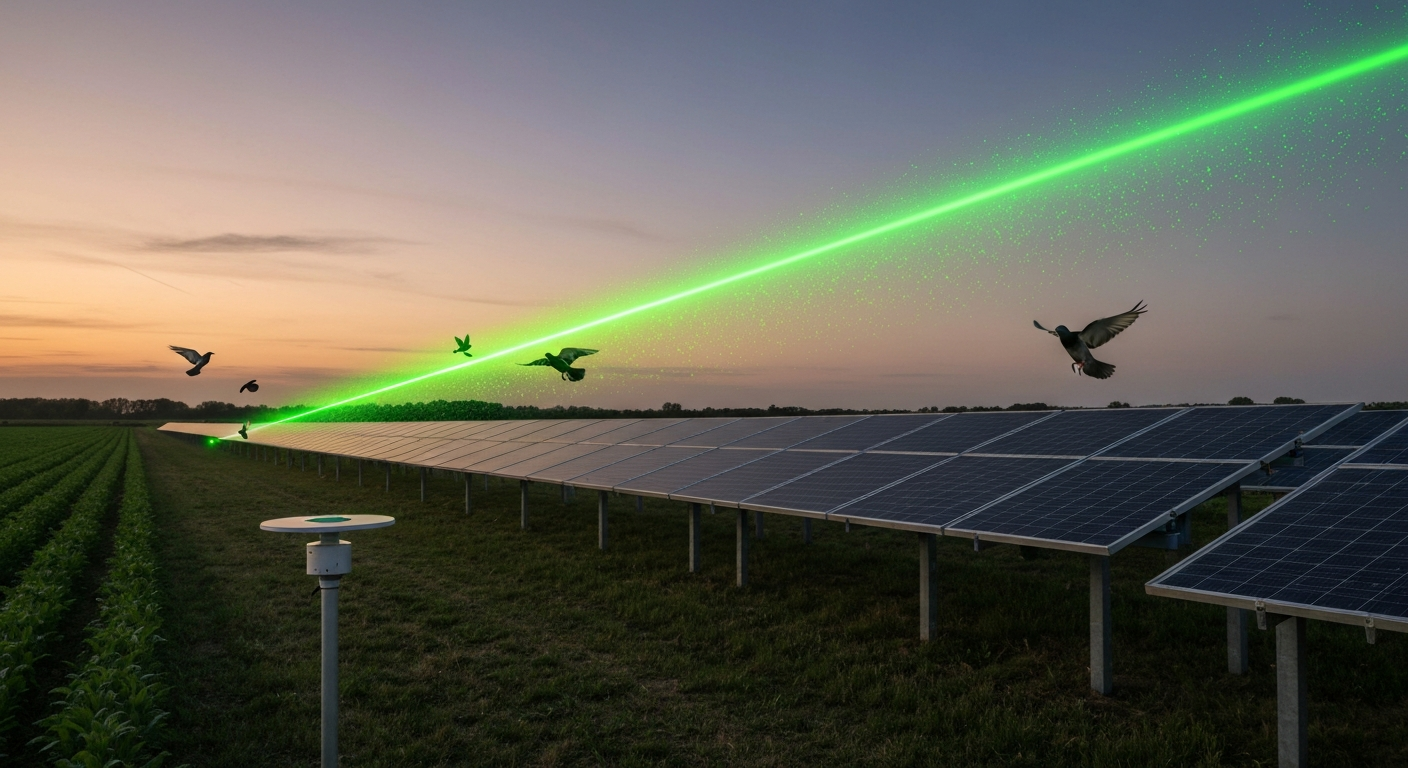
Laser bird scarers work by projecting a moving beam of visible light, usually green at 532 nm, across an area where birds are feeding or roosting. Birds perceive the approaching beam as a physical threat, triggering an instinctive startle and avoidance response. Because the beam keeps moving, birds rarely get the chance to habituate to it as quickly as they would to a static object. The result, in well-designed systems on the right sites and with the right species, is a meaningful reduction in bird activity without noise, chemicals, or physical harm.
How Do Laser Bird Scarers Work: Guide for Homes, Farms & Airports

Marcus Weatherby
27 Jul 2026
What laser bird scarers are and who uses them
A laser bird scarer is a device that emits a low-to-medium power visible laser beam, typically sweeping or rotating automatically, to drive birds away from a defined area. They are sold as handheld units, autonomous rotating pods, vehicle-mounted systems, and fully integrated commercial platforms with programmable sweep patterns and remote monitoring.
The range of people using them is broad. Homeowners reach for them to keep pigeons off roofs and patios. Gardeners use them to protect fruit crops and vegetable beds. Farmers deploy automated units across grain and sweet-corn fields to reduce crop damage. Solar-farm operators use them to keep panels free of fouling from starlings and pigeons. Airport and airfield managers have investigated them as a non-lethal option, though aviation safety rules make this context the most tightly controlled. Pest-control professionals treat them as one tool in a multi-method programme alongside spikes, netting, and sonic deterrents.
How lasers affect bird behaviour
Visual perception: why birds react to laser beams
Birds have four classes of cone photoreceptors rather than the three humans rely on, and many species also perceive ultraviolet light. Cone oil droplets inside bird eyes act as spectral filters that sharpen colour discrimination but also shift peak sensitivity in ways that vary by species and ecology. This means a given laser wavelength is not experienced identically across bird species, but green (around 532 nm) falls within a region of the visible spectrum where a wide range of birds have reasonable sensitivity.
Green lasers also scatter more in particle-laden air than red lasers at the same output power, for the same physical reason that the sky is blue: shorter visible wavelengths scatter more readily off molecules and aerosol particles. That makes the green beam more visible as a travelling line of light, rather than just as a spot. Because birds can perceive this moving luminous object from a greater distance than a red beam of equal power, green lasers dominate the commercial deterrent market.
The startle and avoidance response
When a scanning beam sweeps toward a bird, it triggers a hardwired predator-avoidance reflex. The bird reads the approaching light as a threat moving through the environment and takes flight. In aviary trials by USDA/NWRC researchers, European starlings exposed to a moving green laser were significantly less likely to forage on sweet-corn ears, though the laser did not shorten the duration of individual foraging bouts once a bird had already committed to feeding. This finding is useful practically: lasers are better at keeping birds from landing in the first place than at driving away birds that are already deeply engaged in feeding.
Learning and habituation
Habituation is the single biggest practical challenge. Birds are cognitively flexible, and when they learn that a repeated stimulus is harmless, they stop responding. Using a laser as the only deterrent, at fixed times and in a predictable sweep pattern, accelerates habituation. Research reviews consistently recommend varying the timing, direction, and pattern of laser sweeps, and combining the laser with other deterrent types, to keep the perceived threat unpredictable and maintain avoidance behaviour over time.
Device types and system designs
Handheld lasers are the simplest option: a pen-style unit you sweep manually across a roosting or feeding area. They are low cost, portable, and useful for immediate dispersal, but they need someone present to operate them, making them impractical for overnight or all-day coverage.
Stationary automated units are the most common residential and commercial choice. These are rotating pods, often solar-powered or mains-powered, that sit on a pole or roof mount and sweep a laser beam in programmed patterns. Most allow you to set active time windows and adjust sweep speed and angle. Coverage radius is typically quoted at around 100 metres, though real-world effectiveness falls off before that in daylight.
Mobile tractor or vehicle-mounted systems are used on large agricultural sites, particularly for protecting grain fields or free-range poultry enclosures. The moving platform prevents birds from learning a fixed origin point, which helps delay habituation.
Integrated commercial systems connect multiple laser units to a central controller with scheduling software, real-time monitoring, and sometimes integration with acoustic deterrents or motion sensors. These are used at solar farms, large grain stores, and industrial sites where consistent coverage across a wide area needs to be documented for compliance or insurance purposes.
Wavelengths, power, beam characteristics and safety classes
Most bird deterrent lasers use green at 532 nm or red at around 650 nm. Green is brighter to both birds and humans for equal output power, and scatters more visibly in the air column. Red beams are cheaper to produce and slightly less hazardous at lower power levels, but are meaningfully less visible in daylight and at distance. For deterrence purposes, green is the practical choice.
| Feature | Green (532 nm) | Red (650 nm) |
|---|---|---|
| Typical output power in deterrent devices | 20–100 mW | 5–50 mW |
| Daylight beam visibility | High | Low to moderate |
| Air scattering (equal power) | Higher | Lower |
| Cost | Higher | Lower |
| Eye hazard at given power | Higher (near photopic peak) | Moderate |
| Common use case | Automated commercial/agricultural units | Handheld/entry-level devices |
Output power in deterrent devices typically ranges from around 20 mW to 100 mW continuous-wave. Research prototypes from the University of Rhode Island used 50 mW green lasers in multi-year sweet-corn field trials and reported nominal coverage of roughly 100 metres radius, with effectiveness declining at longer distances as beam irradiance at the target drops. Beam divergence matters here: a narrower beam keeps more power concentrated at distance but increases the hazard level and safety classification.
Early experimental work in the 1990s and early 2000s tested high-energy pulsed lasers and found they could cause feather singeing and eye injuries in birds. Modern deterrent products deliberately avoid high-energy pulsed formats for both animal welfare and human safety reasons. Continuous-wave beams at controlled power levels are the standard. Under international laser safety standards (IEC 60825-1), devices above Class 2 (1 mW visible) require user precautions, and anything above Class 3R (5 mW) is considered to carry a realistic eye-injury risk, confirmed by systematic reviews of retinal injury cases. Always check the safety class of any device you purchase.
Where and when lasers are most effective
Site types and scenarios
Lasers perform best where birds are attracted to a definable, bounded space: a patio, flat roof, stretch of solar panels, grain field, or free-range poultry enclosure. A 2021 Scientific Reports study found that an automated laser reduced wild bird visits to the free-range area of a poultry farm measurably, making this one of the better-evidenced application areas. The study reported significant reductions in wild bird visits to the free-range area when an automated green laser deterrent was used Efficacy of an automated laser for reducing wild bird visits to the free range area of a poultry farm (Scientific Reports, 2021). Agricultural fields, especially sweet corn, have been studied in the most depth. In residential use, lasers can protect patios, garden beds, and roof spaces, though the evidence base here is largely observational rather than controlled.
Solar panels deserve a specific mention because fouling from starlings and pigeons is a real operational issue, and lasers offer a non-contact option that avoids any risk of panel damage from physical deterrents. A laser unit mounted at one end of a panel array can sweep the surface repeatedly during the birds' peak activity windows.
Time of day and environmental conditions
Lasers are substantially more effective in low-light conditions: dawn, dusk, and overcast days. At full daylight brightness, background luminance competes with the beam and reduces its apparent contrast to birds. This is not just a practical observation but a predictable consequence of how beam visibility works: the beam's apparent brightness relative to the background falls as ambient light increases. If your main problem is daytime feeding pressure, you will likely need to combine the laser with other deterrent methods.
Fog, rain, and dust can increase the visible scattering of the beam at close range, but tend to reduce effective range and irradiance at the target. Wind-driven vegetation can interrupt the sweep pattern and create false avoidance at unexpected angles. Consider the typical weather and vegetation at your site when planning coverage.
Which species respond and which do not
Response varies considerably by species. European starlings, some blackbirds, and other flock-foraging passerines show the strongest documented avoidance in controlled trials. Pigeons show variable results: some studies report useful deterrence, others show limited effect, and individual boldness within a flock plays a role. Corvids (crows, jackdaws, rooks) are cognitively sophisticated birds that habituate faster than most species and may require more frequent changes in laser pattern and position to maintain any effect.
Gulls and many waterfowl species show inconsistent responses across studies and field reports. Some reviews describe weak or unreliable deterrence for gulls specifically, which is one reason laser-only approaches at harbours or coastal sites often underdeliver. Raptors (hawks, falcons, owls) show little or no consistent avoidance response to laser beams in published accounts, and attempting to use a laser to deter birds of prey is generally not effective.
Context changes everything. A bird that is very hungry, nesting, or highly motivated by a food source will tolerate deterrents it would otherwise avoid. Flock dynamics also matter: bold individuals that do not flee can inadvertently signal to others that the threat is manageable, rapidly undermining deterrence across the whole group.
| Species group | Typical response | Notes |
|---|---|---|
| European starlings | Strong avoidance in trials | Best-evidenced group; foraging propensity reduced significantly |
| Pigeons/feral doves | Variable | Bold individuals reduce group response; combine with physical barriers |
| Corvids (crows, jackdaws) | Variable to weak over time | High habituation rate; requires frequent pattern changes |
| Gulls | Inconsistent/weak | Not reliable as sole method at coastal/harbour sites |
| Waterfowl (ducks, geese) | Inconsistent | Some positive results in controlled conditions; context-dependent |
| Raptors | Little to no response | Not recommended as a target species for laser deterrence |
| Sparrows and small passerines | Some avoidance at intensity | 2026 study noted behavioural/physiological effects at high power |
Legal, aviation and public-safety rules
This is where you need to pay close attention, because the consequences of getting it wrong are serious. Directing a laser beam toward an aircraft is a criminal offence in most jurisdictions, including the UK, Australia, the US, and the EU, with penalties that include significant prison terms. The rule is not about intent: even an inadvertent sweep of a laser into controlled airspace creates legal liability. If you are within any distance of an airport, airfield, helicopter pad, or known flight path, seek explicit written guidance from your civil aviation authority before deploying any laser deterrent.
For the same reason, lasers are generally not recommended as a primary bird deterrent at active airfields despite early research interest in the concept. Aviation safety bodies in multiple countries, including Transport Canada (TP 13029) and the FAA, have flagged the risk to aircraft as outweighing the deterrent benefit in most airfield contexts. If you are an airport wildlife manager, always work through formal approval channels and consult your national aviation authority directly.
At residential and agricultural sites, check local regulations on laser power class, operating times, and whether a permit is required. Sweeping a high-power laser across a public road, footpath, neighbouring property, or open public space can expose operators to liability for injury. Several local councils and municipalities restrict the outdoor use of lasers above certain power thresholds. Some countries also have specific wildlife protection rules that govern what deterrent methods can be applied to protected species.
Keep written records of your site assessment, the device specifications, and your operating procedures. If you are operating commercially, document your compliance steps. This record-keeping is not bureaucratic box-ticking: it is your protection if an incident is later investigated.
Installation best practices
Mount the laser unit at a height that allows the beam to sweep across the area at bird level rather than over their heads. For a flat roof or patio, a pole mount at one corner of the space works well. For an agricultural field, a central or edge-mounted pole giving 360-degree or semi-circular coverage will reduce gaps. Check the sweep angle against your site dimensions: most commercial units quote a coverage radius, but that figure assumes ideal darkness conditions and a clear line of sight.
Avoid siting the unit so that the beam can reflect off glass, standing water, polished metal, or light-coloured walls toward occupied areas, neighbouring properties, or roads. Reflections can carry a hazardous beam far beyond your intended coverage zone. Walk the perimeter of the intended sweep area before switching the unit on, at the same time of day you plan to operate it, to check for reflective surfaces that may be in shadow during your site assessment but lit differently during operation.
Programme varied sweep patterns from day one. A device that sweeps the same arc at the same speed at the same time every morning will produce faster habituation than one with randomised timing and direction. If your unit allows multiple time windows, spread them across the early morning, evening, and any known peak bird activity periods for your site. For agricultural applications, adjust timing around crop development stages when damage risk is highest.
Operation and routine maintenance
Do a quick visual check of the unit daily during your first two weeks of operation. Look for condensation on the lens, any physical movement of the mount, and whether the beam is still reaching the intended area. After heavy rain or wind, check mounting hardware and cable connections.
Clean the optical lens gently with a dry microfibre cloth every one to two weeks, or more often in dusty or coastal environments. Contamination on the lens reduces output power and beam quality noticeably. For solar-powered units, wipe the solar panel surface at the same time. Check battery charge status weekly if the unit has a battery backup, and replace batteries according to the manufacturer's schedule rather than waiting for failure.
If your unit has firmware update capability, apply updates when the manufacturer releases them. Commercial systems increasingly use firmware to manage sweep algorithms, and updates sometimes improve habituation-reduction patterns based on aggregated field data. Keep a log of any changes you make to settings, along with dates and any observations about bird behaviour, so you can identify what is working.
Cost, procurement and DIY vs commercial solutions
Entry-level handheld laser deterrents start at around £20 to £50. Basic automated rotating pods suitable for a patio or small garden typically range from £80 to £250. Mid-range agricultural and commercial units with programmable sweep patterns, weatherproofing to IP65 or better, and coverage of a 100-metre radius cost from around £400 to £1,500. Fully integrated commercial systems with multiple units, central management software, and professional installation can run from £3,000 to well above £10,000 depending on site size.
DIY is reasonable for low-stakes residential or garden applications: protecting a patio from pigeons or a fruit cage from starlings is a manageable project with a mid-range automated pod. The main risk with cheap devices is inconsistent output power, poor weatherproofing, and lack of sweep-pattern variety, all of which accelerate habituation and reduce effectiveness. Always check the stated laser class and output power before buying: a device that does not clearly state its safety class should be treated with caution.
For agricultural fields, solar farms, large commercial roofs, or any site near aviation infrastructure, professional installation and possibly a managed service contract is worth the cost. Professionals can conduct a proper site survey for reflective hazards and flight paths, configure coverage for the specific species pressure you face, and provide documentation of compliance. The cost of a professional installation is nearly always less than the cost of a bird-damage incident or a regulatory penalty.
Measurable expectations and monitoring
Set a baseline before you switch the laser on. For a garden or patio, spend a week counting bird visits at consistent times each day and noting any visible fouling or plant damage. For agricultural sites, record crop damage assessments at regular sampling points. For solar panels, log cleaning frequency and fouling levels. This baseline data is what lets you honestly judge whether the laser is working. For broader context on effectiveness across deterrent types, see the guide "do bird scarers work".
URI/NWRC field trials using 50 mW automated green lasers in sweet-corn fields found around a 33% average reduction in ear damage across multi-year trials. That is a meaningful result, but it also means damage was not eliminated. Realistic goals for most laser deployments are a noticeable reduction in bird numbers and fouling rather than complete exclusion. If you expect zero birds, you will be disappointed. If you expect a measurable improvement that reduces the burden on other control measures, you are more likely to judge the outcome fairly.
Review your metrics monthly for at least the first season of operation. Declining effectiveness over time is a signal of habituation, a change in species composition, or a seasonal shift in foraging pressure. Record what you observe so you can adjust sweep patterns, timing, or deterrent combinations in response.
Troubleshooting common problems
- Limited range in daylight: this is expected behaviour, not a fault. Supplement with acoustic or visual deterrents during peak daylight hours, and concentrate laser operation on dawn and dusk windows.
- Reflections causing unintended disturbance: identify reflective surfaces in the sweep path (glass, water, polished cladding) and adjust mounting angle or sweep arc to avoid them.
- Rapid habituation: change the sweep pattern timing and direction, vary the active windows, and introduce a second deterrent modality (bird calls, visual scarers, or sonic units) to make the overall deterrent environment less predictable.
- Birds attracted rather than repelled: occasionally reported with curious corvids or species that treat novel light sources as a food cue. Reduce power or switch to shorter active windows; if the behaviour persists, consider a different primary deterrent for that species.
- Unit not reaching the full quoted coverage area: check for lens contamination, battery or power supply issues, and physical obstructions in the sweep path. Also re-evaluate whether the coverage specification was measured in darkness conditions that do not match your site.
- Interference with neighbouring properties or roads: reposition the unit or fit a physical shroud to limit the sweep arc to your property boundary only.
Combining lasers with other deterrents
Multi-method programmes consistently outperform any single deterrent in the literature, and lasers are no exception to this. The reason is straightforward: different deterrents address different senses and behaviours, and combining them prevents birds from adapting to any one predictable threat.
Pairing lasers with bird calls or predator distress sounds adds an auditory startle to the visual one, creating a more convincing threat signal. If you are considering combining sound-based deterrents, the same habituation considerations apply to calls as to lasers: varying the sound types and playback times matters as much as varying the laser pattern. For more on whether playback attracts or deters different species, see the guide on can you attract birds with bird calls.
Visual scarers such as reflective CDs, flash tape, and holographic bird diverters work on different principles from lasers and are generally daytime-focused, complementing the laser's strength at dawn and dusk. Using both gives you broader temporal coverage across the day.
Physical deterrents (spikes, netting, wire systems) address a different problem: they prevent birds from landing on specific structures regardless of how motivated the bird is. For roofs, solar panels, and ledges, combining a laser with physical barriers on the actual roosting points is more effective than either alone. The laser reduces the number of birds attempting to land; the physical barrier prevents the persistent individuals from settling. For gardens and agricultural settings, netting over high-value crops provides direct protection that does not depend on bird behaviour at all.
Sonic repellents and ultrasonic devices add another modality and, like lasers, work best when varied in timing and pattern. The sequencing approach that works well in practice is: use the laser as the primary deterrent at dawn and dusk, run sonic calls through the middle of the day when laser visibility is weakest, and maintain physical deterrents on the highest-priority surfaces year-round.
Evidence-aware effectiveness summary
| Context | Species | Evidence level | Typical outcome | Confidence |
|---|---|---|---|---|
| Agricultural fields (sweet corn) | European starlings | Controlled field trials (URI/NWRC, multi-year) | ~33% reduction in ear damage; reduced foraging propensity | Moderate-high |
| Free-range poultry enclosures | Mixed wild birds | Controlled field trial (Scientific Reports 2021) | Measurable reduction in wild bird visits | Moderate |
| Residential patios/gardens | Pigeons, starlings | Observational/commercial reports | Variable; useful at dawn/dusk, less so in full daylight | Low-moderate |
| Solar panel arrays | Starlings, pigeons | Observational; no large controlled trials identified | Anecdotal improvement in fouling frequency | Low |
| Airport/airfield perimeters | Gulls, starlings | Research interest; regulatory restrictions limit use | Not recommended; aviation safety risk outweighs benefit | N/A (not advised) |
| Grain stores/warehouses | Sparrows, starlings | Limited controlled data; commercial deployment reports | Useful as part of multi-method programme | Low-moderate |
| Harbour/coastal sites | Gulls | Field reports; inconsistent response documented | Unreliable as sole method | Low |
Practical decision checklist
- Identify the primary bird species causing damage or nuisance at your site: check the species response table above to assess whether laser deterrence is likely to be effective for that group.
- Map the site: measure the area to be protected, identify reflective surfaces (glass, water, metal), neighbouring properties, public spaces, and any roads or footpaths within the sweep radius.
- Check for aviation proximity: if you are within several kilometres of an airport, airfield, or known flight path, contact your national civil aviation authority before proceeding.
- Assess ambient light conditions: determine whether your main bird pressure occurs at dawn/dusk (laser-suitable) or full daylight (plan supplementary methods).
- Set your budget: decide whether a DIY automated pod or a professionally installed system is appropriate for your site scale and risk level.
- Choose a device with a clearly stated safety class, output power, and IP weatherproofing rating appropriate for outdoor use.
- Plan your sweep pattern variation schedule before installation rather than after, to minimise early habituation.
- Establish a monitoring baseline (bird counts, fouling records, or crop damage assessments) before switching the unit on.
- Identify which complementary deterrents (bird calls, visual scarers, spikes, netting) you will deploy alongside the laser, and schedule their timing to cover the laser's weaker periods.
- Set a review date no longer than four weeks after deployment to assess whether bird numbers or damage are changing in line with your expectations.
Safety and compliance checklist
- Confirm the device's laser safety class and ensure you have appropriate eye protection (rated for the device's wavelength and power) for anyone operating or maintaining the unit.
- Post warning signs at the perimeter of the coverage area informing people that a laser is in operation. This is required or strongly recommended under most national safety guidelines for outdoor laser use.
- Define and enforce an exclusion zone for unprotected eyes during active operation: the size depends on the device's power class, but a conservatively safe minimum for a 50 mW green laser is at least several hundred metres along the beam axis.
- Confirm the unit cannot sweep toward any aircraft approach or departure path, controlled airspace, or helicopter landing zone. If in any doubt, contact the relevant aviation authority and get written clearance.
- Verify that the beam sweep cannot reach any public road, footpath, or neighbouring occupied property: adjust mounting angle and fit physical arc limiters if needed.
- Check local and national regulations for outdoor laser use, any permit requirements for the power class of device you are using, and any species-specific restrictions under wildlife protection law.
- Keep a written log of: device specifications, installation date and location, operating schedule, any incidents or near-misses, maintenance actions, and any communications with regulatory bodies.
- Review and update your documentation at least annually, or whenever the site conditions, device settings, or applicable regulations change.
Recommendations by audience
Homeowners
A mid-range automated pod (£80 to £250) is a reasonable first step for a patio or flat roof. Set it to run from 30 minutes before sunrise to 90 minutes after, and again in the evening. Combine it with reflective visual deterrents for daytime coverage and physical spikes on any ledges where pigeons regularly roost. Monitor for three to four weeks and adjust the sweep schedule if you notice birds returning on a predictable routine.
Gardeners
For fruit or vegetable gardens, an automated pod works well in combination with netting over the highest-value crops. The laser handles general deterrence across the space; the netting protects specific beds regardless of bird behaviour. Focus laser timing on the first two hours of daylight, when most small birds are most actively foraging.
Farmers
The URI/NWRC research on sweet corn gives you the most directly applicable evidence base. A 50 mW automated green laser on a central pole covering roughly 100 metres radius is the tested configuration, producing around a 33% damage reduction in field trials. For larger fields, plan multiple units. Combine with acoustic bird-call deterrents running during mid-morning and afternoon, and vary all patterns weekly. Start monitoring at the same time as deployment so you can document the result.
Solar-farm managers
Mount automated units at the ends of panel rows with a sweep arc covering the full panel surface. Prioritise dawn and dusk operation when starlings and pigeons are most active around the array. Keep a fouling and cleaning frequency log as your primary metric. Combine with physical anti-perch strips along the panel frame tops, which prevent birds from sitting on the structure regardless of deterrent behaviour. Engage a professional installer who can survey for beam reflections off panel glass at different sun angles.
Airport managers
Lasers are a high-risk option at active airfields and require explicit approval from your national aviation authority before any deployment. In most jurisdictions, the risk to aircraft is considered to outweigh the deterrent benefit, and established airport wildlife management programmes rely on a combination of habitat management, acoustic deterrents, trained falconry, and physical controls. If you are evaluating lasers as part of a research or trial programme, work through your airfield safety management system and ensure all trials are fully documented with a clear incident-response protocol.
Pest-control professionals
Treat laser deterrents as one tool in an integrated programme rather than a standalone solution. They add most value at client sites with strong dawn/dusk bird pressure, flock-foraging species like starlings, and a preference for non-contact, non-chemical methods. Document the species assessment, device specifications, and operating schedule in your site report, and build a scheduled review visit into the contract to assess habituation and adjust the programme as needed.
Related guides on Bird Deterrent Guide
If you are building a multi-method deterrent programme, the Bird Deterrent Guide covers physical barrier options including bird spikes and bird netting in dedicated how-to guides with installation steps, material comparisons, and site-specific recommendations. For solar panel protection specifically, there is a detailed guide covering netting, anti-perch strips, and monitoring approaches. On the sensory deterrent side, the site covers how bird calls work as a deterrent method and whether CD and reflective visual scarers are effective, both of which pair directly with laser use in a combined programme.
Quick action plan and when to call a professional
If you are a homeowner or gardener dealing with a manageable bird problem on a single property, start with the practical decision checklist above, buy a mid-range automated unit from a supplier who clearly states its safety class, establish your baseline monitoring, and give the system four weeks before judging it. If the problem is on a roof or structure where physical barriers would also help, add those in the first week rather than waiting to see if the laser alone is sufficient.
If your site is near an airfield, involves a large agricultural area, a solar farm, or a commercial property with public access, engage a pest-control professional or a specialist bird management company before purchasing anything. A proper site survey will save you money, reduce legal risk, and produce a more effective programme than any off-the-shelf solution. The cost of a professional consultation is almost always recoverable in avoided damage, avoided rework, and avoided regulatory complications.
FAQ
What is the basic mechanism by which laser bird scarers work?
Laser scarers use visible laser beams (usually green or blue wavelengths) to create moving, bright points or lines that birds perceive as sudden, unusual visual stimuli. Two mechanisms combine: (1) optical — beam visibility in air depends on wavelength, scattering (Rayleigh and Mie) and beam irradiance, so shorter/green wavelengths (≈532 nm) and low divergence beams appear brighter at distance; and (2) behavioural — birds often avoid novel, moving, high-contrast stimuli (startle/avoidance). Effectiveness depends on species’ visual system (many birds are tetrachromatic and sometimes UV-sensitive), beam parameters, and context.
Which wavelengths and device specs matter, and why?
Key specs: wavelength (nm), output power (mW), beam divergence (mrad), beam mode (continuous or pulsed), scanning/motion pattern, and mounting/height. Green (≈515–532 nm) and blue wavelengths scatter more and are often perceived as brighter than red at equal power; therefore many commercial units use green. Higher power and lower divergence increase visible range but also raise ocular safety risks and regulatory class. Continuous-wave low- to mid-power (tens of mW) moving beams are common in field trials; high‑energy pulsed systems historically caused injuries and are avoided today.
For which species and site types are lasers shown to be most effective?
Evidence shows best results for flocking passerines (e.g., European starlings, some blackbirds) and in contexts where birds forage in open areas (sweet corn, poultry yards, agricultural fields). Automated moving green lasers reduced crop damage and visits in multiple field trials (e.g., sweet corn, free-range poultry). Responses are variable for pigeons, corvids, gulls and waterfowl; airports are generally a poor choice due to aviation risk and regulations. Residential patios, gardens, roofs and solar arrays can see reductions for some nuisance birds but outcomes depend on species, range and background light.
What do peer-reviewed trials say about real-world effectiveness?
Field trials and aviary experiments report measurable reductions in bird visits or crop damage (for example, ~33% reduced sweet-corn ear damage in multi-year trials with robotic green lasers; reduced wild-bird visits to poultry free-range areas). Controlled aviary work found reduced foraging propensity in starlings but mixed effects on bout length. Reviews consistently note effectiveness is context- and species-dependent and that habituation to a single modality is common.
What are the main limitations and when will lasers likely fail?
Limitations include: reduced beam visibility in bright daylight or on high-luminance backgrounds; long-range reduction in irradiance and visibility as distance increases; poor performance for species less responsive to visual threats (some gulls, waterfowl, bold pigeons/corvids); environmental conditions (rain, fog, heavy dust) that alter scattering and reduce effective range; and habituation over time if the stimulus is repetitive and unpaired with aversive consequences. Aviation safety and legal restrictions make lasers unsuitable for airfields.
What safety, legal and aviation rules should I follow?
Never point lasers at aircraft, vehicles, people or reflective surfaces. Many jurisdictions restrict handheld high‑power lasers and impose penalties for directing beams at aircraft. Use devices compliant with local laser safety standards/classifications; follow ANSI/IEC guidance for signage, training and eye-protection where appropriate. For operations near airports or flight paths, consult aviation authorities — lasers are generally prohibited. Keep documentation, avoid DIY high‑power builds, and do not use pulsed high‑energy systems that risk injury to birds or humans.