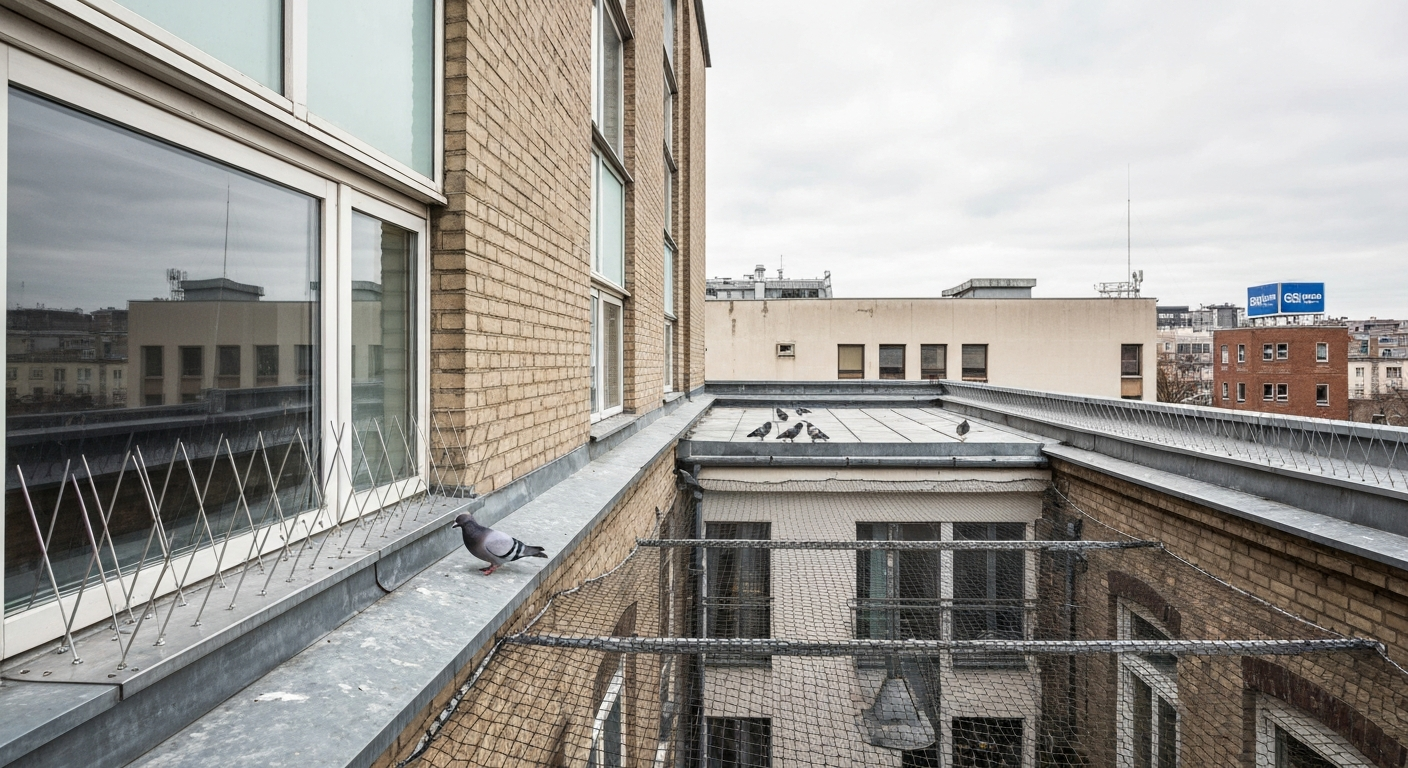
Bird strike prevention comes down to three things: understanding where birds and aircraft (or buildings) share space, knowing which species are driving the risk, and applying the right combination of physical, sensory, and habitat-based tools for your specific setting. Whether you are managing an airport perimeter, a glass-fronted office tower, or a backyard patio, the core logic is the same, reduce attraction, block access, and make the area as uninviting as possible to the species causing the problem.
Bird Strike Prevention Methods: Aviation, Buildings & Homes

Marcus Weatherby
15 Jul 2026
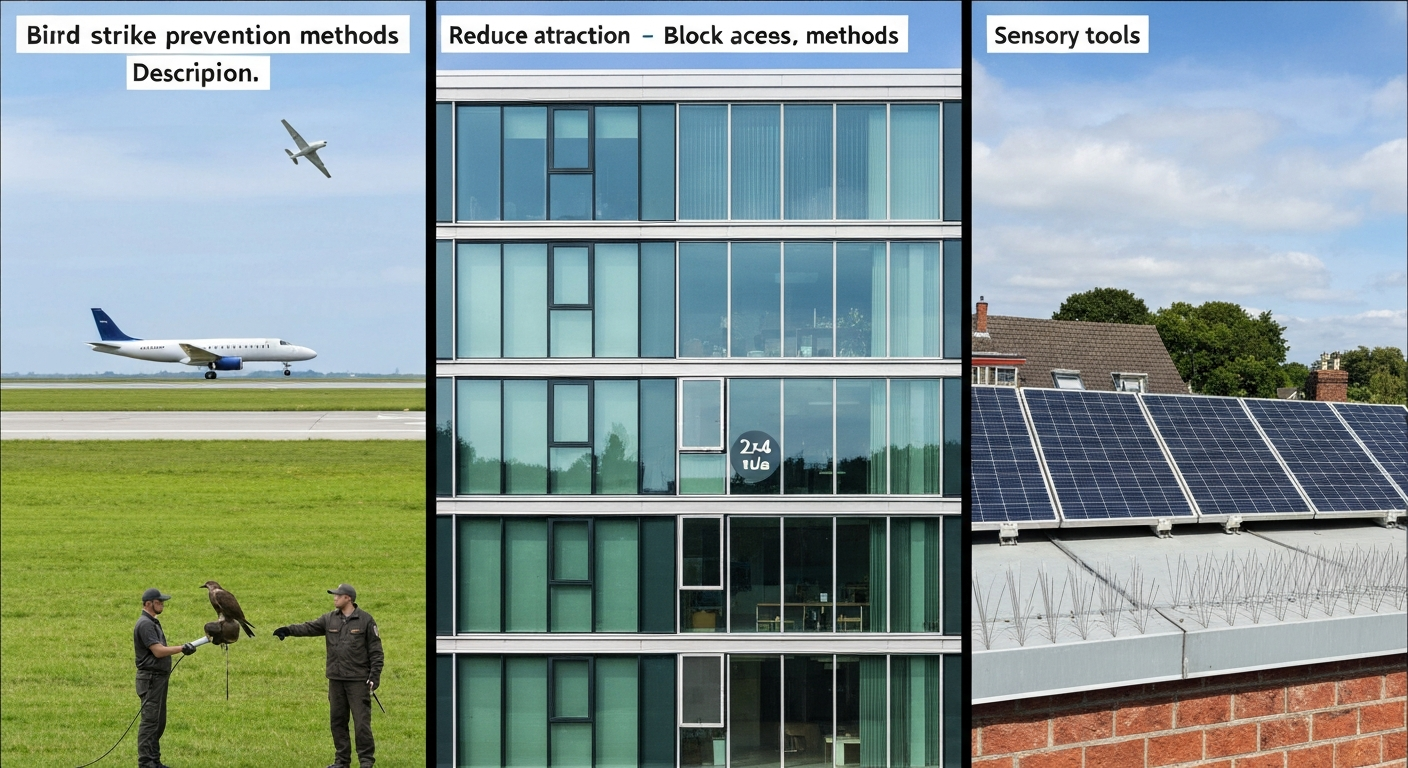
Scope: aviation, commercial buildings, and residential settings
Bird strike prevention means different things depending on context. In aviation, the phrase refers specifically to aircraft-wildlife collisions, a serious safety issue regulated at the federal level. At commercial buildings, it mostly covers bird-window collisions, roosting on ledges and rooftops, and contamination from droppings. In residential settings, the problems range from window strikes and garden damage to nesting under solar panels or around HVAC equipment.
These three contexts overlap in species and season but diverge sharply in scale, regulation, and acceptable tools. An airport wildlife manager operates under FAA Part 139 requirements and works with licensed wildlife biologists. A facility manager at a downtown office building may be bound by local bird-safe building ordinances. A homeowner has far more flexibility but still needs to respect federal protections for most wild bird species. This article addresses all three, with clear flags when advice applies to one context but not the others.
How bird strikes and collisions actually happen
Most aircraft bird strikes happen during the landing and takeoff phases of flight, when aircraft are at lower altitudes and speeds overlap with bird activity near the ground. Runways, taxiways, and the grass areas surrounding them attract foraging birds, particularly gulls, raptors, and waterfowl. The FAA National Wildlife Strike Database, publicly available at wildlife.faa.gov, documents that the majority of damaging strikes in the United States involve a relatively small number of large-bodied species. Small passerines are struck frequently during migration but cause less structural damage than a single collision with a Canada goose or white pelican.
Building and window collisions work differently. Birds do not see glass as a barrier. They fly toward a reflection of sky or vegetation, or try to reach a plant visible through a pane. Tunnel experiments by researcher Daniel Klem and others established that birds will avoid a pattern if its elements are spaced tightly enough: vertical stripes no more than 4 inches apart, horizontal stripes no more than 2 inches apart (the widely cited '2x4 rule'). Larger unbroken panels of glass are the most dangerous. Common hotspots in buildings include floor-to-ceiling windows, glass corners, skywalks, and any glazed wall that faces a garden or tree canopy.
The damage types also differ. An airport bird strike can destroy an engine, crack a windscreen, injure crew, or force an emergency landing. A window collision kills the bird immediately and, if it happens repeatedly, can indicate a serious design or landscape problem. Roosting and nesting cause structural damage through droppings (which are corrosive), blocked gutters, blocked ventilation, and in some cases fire risk when nesting material accumulates near electrical equipment.
Which species to focus on, and when
Not all birds present equal risk, and targeting the wrong species wastes resources. In aviation, hazard ranking studies using FAA strike database data consistently identify a core group of species responsible for the most costly, damaging, or dangerous strikes: Canada geese, white-tailed deer (surprisingly common on runways at night), brown pelicans, sandhill cranes, and large gulls in coastal airports. Recent methodology by Ross et al. (2025) applies relative hazard scores and season-specific strike rates to help individual airports prioritize. A small airport in the Pacific Flyway faces different peak-risk periods than one in the Southeast.
For building and window collisions, migratory songbirds are disproportionately affected, particularly during spring (April-May) and fall (August-November) migration. Research published in The Condor by Loss et al. (2014) estimated hundreds of millions of bird deaths annually from building collisions in the United States alone, with certain species far more vulnerable than others based on their migration routes and flight behavior. Urban buildings along major flyways, especially those with significant nighttime lighting, are highest-risk during migration season.
In residential and commercial settings, the year-round pest species tend to be European starlings, house sparrows, feral pigeons, and in some regions, Canada geese (on lawns near water). These are not migratory concerns in the same way but require persistent, ongoing management rather than a seasonal campaign. Knowing which category your problem falls into, resident pest species versus migratory transients, should shape your timeline and tool selection.
Aviation-specific prevention: what airports actually do
At certificated airports in the United States, wildlife management is governed by 14 CFR Part 139.337 and guided by FAA Advisory Circular AC 150/5200-36. These require airports to identify wildlife attractants on and around the airfield, report strikes using FAA Form 5200-7 (which feeds into the National Wildlife Strike Database), and when a hazard assessment triggers it, develop and implement a FAA-approved Wildlife Hazard Management Plan (WHMP). Internationally, ICAO's Wildlife Hazard Management handbook provides the equivalent framework and covers aerodrome wildlife assessment, monitoring, and mitigation. ICAO publishes a Wildlife Hazard Management (ICAO handbook) that complements national guidance and describes international best practices for aerodrome wildlife hazard assessment, monitoring, reporting, and mitigation options used worldwide.
In practice, airport wildlife management combines several layers. Habitat modification is the foundation: reducing grass height to around 6-14 inches discourages foraging raptors and reduces insect populations that attract smaller birds. Water features, food waste, and open landfills near airports are major attractants that effective WHMPs address first. Active dispersal comes next: trained staff use pyrotechnics (shell crackers, screamers), propane cannons, laser devices, and falconry to move birds off the airfield. These work short-term but require integration with other methods to prevent habituation. Aircraft risk mitigation includes pilot training on bird hazard reporting and procedure adjustments during peak migration.
Lethal control is a legal, regulated option at airports when non-lethal methods are insufficient and the species is not fully protected. It is always a last resort and requires proper permits. The key point for aviation decision-makers is that no single method works alone. The most effective programs layer habitat modification, active dispersal, monitoring, and reporting into a continuous management cycle.
Legal and regulatory considerations
Most wild birds in the United States are protected under the Migratory Bird Treaty Act (MBTA), which prohibits killing, capturing, or disturbing migratory birds and their active nests without a federal permit. This applies even to nuisance species on your property with a few statutory exceptions (house sparrows, European starlings, and feral pigeons are not covered by the MBTA, which is why they are the most common targets for trapping and exclusion). Canada geese, gulls, swallows, and virtually all raptors are protected. Before you deploy any trap, use any toxicant, or disturb an active nest, check federal and state protections for that specific species.
For building design, several U.S. cities now have enforceable bird-safe building standards. New York City's Local Law 15 of 2020 (Int. No. 1482) requires bird-friendly glazing materials on new construction and certain alterations up to 75 feet above grade. It sets prescriptive compliance pathways including fritted glass, patterned glazing, external screens, or equivalent treatments. San Francisco has its own Standards for Bird-Safe Buildings. The American Bird Conservancy tracks municipal ordinances across the country, and this list is growing. If you are involved in commercial construction or major renovation, check local building codes before specifying glazing.
Chemical repellents and toxicants face their own regulatory layer. 4-Aminopyridine (sold as Avitrol) is a restricted-use pesticide registered with the U.S. EPA for specific avicide uses. Its label requirements are strict and it cannot be legally applied by unlicensed individuals. Nicarbazin-based avian contraceptives like OvoControl are registered in some jurisdictions for pigeon and Canada goose fertility control; eligibility and registration status vary by state. Never use any chemical bird control product without confirming current label compliance and local registration.
Acoustic devices, visual deterrents, and physical exclusion systems are generally unregulated at the product level, but local noise ordinances and HOA rules may restrict propane cannons or high-decibel sonic devices in residential or suburban areas. Check before purchasing.
Risk assessment: how to size up your problem before acting
A site survey before you spend anything is worth more than any single deterrent product. Walk the affected area and document what you are actually seeing: species present, approximate numbers, time of day, what they are doing (foraging, roosting, nesting, transiting), and the physical features attracting them. A pigeon roosting problem on a warehouse roof is very different from a sparrow nesting problem in a sign cabinet, even if they look similar at first glance.
Use this checklist as a starting point for your site survey:
- Identify the species (photograph if unsure; consult a field guide or local wildlife agency for identification help)
- Count approximate numbers and note peak activity times
- Locate all access points, ledges, or roosting surfaces being used
- Identify attractants: food sources (exposed garbage, bird feeders, fruit-bearing plants), water (standing water, HVAC condensate, pools), and shelter (dense shrubs, open eaves, gaps under solar panels)
- Note any existing deterrents that have been tried and whether they are still in place
- Document any damage already occurring: droppings accumulation, plant damage, structural impacts
- Check whether active nests are present (changes your legal options immediately)
- Note any proximity to neighbors, pedestrian areas, or infrastructure that limits certain tool types
Once you have that information, you can set a clear goal: reduce strike risk (aviation), stop active roosting or nesting, prevent property damage and health hazards, or some combination. Your goal determines which tools belong in your plan and in what order to apply them.
DIY or professional: where to draw the line
Many physical deterrents like spikes, netting, reflective tape, and visual decoys are straightforward enough for a confident DIY installer. But several factors should push you toward hiring a licensed pest control operator or wildlife management specialist.
- Species protection: if the problem species is protected under the MBTA or a state analog, any physical interference with active nesting requires a federal or state permit — this almost always means professional involvement
- Scale: multi-story buildings, large roof areas, or extensive netting projects involve working at height and require commercial equipment and safety protocols
- Aviation settings: FAA-regulated airports must use qualified wildlife biologists approved under AC 150/5200-36 for Wildlife Hazard Management Plan development and implementation
- Chemical use: restricted-use pesticides and registered toxicants can only be applied by licensed applicators
- Persistent failure: if you have tried two or more deterrent approaches over a full season and the problem is unchanged, a professional survey will identify what you are missing
- Health risk: large accumulations of pigeon or starling droppings can harbor histoplasmosis; cleanup and access to these areas should involve proper respiratory protection and may need professional remediation
On cost thresholds: DIY netting for a small patio or spike installation on a single ledge is generally affordable and straightforward. Once the project involves more than one story, more than a few hundred square feet of netting, or any element that requires a permit, the liability and safety case for professional installation is strong. Get at least two quotes and ask specifically whether the contractor is familiar with your target species and any applicable federal protections.
Physical barriers: the most reliable long-term solution
Physical exclusion is the most evidence-backed category of bird deterrent. Unlike sensory methods, which depend on a bird's response staying consistent over time, physical barriers either work or they don't. When properly installed with no gaps, they deliver permanent results for the target area.
Bird spikes
Spikes are the most widely used ledge deterrent. They prevent landing on horizontal surfaces without harming birds. They work best on narrow ledges, window sills, parapets, signage, and HVAC equipment surrounds. Manufacturer specs (using Nixalite as a reference example) specify that spikes must extend beyond the edge of the surface by a specified margin, with no gaps in coverage, and be mounted with adhesive, screws, or tie-wire appropriate to the surface material. A common installation mistake is leaving small gaps at corners or around downpipes, which birds immediately exploit. Stainless steel spikes outlast polycarbonate versions significantly and are the better investment for permanent installations.
Netting
Netting is the most complete exclusion solution for large areas: building facades, loading docks, under bridges, courtyards, fruit trees, and ponds. It physically prevents birds from accessing the enclosed space. Mesh size must match the target species: 19mm (3/4 inch) for sparrows and starlings, 50mm (2 inch) for pigeons, and larger mesh for gulls or corvids. UV-stabilized polyethylene or knotted nylon are both durable outdoors. The critical installation requirement is tension: loose netting sags, creates pockets, and eventually traps birds rather than excluding them. For solar panels, heavy-duty UV-stabilized steel or PVC-coated mesh skirts (commonly specified at 25mm x 25mm with 1.6mm wire) clipped to panel frames prevent nesting underneath without blocking airflow or requiring penetrating attachments into the roof.
Wire and tensioned strand systems
Multi-strand tensioned wire systems (sometimes called parallel wire or bird wire) are less visible than netting and work well on wider ledges, rooflines, and structural steelwork where pigeons and gulls try to land. The wires are mounted on springs at intervals and create an unstable landing surface. They are not appropriate for small birds, which can land between strands. Stainless steel wire on stainless posts is the standard specification for most commercial applications.
Window screens and patterned glazing
For window collision prevention, external screens (fine mesh attached to the outside of the glass) are highly effective because they provide a physical surface birds detect before reaching the glass. Fritted or patterned glazing treatments applied directly to glass work by breaking up the reflective surface. Klem's research and ABC test-tunnel results confirm that patterns must meet minimum density thresholds: elements spaced no more than 2 inches apart in either direction, or at minimum 20% surface coverage in frit. Vertical stripes of 1/8-inch width spaced 4 inches or less, or horizontal stripes 1/4-inch wide spaced 2 inches or less, are the commonly cited minimum specifications. Decals and single stickers placed sporadically on a large pane do not meet this standard and should not be relied upon.
Pros and cons at a glance
| Method | Best for | Pros | Cons |
|---|---|---|---|
| Bird spikes (stainless steel) | Narrow ledges, parapets, sills | Permanent, low maintenance, no bird harm | Ineffective on wide surfaces; debris can accumulate in spikes |
| Netting (poly/nylon) | Large open areas, facades, solar panels, ponds | Complete exclusion if installed correctly | Needs professional tensioning; can trap birds if sagging |
| Tensioned wire systems | Wide ledges, rooflines, structural steel | Low visibility, durable, no chemical use | Not suited to small birds; higher install cost than spikes |
| External window screens | Glass facades, residential windows | Highly effective, no glass modification needed | Changes building appearance; requires frame attachment |
| Patterned/fritted glazing | New construction, glass replacements | Integrated into glass, permanent, code-compliant | Expensive to retrofit; must meet minimum spacing specs to work |
Sensory deterrents: what works and what doesn't
Sensory deterrents cover visual devices, sonic systems, and ultrasonic emitters. The honest summary from the research is that habituation is the main problem with all of them. Transport Canada’s technical review Evaluation of the Efficacy of Products and Techniques for Airport Bird Control (Transport Canada TP13029, 1998) supports these findings, reporting limited or short-term effects for many sonic and ultrasonic deterrents and rapid habituation by birds. Birds are adaptive, and repeated exposure to a non-harmful stimulus almost always results in them ignoring it. That said, some sensory deterrents have a genuine short-term role, particularly as part of a layered system.
Visual deterrents include reflective tape, reflective windmills and pinwheels, predator decoys (owl and hawk shapes), and holographic bird diverter products. Reflective, moving elements create unpredictable light patterns that disturb birds initially. Pinwheels and reflective windmills work on the same principle and are inexpensive enough to be worth trying in garden and patio settings. Predator decoys have a poor long-term record unless they are moved frequently and supplemented with other deterrents. A stationary plastic owl on a roofline will typically be ignored within a week or two.
Sonic deterrents broadcast recorded distress calls or predator calls. They produce modest short-term effects in some field studies. Propane cannons create loud percussive blasts and have demonstrated effectiveness for dispersing flocks from agricultural fields and airport perimeters, but require noise variance permits in many urban areas and cause rapid habituation without rotation and integration with other tools. Transport Canada's technical review (TP 13029) concluded that sonic deterrents often produce only small, short-term effects.
Ultrasonic devices, which emit frequencies above the human hearing range, have consistently failed to demonstrate reliable effectiveness in independent testing. Both Transport Canada's TP 13029 review and Bomford and O'Brien's systematic review concluded that ultrasonic devices should not be relied upon as a primary control method. They are not recommended for purchase as a standalone solution.
Chemical repellents and fertility control
Chemical repellents fall into two categories: contact or taste repellents applied to surfaces, and registered avicides or fertility control agents administered as bait.
Polybutene-based sticky gels are the most common contact repellent for ledges and surfaces. Birds dislike the sticky sensation and avoid treated areas. They work reasonably well on pigeons when applied correctly but degrade in UV light, collect debris, and need periodic reapplication. They are not appropriate on surfaces where birds could become stuck, and they attract insects and dust over time.
Methyl anthranilate is a grape-extract-derived liquid repellent registered for use on turf, water surfaces, and some crops. It irritates mucous membranes in birds, particularly Canada geese. It is one of the more acceptable tools for golf courses, corporate campuses, and areas where geese graze on open turf. It needs reapplication after rain.
Avitrol (4-aminopyridine) is a restricted-use avicide that causes distress behavior in treated birds, triggering alarm responses in flocks. It is legal only for licensed applicators, and its use is tightly regulated under EPA label requirements. It is not a DIY option.
OvoControl and related nicarbazin-based products are registered fertility control baits for feral pigeons and Canada geese in some jurisdictions. They are non-lethal and reversible: birds on the bait lay non-viable eggs, which gradually reduces flock size over breeding seasons. They require consistent baiting during egg-laying periods and their regulatory status varies by state and country. They are a legitimate long-term option for flock reduction where lethal control is politically or legally restricted.
Trapping: when it applies and what it requires
Live trapping is occasionally appropriate for flock management of unprotected species (primarily feral pigeons, house sparrows, and European starlings in most of the U.S.). It requires consistent monitoring, species verification before any action is taken, and a plan for the trapped birds. Release of trapped feral pigeons near the original site is generally ineffective since they return quickly. Trapping programs for protected species require federal or state permits and should be managed by qualified wildlife professionals. For more on nuisance species trapping approaches, the principles covered in nuisance bird control methods context apply directly here. See the nuisance bird control methods overview for additional trapping principles and practical examples (internal ref. 609f029f-8eb8-4f84-8813-03305ca02a2a). For detailed protocols and best practices, see bird trapping methods.
Combining methods: why integrated approaches outperform single tactics
The most effective bird management programs, in aviation and in buildings alike, combine habitat modification with physical exclusion and intermittent active deterrence. This mirrors the integrated pest management (IPM) model: start with prevention (reduce attractants and access), layer in barriers, then use active deterrents to address residual pressure. Relying on any single method, especially a sensory one, leaves the program vulnerable to habituation and species shifts.
For a glass-heavy office building on a migration corridor, a layered approach might look like: patterned or fritted glazing on the most problematic panes, exterior screens on others, a Lights Out policy during peak migration weeks in spring and fall, and a carcass survey program to document and monitor outcomes. For a patio or garden, a combination of physical exclusion (netting over fruit trees, spikes on fence tops) plus reflective visual deterrents and removal of food sources covers most scenarios.
Monitoring and maintenance: keeping prevention working
Prevention systems fail gradually. Netting develops holes. Spikes get bypassed at poorly treated corners. Sonic units malfunction. A monitoring schedule is not optional if you want durable results.
For aviation contexts, airports maintain systematic Wildlife Hazard Site Visit schedules, conduct regular runway and airfield scans at dawn and dusk, and report all strikes via FAA Form 5200-7 to build a local hazard database. Radar, thermal cameras, and transect counts supplement visual observation at busier or higher-risk facilities.
For buildings, carcass surveys (walking the perimeter and recording dead birds after migration events) are the simplest monitoring tool and are used by programs like FLAP Canada and Project Safe Flight to quantify collision rates over time. Automated cameras set to trigger on motion near known problem windows can capture species and volume data without requiring someone on-site at 5 a.m.
A practical maintenance schedule for physical barriers:
- Inspect all spike installations twice per year: check for debris accumulation (nesting material packing in around spikes), any displaced sections, and any areas where birds have found access around the treated surface
- Inspect netting quarterly: look for holes, sagging, attached anchor points that have loosened, and any birds or debris caught in the net
- Reapply polybutene gel annually or when visibly fouled or hardened
- Test sonic and electronic devices monthly and rotate broadcast locations or call libraries to reduce habituation
- After any significant weather event (high wind, ice, heavy snow), do a targeted inspection of all installed systems
Cost and effectiveness comparison by scenario
| Scenario | Recommended primary method | Approximate cost range | Effectiveness if installed correctly | Key limitation |
|---|---|---|---|---|
| Airport airfield | Habitat modification + active dispersal + WHMP | Varies widely (program cost) | High with multi-layer program | Requires licensed wildlife biologist; FAA compliance required |
| Commercial glass facade (collisions) | Fritted glazing or external screens | $15–$40+ per sq ft installed | High (meets Klem 2x4 rule spacing) | Expensive to retrofit; must meet minimum pattern density |
| Residential window (collisions) | External insect screen or window film | $50–$300 per window (DIY-friendly) | High if full coverage | Film aesthetics; screen frame attachment required |
| Roof and ledge roosting (pigeons) | Stainless steel spikes or tensioned wire | $10–$30 per linear foot installed | High if no gaps left | Debris accumulation; must cover all landing surfaces |
| Solar panel perimeter (nesting) | UV-stabilized mesh skirt, 25mm x 25mm | $200–$600 per array (installed) | High with non-penetrating clips | Requires periodic inspection for damage or gaps |
| Patio/garden (general deterrence) | Physical netting + reflective visual deterrents | $50–$500 depending on area | Moderate to high (varies by species) | Reflective elements habituate quickly without rotation |
| Open turf / goose grazing areas | Methyl anthranilate spray + landscape modification | $100–$400 per acre per season | Moderate; needs reapplication | Rain degrades product; not a permanent fix |
| Pond or pool (waterfowl) | Decoy predators + surface netting or wire grid | $100–$800 | Moderate; decoys require frequent repositioning | Habituation to stationary decoys within days to weeks |
Troubleshooting: when prevention isn't working
If your deterrents are in place but birds are still present in numbers, work through these checks before escalating to a professional or adding more products:
- Check for gaps: birds are extremely good at finding the one untreated corner, post, or pipe that lets them access a protected area. Walk every inch of the treated zone
- Remove the attractant you might be missing: a single nearby food source, uncapped chimney, or dripping pipe can override every deterrent you have installed
- Confirm species identification: the wrong mesh size or wrong spike width will not deter the target species effectively
- Check habituation timelines: if a previously effective sonic or visual deterrent stopped working within a few weeks, that is expected; rotate or replace it
- Review installation spec compliance: manufacturer installation instructions (spacing, edge overhang, hardware type) are based on field testing; deviating from them commonly produces failure
- If active nests are present, stop any physical interference immediately and consult a wildlife professional about your legal options
When multiple attempts have failed across a full season, a professional survey is worth the investment. A licensed wildlife control operator can identify attractants and access points that are easy to miss, and they carry liability insurance for any species-protection issues that arise during work. The bird control methods and bird deterrent methods available to professionals include tools and permits not accessible to the general public, which sometimes makes the difference between a workable outcome and an ongoing problem.
FAQ
What primary regulatory and guidance documents must be researched for aviation bird‑strike prevention?
FAA Advisory Circular AC 150/5200-36 (Wildlife Hazard Management at Airports), 14 CFR Part 139 requirements (reporting and WHMPs), FAA National Wildlife Strike Database outputs and reporting forms (Form 5200‑7), and ICAO’s Wildlife Hazard Management handbook. Also review country‑specific regulations (e.g., Transport Canada TP‑13029) and any national aerodrome‑specific guidance.
What building and municipal regulations or standards should be reviewed for bird‑safe design?
Model and local bird‑friendly building laws and guidance such as NYC Local Law 15, American Bird Conservancy guidance, and municipal bird‑safe ordinances. Include façade glazing standards (frit, patterned glass, screening), lighting ordinances (Lights Out programs), and applicable local building codes and permitting requirements.
Which empirical studies and datasets are essential to assess species and season risk?
FAA National Wildlife Strike Database analyses and peer‑reviewed hazard ranking studies (seasonal RHS methods), Loss et al. (bird–building collision estimates), migration timing and species vulnerability tables, and localized strike/collision records. Include regional migration radar and citizen‑science datasets (e.g., eBird) to time interventions.
What installation standards and manufacturer specifications must be collected for physical exclusion devices?
Manufacturer installation manuals and specs for spikes, netting, screens and mesh skirts (e.g., Nixalite, solar‑PV skirt specs): required gap tolerances, mounting hardware types, recommended overhangs/coverage, material UV/ corrosion ratings, and cleaning/inspection intervals. Also document roof/wall substrate anchoring limits and non‑penetrating attachment recommendations for PV arrays.
What evidence is needed on effectiveness and limitations of sensory deterrents (visual, sonic, ultrasonic)?
Controlled studies and field trials (e.g., Transport Canada review, Bomford & O’Brien) on visual decoys (falconry models, reflective devices), reflective windmills/pinwheels, sonic deterrents, and ultrasonic devices. Look for species‑specific response data, habituation rates, short‑ vs long‑term efficacy, and documented non‑target or human impacts.
What legal and safety constraints apply to chemical repellents and avicides?
Review EPA and national pesticide/avicide registration documents (e.g., 4‑Aminopyridine/Avitrol label restrictions and reregistration reviews), local pesticide laws, protected species statutes, buffer requirements, baiting restrictions, public‑health notices, and required applicator certifications. Also research contraceptive agents (nicarbazin) regulatory status and permitted use cases.
Next Article
Nuisance bird control methods: Practical, humane solutions
Nuisance bird control methods: evidence-based barriers, deterrents, repellents, trapping; DIY, costs, safety.