
Bird deterrent tape works, but only in specific conditions and only for a limited time. Field trials show reflective and Mylar tape can meaningfully reduce bird activity at treated sites, especially in the first few weeks after installation. The problem is habituation: birds figure out that the flashing ribbon poses no real threat, and many species stop reacting to it within a few weeks to a few months. That does not make tape useless; it makes tape a short-term or supplementary tool rather than a set-and-forget solution. Used correctly, rotated regularly, and combined with other deterrents, it genuinely earns its place in a bird management plan.
Does Bird Deterrent Tape Work? Evidence-Based Guide for Owners

Marcus Weatherby
6 Aug 2026
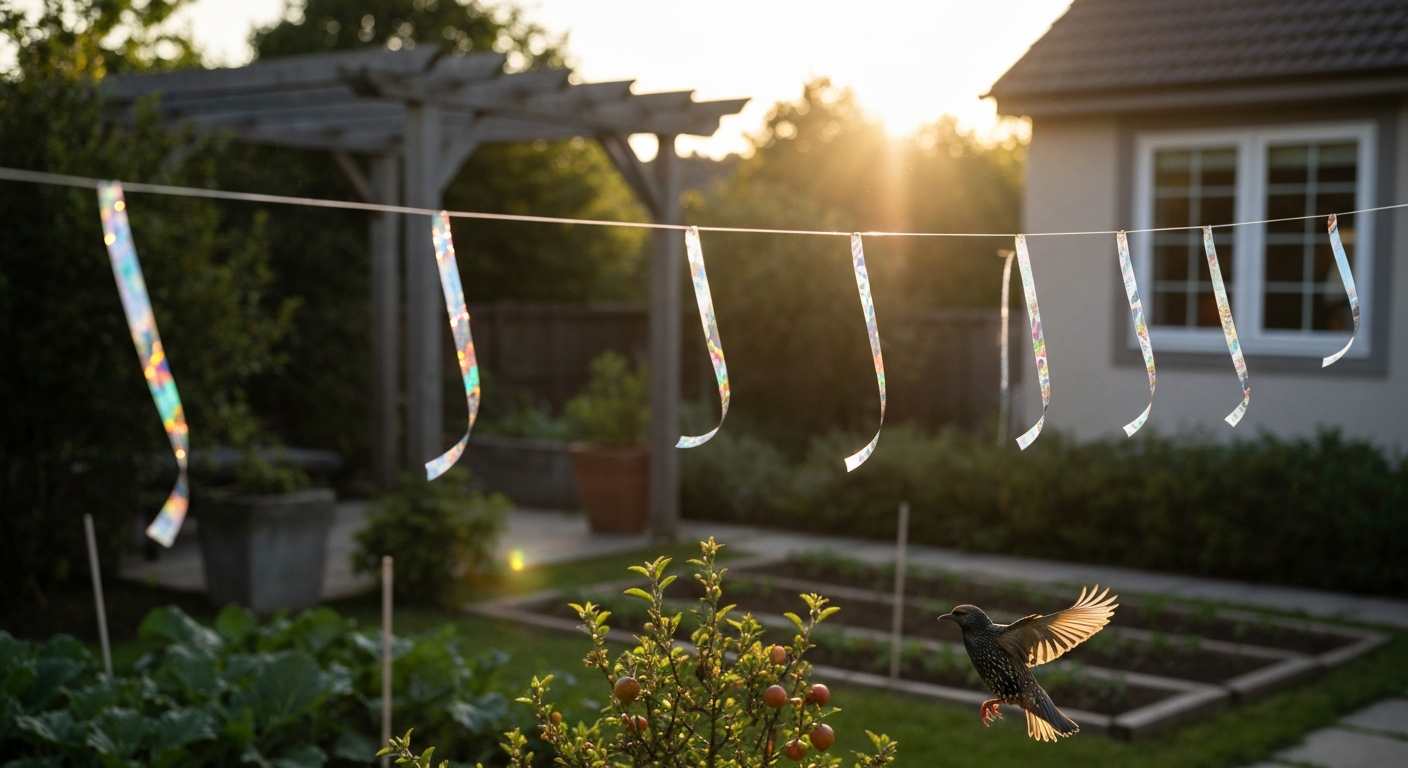
Quick verdict: does bird deterrent tape work?
The research gives a nuanced answer. For a concise practical answer, see the quick verdict on whether reflective bird tape works does reflective bird tape work. For a concise answer to does bird scare tape work, see the quick verdict section that summarizes effectiveness, limitations, and best-use cases. Replicated field trials by Bruggers, Dolbeer and Woronecki found that thin Mylar tape suspended above crops significantly reduced damage by blackbirds, crows and munias in millet, sunflowers and sweet corn. That is a real, measurable result. But later work by Tobin et al. found the same tape failed to deter birds in blueberry plantings, and blank" rel="noopener noreferrer">USDA/NWRC research showed Mylar flags did not stop herring gulls from nesting, though they did reduce loafing at some sites. Transport Canada's TP13029 aviation review concluded reflective tape has occasional, limited usefulness but that the biological basis for long-term effectiveness is weak.
The pattern across studies is consistent: tape produces a strong initial response driven by the novelty of something strange and flashing, but that response fades as birds learn there is no associated danger. University extension hazing manuals are direct about this, noting that habituation typically occurs fairly rapidly for exactly that reason. So the honest answer is: yes, it works, especially early on, for many (not all) species, in open exposed settings, when properly installed. But it needs active management to stay effective. For a concise, practical summary answering does bird tape work, see our short guide on when and how tape is most effective.
What the evidence actually says
- Short-term effectiveness: well-supported by field trials across multiple crop types and pest species.
- Long-term effectiveness: inconsistent; habituation is the primary limiting factor across nearly all reviewed studies.
- Species dependency: pest species like blackbirds and crows respond well initially; gulls show partial or limited responses.
- Setting dependency: open, exposed sites where tape can move freely in wind outperform sheltered or enclosed areas.
- Best practice: systematic reviews recommend rotating or combining tape with other deterrents (multimodal programs) for sustained results.
How bird deterrent tape works, reflective, scare, Mylar and UV mechanisms
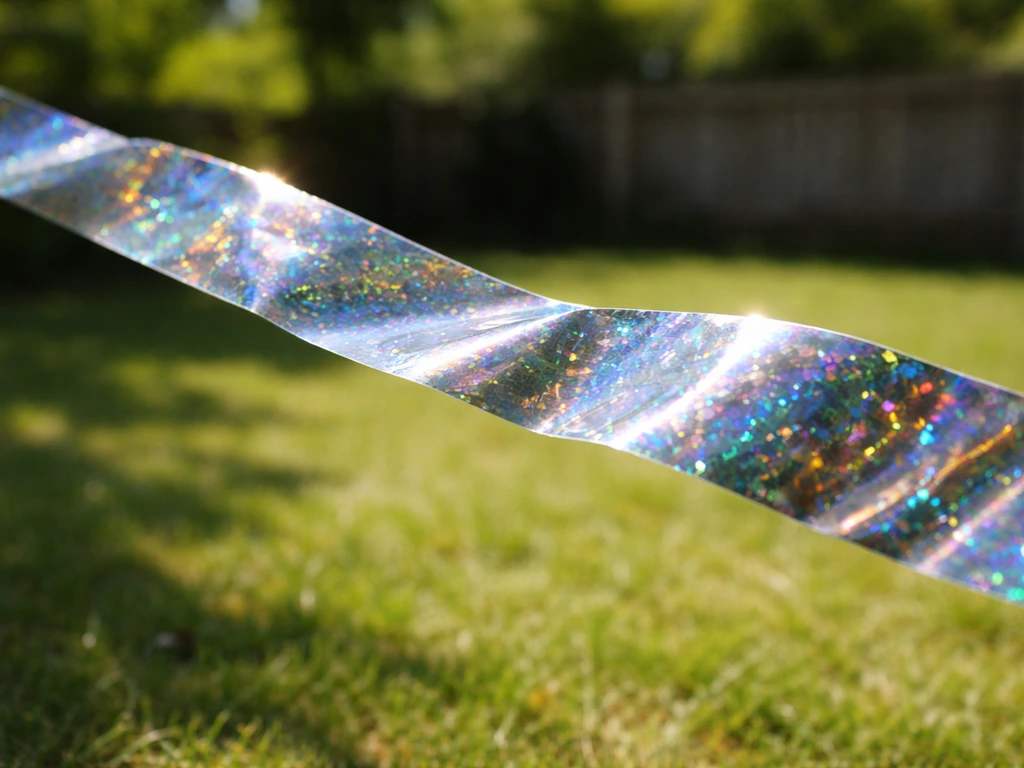
Bird deterrent tape works by exploiting two things birds are naturally cautious about: sudden, unpredictable flashes of light and unfamiliar moving objects. Most deterrent tapes are made from BoPET (biaxially oriented polyester film), the same base material as commercial Mylar. The film is thin, highly reflective, and often printed with holographic or iridescent patterns that scatter and redirect light in multiple directions as the tape twists in wind. From a bird's perspective, this creates a constantly shifting, unpredictable visual stimulus. For a concise explanation of how does bird scare tape work, see our internal guide on the topic.
There is also an auditory component. When wind moves a suspended strip of tape, the film crackles and hums. Manufacturers of products like Bird-X Irri-Tape specifically market this dual visual-plus-auditory effect, and while the crackle is mild compared to dedicated sonic deterrents, it adds another layer of unpredictability that heightens the startle response.
The UV angle is worth understanding separately. Birds are tetrachromatic, meaning they see four color channels compared to the human three, and many species, particularly passerines and shorebirds, are sensitive to ultraviolet wavelengths below 400 nm that are completely invisible to us. Some holographic and iridescent tapes reflect light across a broad spectrum including near-UV. Research into avian UV and violet vision confirms significant interspecific variation, meaning some species will perceive UV-reflective tape as far more visually prominent than it appears to human eyes. This is a legitimate mechanism, though the degree of benefit depends on the exact spectral output of the tape and the UV sensitivity of the target species.
The core limitation of all these mechanisms is the new-object reaction. Birds treat novel stimuli as potential threats, but they habituate quickly when the object does not reinforce that threat with any actual consequence. The flash or crinkle stops being alarming once a bird has approached the tape a few times without anything bad happening. This is why tape alone, left in one place indefinitely, reliably loses effectiveness over time.
Types of bird deterrent tape compared (materials, finish, and formats)
Not all bird deterrent tape is the same. The material, finish, and physical format affect both how it works and how long it lasts outdoors. For recommendations on specific products and what constitutes the best bird scare tape for different situations, see our guide to the best bird scare tape.
| Type | Base Material | Reflective Finish | Auditory Effect | Typical Outdoor Lifespan | Best For |
|---|---|---|---|---|---|
| Standard Mylar/BoPET ribbon | Polyester film | Single-sided or double-sided silver/metallic | Moderate crackle in wind | 3 to 12 months | Crops, gardens, open areas |
| Holographic/iridescent tape | BoPET with holographic laminate | Multi-color prismatic scatter, broad-spectrum including near-UV | Moderate crackle | 6 to 18 months | Patios, balconies, windows, rooftops |
| Flash/scare tape (double-sided) | BoPET, sometimes thicker gauge | Both sides metallic; high-visibility flash | Louder crackle due to thickness | 6 to 24 months | Vineyards, orchards, open roofs, docks |
| UV-specific reflective tape | BoPET or polypropylene with UV-reflective coating | UV-optimized reflectance | Minimal | Varies; coating durability limits lifespan | Window collision prevention, species with strong UV sensitivity |
| Non-reflective scare/visual tape | Plastic or polypropylene ribbon, often red/yellow striped | Minimal reflectance; works by movement only | Low crackle | Up to 2 years (no UV-degrading reflective layer) | Low-light or shaded areas where reflective effect is limited |
Outdoor lifespan is a practical concern that does not get enough attention. BoPET films are reasonably weather-resistant, but UV exposure, mechanical stress from wind cycling, and edge delamination progressively degrade both the optical performance and the physical integrity of the tape. In high-UV coastal or desert climates, a tape rated for 18 months may look dull and tattered within 6 months. UV stabilizers and thicker gauge films extend useful life, but no tape lasts indefinitely outdoors. Budget for regular inspection and replacement.
Which tape type is best for different situations
Matching tape type to the specific problem makes a real difference to results. The key variables are the species involved, the level of ambient wind, the amount of direct sunlight the area receives, and whether the deterrent needs to blend into the environment or can be visually prominent.
| Situation | Recommended Tape Type | Why It Fits |
|---|---|---|
| Open garden or crop row | Standard Mylar or flash tape suspended in rows | Maximum wind movement and flash in open areas; rows create zone coverage |
| Patio, pergola or balcony | Holographic ribbon hung vertically at 2 to 3 ft intervals | Consistent air movement at height; iridescent scatter works at close range |
| Window glass (collision prevention) | UV-reflective tape strips applied to exterior glass at 4-in vertical spacing | Disrupts clear-glass illusion; UV contrast visible to birds approaching at speed |
| Fruit tree or berry patch | Flash/scare tape looped or strung through canopy branches | Irregular movement within canopy catches birds already inside vegetation zone |
| Roof ridge or eaves | Double-sided flash tape pinned along ridge line | Wind exposure at roof level generates consistent movement and sound |
| Gutter or ledge edge | Holographic tape strips secured with UV-stable clips along ledge edge | Low profile; works at perch entry points rather than open area |
| Dock or marina loafing area | Flash tape or Mylar flags on poles at 6 to 10 ft spacing | Supported by gull-loafing field data; open waterside locations maximize flag movement |
| Under solar panels | Tape is a secondary option; mesh/bird guard exclusion is primary | Tape cannot address birds already under panels; physical exclusion outperforms here |
One point worth making clearly: for solar panel installations, physical exclusion (purpose-made bird mesh secured to panel frames) is consistently recommended by installers as the most durable solution. Installer guidance and technical reviews, including Bird Netting, review of exclusion options and installer practice (ScienceDirect Topics), recommend physical exclusion as the most durable solution and warn that poorly designed exclusion can shift perching onto panel surfaces and increase soiling if not planned correctly Bird Netting — review of exclusion options and installer practice (ScienceDirect Topics). Bird droppings on panels can reduce output by measurable margins, with some experimental studies reporting losses in the range of 23 percent or more in heavily affected cases, but tape strung around panel edges does not prevent birds from getting underneath to nest or roost. It may reduce perching on panel surfaces, but if nesting under panels is the real problem, bird guard mesh is the right tool.
Step-by-step installation, spacing and placement
How you hang the tape matters almost as much as which tape you use. Tape tied off at both ends so it cannot move will lose most of its deterrent value within days. The goal is maximum free movement in whatever air currents exist at the site.
- Assess wind patterns at the site before installing. Tape at a sheltered interior courtyard behaves completely differently from tape at a rooftop or open garden bed. Adjust your suspension method accordingly.
- For open area coverage (gardens, crops, patio zones), suspend horizontal lines of thin cord or monofilament across the area at canopy height or just above head height, spaced about 10 to 15 feet apart. Hang vertical tape strips from each line at roughly 3 to 5 foot intervals, cutting strips to 12 to 18 inches so they move freely in light breezes.
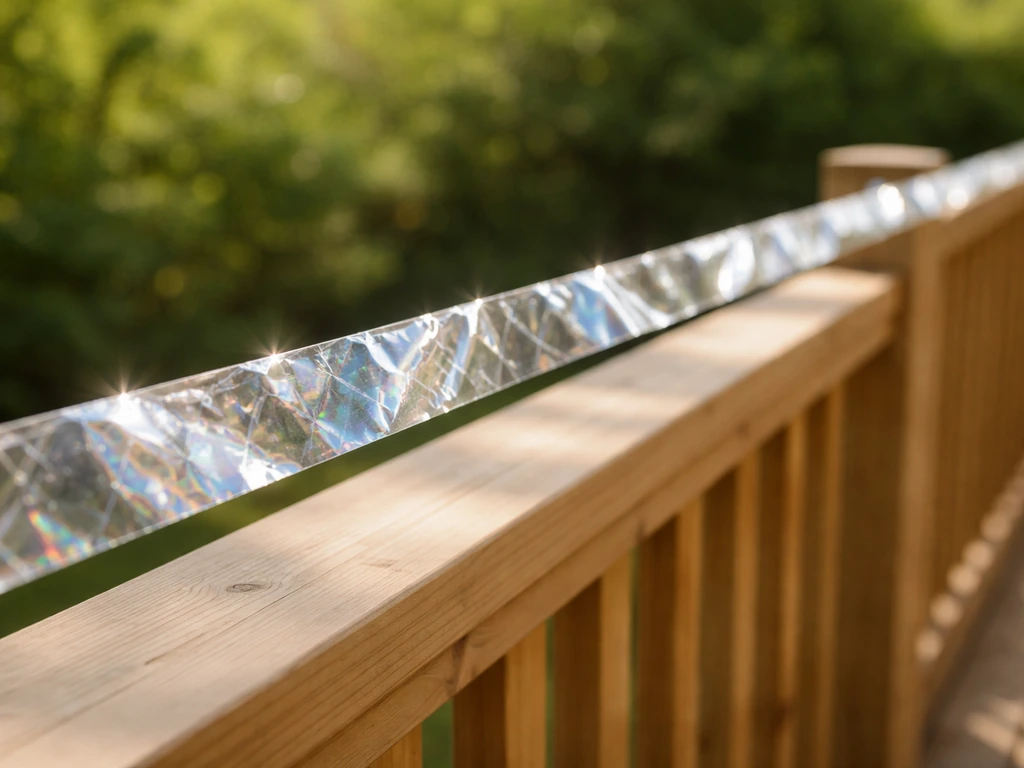
- For vertical surfaces and ledges (railings, beams, eaves), tie strips so one end is fixed and the other hangs free. Twist the tape a few times before securing to increase the rotational movement.
- For windows, apply tape strips to the outside surface of the glass, oriented vertically, spaced no more than 4 inches apart. Horizontal stripes at 2-inch spacing also work. The density of coverage is what prevents collision, not the reflectivity alone.
- Avoid over-tensioning. Tape pulled tight between two anchor points cannot flutter and loses both its visual flash and auditory crackle.
- Move or reposition tape every 2 to 4 weeks. Changing the location, height or pattern is the single most effective way to slow habituation.
- Inspect monthly for UV fading, tearing, tangling or loss of reflective finish. Replace dull or damaged strips promptly, as degraded tape is essentially just visual clutter without deterrent value.
Top use case: patios, balconies and outdoor seating
Patios and balconies are probably the most common residential application, and tape performs reasonably well here for a simple reason: there is usually consistent air movement at balcony height or at the exposed edges of a pergola, and the birds causing problems are typically small-to-medium perching species like pigeons, sparrows and starlings that respond well to visual disruption in the early stages.
The practical approach is to hang holographic or iridescent ribbon at the perimeter of the space, using the railing, overhead beams, or a stretched line of monofilament as anchor points. Strip lengths of 12 to 18 inches hung at 2 to 3 foot intervals give reasonable zone coverage without making the space feel like a crime scene. Keep the lower end of each strip free to move. For covered patios with little natural air movement, small rotating hooks or swivels can add mechanical motion.
Realistic expectations matter here. Most people get 2 to 6 weeks of good results before birds start to return. Rotating the tape positions or supplementing with a visual decoy (hawk or owl silhouette) on an alternating schedule is the best way to extend that window. For persistent patio bird problems, tape works best as one layer in a broader plan that might also include physical spikes on ledges and rails or an ultrasonic unit covering the immediate seating area.
Top use case: windows and glass collision prevention
Window strikes are a different problem from roosting or feeding deterrence, and tape addresses them through a different mechanism. The goal is not to frighten birds away from the window but to make the glass visible to a bird in flight. Clear glass is effectively invisible to an approaching bird, which cannot distinguish a reflection of open sky from actual open sky.
For collision prevention, standard reflective scare tape used loosely on a line is not the right tool. You need tape applied directly to the glass surface to break up the reflection. UV-reflective window tape products are specifically designed for this, applying a pattern that is conspicuous to UV-sensitive bird vision but relatively subtle to human eyes. Plain holographic tape strips work too, but require close enough spacing, typically vertical strips no more than 4 inches apart, to be genuinely effective. Gaps wider than that allow birds to misjudge the opening and still strike.
Applied correctly to exterior glass, tape for collision prevention can be very effective and does not habituate in the same way as area deterrents, because the birds are not learning that a flashing ribbon is harmless. They are simply detecting that the glass surface exists. Keep the tape on the exterior surface, not the interior, and replace it when the adhesive fails or the surface becomes dirty enough to reduce contrast.
Top use case: gardens, fruit trees and ornamental plantings
Gardens are where the original field research on reflective tape was conducted, and the results are genuinely encouraging for short-term crop protection. The Bruggers et al. trials suspended Mylar tape in parallel rows above crops and achieved significant damage reductions in millet, sunflowers and sweet corn. The key was deploying the tape at or just above canopy height so it moved in the same air currents that birds encounter when approaching the plants.
For a typical home garden or small orchard, run lines of monofilament or thin cord across the planted area at roughly 10 to 12 foot spacing and hang strips of double-sided Mylar tape at 3 to 4 foot intervals along each line. Start the deployment about a week before ripening, when birds begin scouting for food. Earlier deployment with nothing worth eating may speed up habituation before the tape is actually needed.
For fruit trees specifically, looping tape loosely through the canopy branches at multiple points adds irregular movement within the tree structure, which birds actively foraging inside the canopy find more disruptive than tape only at the perimeter. Even so, expect to see reduced effectiveness within 4 to 6 weeks and plan to supplement with netting for high-value crops like blueberries and cherries, where the Tobin et al. research found tape alone to be insufficient.
Top use case: roofs, eaves and gutters (nesting and roosting sites)
Rooftops, eaves and gutters present a more challenging deterrence problem because birds are not just passing through; they are selecting these sites for nesting or long-term roosting. The attachment and motivation level is higher, and the tolerance for unfamiliar stimuli is often lower once a bird has committed to a site.
Tape can play a useful early-season role here. Pinning double-sided flash tape along ridge lines or securing strips to eave soffits in late winter to early spring, before nesting season starts, can discourage birds from selecting the site in the first place. Prevention is substantially easier than eviction once a bird has begun nesting. Many species are legally protected during active nesting periods, making deterrence before nest construction the only practical and legal window for action in many jurisdictions.
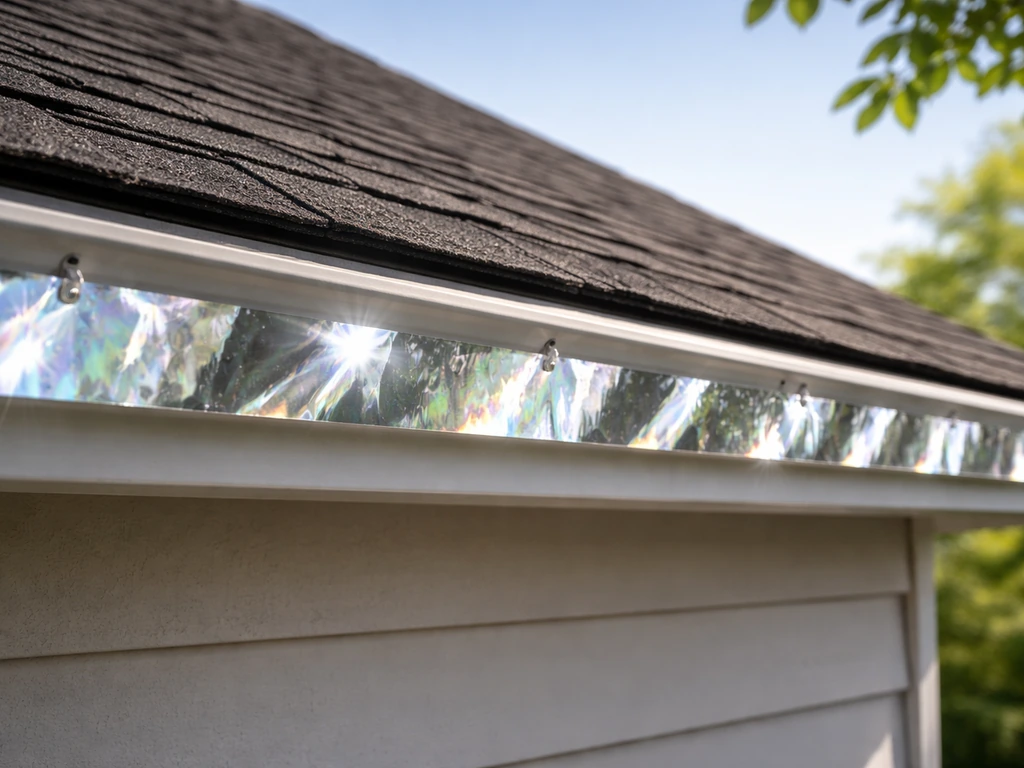
For gutters and ledges, tape at the perch entry points is more effective than tape at a distance. Strips secured to the gutter lip or fascia board at the points where birds typically land and walk reduce the comfort of those specific spots. That said, tape for roosting and nesting suppression almost always needs physical backup. Spikes or coil deterrents on ledges and ridge lines give physical exclusion that tape cannot provide, and netting or bird guard mesh is the correct solution for enclosed eave gaps and gable vents where birds are actually entering.
One broader note on roofs: the USDA NWRC gull research found that Mylar flags reduced loafing on flat roof areas at some sites. If your problem is large birds like gulls or pigeons using a flat commercial roof as a resting area, tape deployed on poles at regular spacing across the roof surface can give measurable short-term results, particularly in the first few weeks of the season. This is consistent with how airport and aviation wildlife programs use tape: as a temporary measure within a broader coordinated program, not as a standalone long-term fix.
Habituation: the main reason tape fails over time
Habituation deserves its own section because it is the single most important factor determining whether your tape installation succeeds or fails over weeks and months. Birds learn. When a stimulus appears repeatedly with no negative consequence, the animal's response diminishes through a process called habituation. The new-object reaction that makes tape effective on day one is the same mechanism that makes it ineffective by week six.
The practical countermeasures are straightforward. Move the tape position every 2 to 4 weeks to reset the novelty response. Swap tape colors or patterns periodically. Combine tape with a second deterrent type on a rotating schedule, for example using tape for two weeks, then switching to a predator decoy, then back to tape in a different configuration. This multimodal rotation approach is what systematic reviews consistently recommend as the most effective long-term strategy. No single deterrent, tape or otherwise, maintains effectiveness indefinitely without some form of variation.
Species-specific effectiveness
Response to reflective tape varies significantly across bird species. Smaller songbirds, blackbirds, crows, and myna species tend to show strong initial startle responses. Pigeons and doves are moderately responsive but habituate relatively quickly, particularly urban birds that are already accustomed to novel objects. Gulls show inconsistent responses: some loafing displacement has been documented, but nesting behavior is not reliably deterred. Raptors and corvids are among the most adaptable birds and may investigate rather than avoid tape.
If you are dealing with a species that has a strong UV sensitivity, such as many passerines and shorebirds, UV-reflective or holographic tape with broad-spectrum scatter may provide stronger deterrence than plain silver Mylar, because the tape appears more visually prominent to those birds. For pest species with limited UV sensitivity, the reflective flash in visible wavelengths is the dominant mechanism, and standard Mylar or double-sided flash tape is sufficient.
How to measure whether the tape is actually working
You do not need sophisticated equipment to evaluate effectiveness. The simplest approach is a before-and-after count: spend 10 minutes at the site at the same time of day (morning, when bird activity peaks) for 3 to 5 days before installation to get a baseline bird count, then repeat the same count for 3 to 5 days after installation. A clear drop in bird presence or activity is a genuine positive result.
For crop or garden applications, photograph damage areas before and after deployment: bite marks on fruit, droppings on surfaces, feathers, and scratched soil are all useful proxy measures. For windows, a simple tally of strike events (birds found dead or dazed below windows) over a few weeks before and after applying tape gives a direct measure of collision prevention effectiveness.
If counts and damage indicators are not improving after two weeks, try repositioning the tape before concluding it does not work at your site. If counts recover after an initial drop, habituation has set in and it is time to rotate or supplement.
Costs, pros and cons at a glance
| Factor | Detail |
|---|---|
| Typical cost per 50-foot roll | $8 to $25 depending on tape type and brand |
| Initial effectiveness | Strong for most species in the first 2 to 6 weeks |
| Long-term effectiveness | Declines without rotation or multimodal support |
| Installation complexity | Low; requires only cord, stakes or clips and scissors |
| Maintenance requirement | Monthly inspection; replacement every 3 to 12 months depending on climate |
| Appearance impact | Visible; some homeowners find it visually intrusive |
| Safety | Physically harmless to birds; no chemicals; no regulatory restrictions in most jurisdictions |
| Limitations | Habituation; species dependency; ineffective in still-air sheltered areas; does not prevent physical nesting or access |
When tape is not enough: complementary and alternative methods
Bird deterrent tape works well as one component of a broader strategy, but there are situations where it is clearly the wrong primary tool. For any location where birds are actively nesting inside a structure, accessing a space through a gap, or roosting on a ledge under daily use, physical exclusion methods are more appropriate as the first line of defense. Spikes and coil deterrents deny access to specific landing surfaces. Netting and bird guard mesh provide complete exclusion from larger areas like under solar panels, in eave gaps, or over berry patches.
Sonic and ultrasonic deterrents add an auditory dimension that tape cannot provide, and rotating sonic deterrents with visual tape on a scheduled cycle can significantly slow the habituation rate compared to either method used alone. Predator decoys, particularly those with moving parts or that can be repositioned, complement tape well because they represent a physical threat object rather than just a confusing visual stimulus.
For aviation and commercial facilities, tape is explicitly classified in wildlife management guidance as a temporary, limited-use tool within a coordinated Wildlife Hazard Management Plan. At airports and large commercial properties, tape should never be positioned as the primary deterrent; it belongs in a toolkit alongside active hazing, habitat modification, and professional wildlife management.
Chemical repellents (applied to surfaces or vegetation) are another option for areas where physical deterrents are impractical, though they require careful selection for surface compatibility and attention to any applicable local regulations. For most residential and small commercial situations, a layered plan of tape plus spikes or netting plus one sonic or visual decoy will outperform any single method used in isolation.
Troubleshooting: why tape might not be working at your site
- Tape is installed too tight: if strips cannot flutter freely, the deterrent mechanism is largely disabled. Re-hang with one end free.
- Site has too little wind: enclosed courtyards, under decks, and heavily sheltered spaces do not generate enough air movement. Add mechanical swivels, use a different deterrent type, or focus on physical exclusion instead.
- Habituation has set in: if the tape has been in the same position for more than 4 weeks without change, birds have learned to ignore it. Reposition and supplement.
- Wrong species for this method: some species, particularly highly urban-adapted pigeons and large gulls, are resistant to visual deterrents in general. Combine with physical barriers.
- Tape has degraded: dull, faded or torn tape has lost its reflective and auditory properties. Replace it.
- Coverage is insufficient: sparse tape coverage leaves large untreated zones that birds simply route around. Follow spacing guidelines and treat the full perimeter of the problem area.
- Deployment started too late: for seasonal problems like crop ripening or spring nesting, deploying tape after birds have already committed to the site is far less effective than pre-season prevention.
FAQ
Core question — does bird deterrent tape work?
Short answer: sometimes. Reflective/mylar/UV bird deterrent tapes can produce measurable short‑term reductions in bird presence or crop damage in some settings and for some species, particularly where movement, flash and UV reflection increase detectability. However, scientific reviews and field trials show results are inconsistent across species and contexts, and tape alone typically loses effectiveness over weeks to months because birds habituate. Best results occur when tape is used as one element of an integrated, rotated program (multimodal control) rather than as a lone, permanent solution.
How does bird deterrent tape work (mechanisms)?
There are three main mechanisms: 1) Visual flash/iridescence — BOPET/Mylar and holographic tapes create bright, shifting flashes that attract attention and can trigger avoidance. 2) UV contrast — some tapes reflect or scatter ultraviolet wavelengths that many birds detect more strongly than humans, making strips particularly conspicuous to species with UV‑sensitive vision. 3) Motion/sound cues — when wind moves the tape it ripples and can produce subtle sound or fluttering motion that simulates a novel stimulus. These mechanisms rely on novelty and conspicuity; they do not convey real danger, which is why habituation commonly occurs.
Types of bird deterrent tape and how they compare
Common types: 1) Standard metallic/holographic Mylar (BOPET) — strong visual flash, widely used, moderate weather resistance. 2) Holographic/iridescent tape — enhances directional flash and apparent motion, often marketed as 'scare' tape. 3) UV‑enhanced tape/UV paint strips — designed to reflect UV; potentially more visible to species with UV sensitivity. 4) Non‑reflective streamers/contrasting colored tape — relies on motion and contrast, less light‑dependent. Comparison summary: reflective/holographic tapes are most effective at initial displacement; UV variants may help with UV‑sensitive passerines/shorebirds; plain colored streamers help in low‑light or when glare is unwanted. Longevity and performance vary by material grade and UV stabilizers — commercial BOPET with UV additives lasts longer than cheap foil ribbon.
Top use cases — where tape works best (patios, windows, gardens, roofs, pools, solar panels, aviation)
Patios & windows: useful short‑term to reduce perching and window‑strike risk when placed above patios/near glass. Gardens & fruit trees: can reduce acute crop damage during vulnerable ripening windows (rows of tape over fruit), but variable by species. Roofs & eaves: can deter loafing in small areas temporarily but birds may relocate nearby. Pools: can discourage gulls/large birds briefly. Solar panels: tape may reduce occasional perching/loafing but is not a reliable long‑term fix for nesting and soiling — physical exclusion is preferred. Aviation/airfields: tape gives limited, short‑term displacement in loafing areas; not recommended as a standalone WHMP tool because habituation and safety concerns limit usefulness.
Step‑by‑step installation guidance (materials, heights, spacing, placement)
Materials: weather‑rated BOPET/Mylar or UV‑enhanced tape, UV‑resistant twine/cord, zip ties or stainless hooks, gloves and ladder. Steps: 1) Identify target zones and species behaviour (roost/perch/feeding spots). 2) Use multiple parallel lines: for orchards/rows, suspend tape rows 1–2 m above crop canopy; in gardens/patios, hang strips 0.5–2 m above ground or directly above vulnerable items. 3) Strip length & spacing — weave 1–3 m long strips tied every 0.5–1.5 m along support, with row spacing 3–10 m depending on area (closer spacing for smaller areas and more pest pressure). 4) Orientation — allow free movement and rotation in breeze for motion and sound; secure ends to prevent fraying. 5) Height for windows — attach strips just above the window frame and extend outwards to interrupt flight paths. 6) For roofs/solar — attach on perimeter rails or above arrays at heights that discourage loafing without touching panels; do not cover modules. 7) Replace or refresh after 3–12 months depending on wear; inspect monthly initially.
Maintenance, replacement and service life expectations
Expect consumer tapes to show noticeable degradation from UV and wind in months to ~2 years depending on product quality and climate. Check monthly for tears, delamination, loss of flash, and fraying; replace when reflectivity or motion is reduced. Use tapes with UV stabilizers for longer life, and trim sharp frayed edges to avoid wildlife entanglement. Store spare strips and rotate placement periodically to reduce habituation.
Next Articles
How Does Bird Scare Tape Work? Setup and Effectiveness Guide
Learn how bird scare tape works, where to install it, how high to hang, and how well it deters birds.
Does Bird Tape Work? What to Expect and How to Use It
Find out if bird tape works, best placements, correct setup steps, why it fails, and what to use if it doesn’t.
Best Bird Scare Tape: How to Choose and Install It
Choose and install the best bird scare tape, know limits, compare options, and troubleshoot for lasting deterrence.