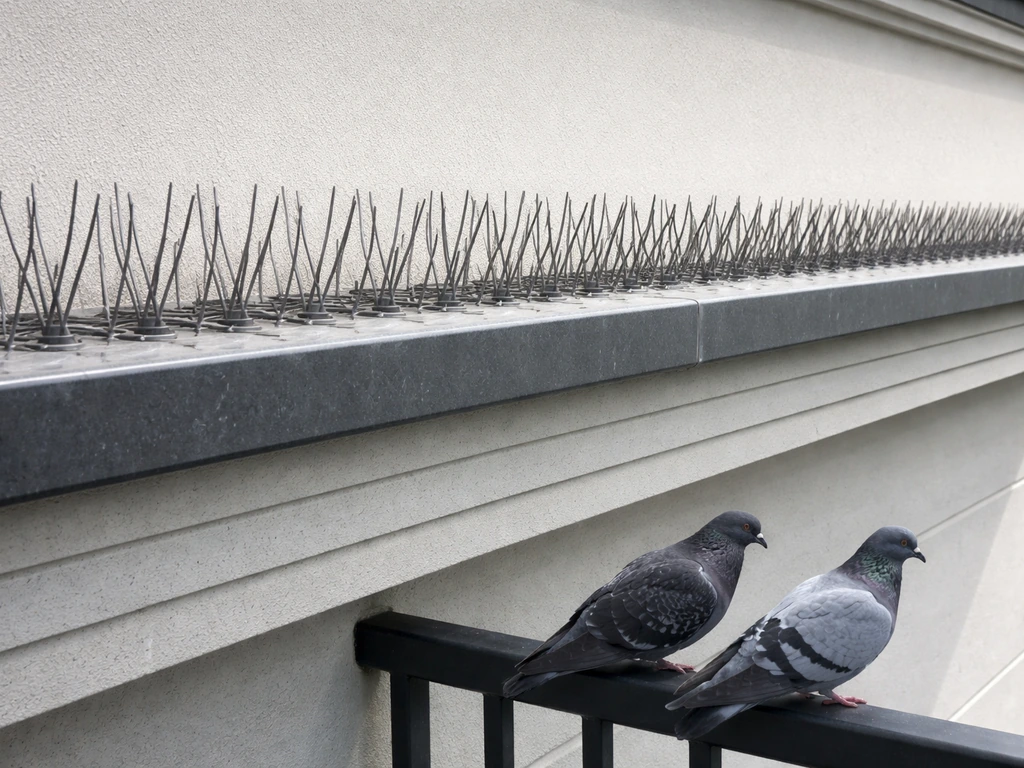
Bird spikes can deter cats from landing on ledges, fence tops, and rooflines, but they are not a guaranteed solution. Cats are agile, tactile animals with strong jumping ability and sensitive paw pads, so the effectiveness of spikes depends heavily on the spike type, coverage width, installation quality, and how motivated a particular cat is to access a surface. In the right configuration, spikes make perching uncomfortable enough that most cats will choose an easier route. In the wrong configuration, a determined cat will simply step around them or jump over them entirely.
do bird spikes work for cats: humane effectiveness & tips FAQ

Marcus Weatherby
12 Jul 2026
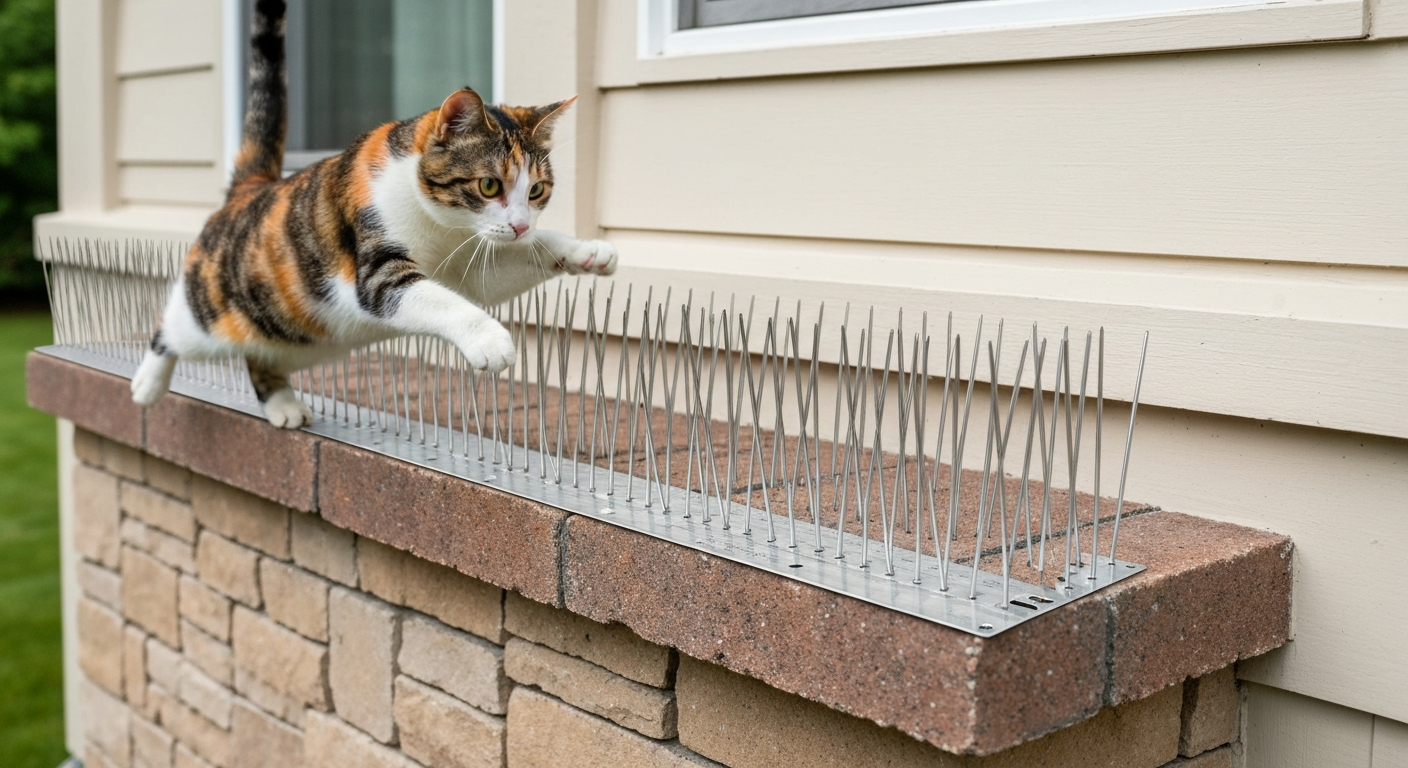
Quick verdict: Do bird spikes work for cats?
Yes, bird spikes work for cats in many practical situations, but with important caveats. See the detailed guide Do bird spikes work for a deeper dive on overall effectiveness and best-use scenarios. Spikes are primarily designed to stop birds from perching, and they do that by removing stable footing. That same principle applies to cats: if a surface is covered with closely spaced, upward-pointing tines, a cat cannot land or walk comfortably on it. The problem is that cats can jump over a spiked zone entirely, squeeze onto narrow unguarded sections, or occasionally press through low-profile plastic strips without serious discomfort. Manufacturer product pages do market certain spike lines as effective against cats and other climbing animals, but there are no peer-reviewed controlled trials specifically testing spikes against domestic cats. What we do have is solid biomechanics research showing cats adjust their paw contact to surface conditions, anecdotal homeowner reports suggesting moderate success, and practical installation principles that can improve outcomes considerably. Used correctly and as part of a layered approach, spikes are a reasonable, humane first line of defense.
How bird spikes work, design intent versus typical cat behavior
Bird spikes work by making a surface impossible to stand or perch on comfortably. Rows of rigid or semi-flexible tines, typically 4 inches (about 10 cm) tall and spaced 1 to 1.5 inches (2.5 to 4 cm) apart, prevent a bird from finding a flat, stable footing. The bird does not get impaled; it simply cannot land cleanly and moves on.
Cats interact with surfaces differently. Research on cat locomotion shows they routinely jump more than 1 to 1.5 metres vertically and have highly precise landing mechanics. Their paw pads are packed with mechanoreceptors (Merkel cells, Pacinian-type receptors) that give them fine tactile sensitivity. When a cat lands on a spike strip, it detects point pressure instantly and will shift weight or abort if the sensation is strong enough. Studies on avoidance learning in cats confirm they can rapidly learn to avoid surfaces consistently associated with unpleasant tactile feedback. The key word is consistently: if the spikes cover a surface fully and reliably poke the paws every time, most cats learn to avoid it. If coverage is partial or the spikes are too soft, the cat may habituate and simply push through.
The design gap is coverage width. A 1-inch-wide spike strip stops a small bird from landing on a narrow ledge. A cat needs far wider coverage because it can land on any unprotected section of a surface, even a gap of 6 to 8 inches is enough. This is the single most common reason spikes fail against cats: insufficient coverage, not an inherent flaw in the spike concept.
Realistic effectiveness: what bird spikes can and cannot stop
Spikes are most effective when the surface a cat wants to access is narrow and fully coverable. A fence top cap, a narrow masonry ledge, or the rail of a balcony are ideal candidates. Covering the full usable width removes stable landing zones entirely.
Spikes are less effective on wide, flat surfaces like patios, flat roofs, or broad garden walls where a cat can land beside the spiked strip or where cost and practicality make full coverage difficult. They also do not address the jump itself: a cat landing from above onto a large unprotected area will simply bypass the spikes.
- Spikes can stop: cats perching on narrow ledges, fence caps, window sills, gutters, and roofline ridges when coverage is complete.
- Spikes can stop: cats walking along a fence line or roofline edge if the full width is covered.
- Spikes cannot reliably stop: cats jumping onto wide flat surfaces where only partial coverage is installed.
- Spikes cannot stop: cats motivated by nesting prey or food if a nearby unprotected route exists.
- Spikes do not address: cats already inside an area (they deter entry points, not open spaces).
Scenario-by-scenario guidance: ledges, rooflines, fences, gardens, patios, and solar panels
Narrow masonry ledges and window sills
This is the best-case scenario for spikes. The surface is narrow, and a 3 to 5 inch wide spike strip will cover the full usable width. Use stainless steel or rigid polycarbonate spikes here for durability. Adhesive mounting works well on smooth masonry. Full coverage means a cat landing attempt results in immediate discomfort and most cats stop returning within a few days.
Rooflines and ridge tiles
Ridge tiles are a popular perch for cats hunting birds nesting in the roof space. Spike strips installed along the full ridge length are effective, but rooftop work requires serious attention to fall protection. OSHA 1926.502 fall protection standards apply to anyone working at height, and I would strongly recommend a professional installer for anything above single-story level. A 3 to 5 inch strip along the ridge cap will cover the perch zone for most ridges.
Fence tops
Fence tops are a very common cat highway. A standard fence cap is typically 3 to 5 inches wide, which matches the width of a single spike strip. The challenge is the full length: cats will find any unprotected gap and use it. Cover the entire fence run, including corners and gate tops. Flexible polycarbonate or stainless steel strips both work here. For added effect, combine with a roller-bar system (more on those below).
Gardens and garden walls
Garden walls are often 6 to 12 inches wide, which means a single spike strip will not cover the surface. Use multiple rows side by side, or switch to a wider-coverage spike product (some manufacturers offer 8-inch wide base strips). For large flat-topped walls, consider roll bars or fence topper rollers as an alternative or complement, since they work on the width problem differently.
Patios
Patios are not suitable for spike coverage as a primary cat deterrent. The surface area is too wide to spike economically, and point-of-entry deterrence at the perimeter fence or wall is more practical. Use spikes on the fence or wall surrounding the patio rather than on the patio surface itself.
Solar panels
Cats sheltering or walking on solar panel rails can cause significant damage to wiring and fixings. Spike strips can be attached to the outer frame rails using adhesive or cable ties, but care is essential: the adhesive must not void the panel warranty, and cables must not be pinched or compressed. Manufacturer guidance should be checked before any installation on panel frames. Purpose-made solar panel exclusion kits (mesh skirting) are often a more appropriate solution for the underside, with spikes reserved for the outer frame edges only.
Types of spikes compared, metal, polycarbonate, flexible strip, and bladeless options
Not all spikes are equal. The material and tine geometry affect both effectiveness against cats and suitability for different environments. Here is how the main types compare.
| Type | Tine stiffness | Typical width options | Durability | Cat deterrence | Best use case |
|---|---|---|---|---|---|
| Stainless steel | Rigid | 1", 3", 5", 8" | Excellent (10+ years) | High — firm tines resist paw pressure | Ledges, rooflines, commercial installations |
| Polycarbonate (rigid base) | Semi-rigid tines | 1", 3", 5" | Good (5–8 years, UV-resistant grades) | Good — adequate point pressure | Residential fence tops, window sills, aesthetics-sensitive sites |
| Flexible plastic strip | Soft/pliable | 2"–4" typical | Moderate (may warp in heat) | Lower — cats may compress tines | Light bird deterrence only; less suitable for cats |
| Bladeless / flat spike mat | Rigid multi-point mat | Varies (tile format) | Good | Moderate — depends on point density and height | Wide flat surfaces, garden walls, shed roofs |
For cat deterrence specifically, stainless steel is my first recommendation. The tines are rigid, they do not compress under paw weight, and they hold up in all weather. Polycarbonate is a solid second choice and blends into lighter-coloured surfaces. Avoid soft flexible plastic strips for cats: they compress too easily and a cat will quickly learn the surface is not actually harmful.
Placement and product-selection criteria
Choosing the right spike product starts with measuring the surface you need to protect and thinking through these criteria before you buy anything.
- Surface width: measure the full usable width the cat can land on, then select a spike width that covers it completely. A 4-inch fence cap needs a 5-inch strip, not a 1-inch strip.
- Surface material: adhesive bonds best to smooth masonry, metal, and uPVC. Rough stone or old timber may need screw-fixed base plates instead.
- Exposure and weather: coastal or high-UV environments need UV-stabilised polycarbonate or marine-grade stainless steel. Standard steel rusts in high-humidity or coastal zones.
- Aesthetics: polycarbonate is nearly invisible at distance on white or grey surfaces. Stainless steel is more visible but generally accepted on commercial or industrial sites.
- Non-target animals: check that the coverage will not trap or injure small birds, bats, or other wildlife in the area. Leave appropriate gap zones where known nesting occurs and never install directly over active nests.
- Cat pressure level: a single resident cat using a fence path occasionally needs lighter deterrence than a stray colony using a ledge as a daily hunting perch. Match product rigidity and coverage density to the pressure.
Step-by-step installation guide
Masonry ledges
- Clean the surface thoroughly with a wire brush and remove all loose mortar, dirt, and bird droppings. Allow to dry completely.
- Measure the ledge width and length. Cut spike strips to length using tin snips (steel) or a hacksaw (polycarbonate base).
- Apply a construction-grade adhesive (such as Loctite Power Grab or equivalent) in a continuous bead along the base of the spike strip. Check the product SDS for handling precautions — many contain eye and skin irritants.
- Press the strip firmly onto the ledge, ensuring tines face upward and the strip is centred on the usable width.
- For ledges wider than one strip, butt multiple strips side-by-side with no gaps wider than 1 inch.
- Allow the adhesive to cure per manufacturer instructions (typically 24 hours) before exposing to weather.
Metal roof ridges
- Plan fall protection before going on the roof. Comply with OSHA 1926.502 or your local equivalent. Use a harness and anchor system for anything above single-story height.
- Clean the ridge cap metal surface with a degreaser and allow to dry.
- Attach spike strips using UV-resistant cable ties through the base plate holes, or use a metal-compatible construction adhesive. Screws are an option on exposed metal roofing but require sealing with roofing-grade sealant to prevent water ingress.
- Cover the full ridge length from end cap to end cap. Leave no unprotected sections.
Fence tops
- Inspect the full fence length for gaps, broken sections, and gate tops that will also need coverage.
- For uPVC or timber fence caps, clean the surface and apply adhesive or screw through the base plate at regular intervals (every 12 inches recommended).
- On wooden fence tops, pre-drill to avoid splitting the timber.
- Cover corners and gate frames separately — these are the gaps cats exploit most.
- For wider timber fence tops, add a second parallel row of strips flush against the first.
Solar panel rails
- Check the panel manufacturer's warranty documentation before attaching anything to the frame.
- Use adhesive-mount strips on the outer-facing rail edge only. Do not obstruct any ventilation gaps.
- Cable ties are a safer attachment method than adhesive on panel frames, as they can be removed without residue.
- For protection of the underside cavity, purpose-made mesh skirting kits are more appropriate than spikes.
Garden walls
- Measure the full top width of the wall. If it is wider than 5 inches, plan for multiple parallel rows.
- Repoint any loose mortar before installation — adhesive will not bond properly to a crumbling surface.
- Apply and cure as per the masonry ledge method above.
- On capped walls with smooth concrete or stone caps, adhesive alone is usually sufficient. On rough or uneven surfaces, screw-fix through base plate holes using masonry anchors.
Patios (perimeter entry points)
- Identify the access points cats are using: typically the top of a surrounding fence or wall.
- Install spikes on those perimeter surfaces rather than on the patio floor.
- For open patios without perimeter barriers, combine with motion-activated sprinklers or ultrasonic devices at ground level for area coverage.
Safety, legal, and animal-welfare considerations
Bird spikes are accepted by organisations like the RSPCA and RSPB as a humane deterrent when correctly installed. The key phrase is 'correctly installed': poorly fitted spikes, or those placed over active nest sites, can injure birds, bats, and small mammals. There are documented cases of animals becoming impaled on poorly installed systems. This is avoidable with proper specification and care.
For cats specifically, the point pressure from well-specified spikes should be uncomfortable but not injurious. Thin, very sharp spike tips on some budget products can cause pad injuries if a cat lands with full body weight. Choose products with rounded or blunted tip geometry where cats are a likely non-target contact. RSPCA guidance emphasises that deterrents should discourage without injuring.
Local regulations matter. In some jurisdictions, causing injury to a neighbour's cat through a deliberate installation could create civil or even criminal liability. In the UK, for example, the Animal Welfare Act 2006 is relevant. In the US, municipal ordinances on feral cat management and property modifications vary widely. Check your local rules before installing any deterrent intended to affect domestic animals.
- Never install spikes over active bird or bat nesting sites. Wait until the breeding season is complete and check for protected species in your area.
- Use signage on commercial or shared-property installations to inform others of the deterrent system, especially where cats belonging to residents may be affected.
- Choose blunted-tip or rounded-tine products when cats are a known contact risk.
- Wear gloves when handling steel spike strips: the tine ends are sharp enough to puncture skin during installation.
- Follow the adhesive product SDS for ventilation and PPE requirements during application.
- For rooftop work, comply with fall protection requirements and do not work alone at height.
Maintenance, monitoring, and measuring success
Spikes are largely passive once installed, but they do require periodic inspection. Adhesive bonds can fail in freeze-thaw cycles or if the surface was not properly prepared. Polycarbonate can become brittle after several years of UV exposure. Debris, bird droppings, and leaf litter can accumulate between tines and create a soft layer that partially fills the spike zone, reducing its effectiveness.
I recommend inspecting installations every three to six months and after any significant storm. Check for: displaced or lifted strips, broken tines, accumulated debris, and any signs of animal entry at previously protected points.
Measuring success is straightforward: are cats still accessing the protected surface? Set a baseline by noting the frequency of access before installation (footprints, droppings, disturbed plants, camera evidence). After installation, re-check after two weeks and again at one month. If cats are still accessing the area, check coverage gaps before assuming the product has failed. In almost every case I have reviewed, renewed access traces back to an unprotected section, not spike failure.
| Inspection item | Check frequency | Action if issue found |
|---|---|---|
| Adhesive bond integrity | Every 3–6 months | Re-apply adhesive; consider screws for permanent fix |
| Tine breakage or bending | Every 3–6 months | Replace affected strip section |
| Debris accumulation between tines | After storms / seasonally | Clear with brush or compressed air |
| Coverage gaps at joins and corners | Monthly (first 3 months) | Add additional strips or angle pieces |
| Signs of cat access (prints, droppings) | Weekly (first month) | Identify access point and extend coverage |
Complementary and alternative cat-deterrent solutions
Spikes work best as part of a layered approach. No single deterrent is 100% effective against a highly motivated cat, and combining two or three methods significantly improves outcomes.
| Method | How it works | Best for | Limitations |
|---|---|---|---|
| Fence roller bars (Oscillot, Cat Fence-In) | Rotating PVC cylinders on fence tops make it impossible for cats to grip and climb over | Fence perimeters, full garden exclusion | Requires installation along full fence length; does not work on all fence types |
| Motion-activated sprinklers (Scarecrow, Orbit) | Infrared sensor triggers a burst of water when movement is detected | Garden beds, patios, open areas | Needs water supply; can affect non-target animals and people; not suitable for rooftops |
| Ultrasonic devices | High-frequency sound triggered by motion; unpleasant to cats | Gardens, patios | Variable evidence; effectiveness may reduce with habituation; affects other animals |
| Netting / physical exclusion | Physical barrier prevents cats from entering an area entirely | Enclosed gardens, fruit cages, ponds, patio perimeters | Requires full perimeter installation; more visible and costly |
| Cat-repellent granules / sprays | Scent-based deterrents (citrus, predator urine, commercial formulas) | Garden beds, specific spots | Short duration; requires frequent reapplication; weather-dependent |
| Spike mats (flat format) | Multi-point plastic mats laid flat on surfaces | Wide flat tops of walls and sheds | Less effective than tined strips for vertical landing; easier to move |
| Plant-based deterrents (Coleus canina, citrus peels) | Natural scent repellents planted or scattered | Garden beds, borders | Low-tech, low-cost, but low reliability; inconsistent |
My typical recommendation for a garden or patio scenario is: spike strips on all fence tops and wall caps (covering entry points fully), combined with a motion-activated sprinkler for open ground coverage. That combination addresses both the climbing access route and the open-area hunting ground simultaneously. For full garden exclusion, fence roller bars are the most robust perimeter solution and often cheaper over the long run than trying to spike every possible surface.
When to call a professional
Most fence-top and ledge spike installations are genuine DIY projects. There are situations, though, where professional help is the right call.
- Rooftop installations above single-story height: fall protection requirements and the complexity of working on pitched or metal roofs make this unsuitable for most homeowners without proper equipment and training.
- Large commercial or industrial sites: consistent coverage across extensive perimeters, gutters, HVAC units, and roof structures benefits from a professional survey and specification to avoid patchy results.
- Aviation facilities: airports and facilities where wildlife management intersects with airfield safety have specific regulatory requirements (FAA guidance applies in the US) and need qualified wildlife management contractors.
- Protected species involvement: if bats, nesting birds, or other protected species are present, any installation near their roost or nest sites may require a wildlife license or survey. A licensed ecologist should be consulted first.
- Listed buildings or heritage structures: adhesive application or screw fixing may be restricted on historic structures. A professional familiar with planning and conservation requirements can advise on approved methods.
Quick do's and don'ts
- Do measure the full width of every surface before buying spike products.
- Do cover the entire length of a fence run or ledge with no unprotected gaps.
- Do use stainless steel or UV-stabilised polycarbonate for outdoor installations.
- Do check for active nests before installation and wait until the breeding season ends.
- Do wear cut-resistant gloves when handling metal spike strips.
- Do use signage on shared-property or commercial sites.
- Don't use soft, flexible plastic strip spikes as a primary cat deterrent — they compress too easily.
- Don't install spikes over active bird or bat nesting sites.
- Don't rely on a single 1-inch strip on a 6-inch wide fence cap and expect cats to be deterred.
- Don't apply adhesive to a dirty, wet, or crumbling surface.
- Don't work on rooftops above single-story height without fall protection.
- Don't assume spikes alone will solve a high-pressure stray cat problem on a wide open surface.
Decision checklist: choosing the right solution for your site
Work through these questions before buying any product. The answers will point you to the right combination of methods.
- What surface are cats accessing? (Narrow ledge, fence top, wide wall, open patio, roofline, solar rail)
- How wide is the surface? If it is wider than 5 inches, will you use multiple rows or a different method?
- How motivated are the cats? (Single resident pet vs. stray colony vs. occasional visitor)
- What is the surface material and condition? (Smooth masonry, rough stone, metal, uPVC, timber, tile)
- What is the exposure? (Coastal, high UV, freeze-thaw, or sheltered indoor/covered area)
- Are there protected species (bats, nesting birds) nearby? If yes, seek ecological advice first.
- What is the budget? (Per linear metre, spikes range from roughly $2 to $10 or equivalent; professional installation adds labour cost)
- Is this a shared property or rental where consent or notification to others is required?
- What is the permanence requirement? (Temporary seasonal deterrence vs. permanent fixture)
- Are aesthetics important? (Polycarbonate for low-visibility; stainless steel for durability over looks)
Other animals and non-target impacts
Any spike installation designed with cats in mind will also affect other animals using the same surfaces. This is worth thinking through deliberately rather than treating as an afterthought.
Pigeons, starlings, and gulls are the primary target species for most commercial spike products. The same installation that deters a cat from a roofline ridge will also keep pigeons off it. This dual benefit is real and worth noting, especially on ledges where pigeon fouling is also a problem. The spike geometry effective against pigeons (4-inch tines, 1 to 1.5 inch spacing) also happens to be the geometry most effective against cats. For a focused discussion on effectiveness specifically against pigeons, see do bird spikes work for pigeons.
Bats are a more sensitive case. Spikes installed near bat roost entry points can obstruct access or, in rare cases, trap bats trying to exit. In many countries bats are protected by law and their roosts cannot be disturbed without a license. If you suspect bats are roosting in the structure, get an ecological assessment before any installation.
Raccoons, squirrels, and other climbing mammals are another consideration, particularly in North America. Some manufacturer literature claims spikes deter raccoons, and the same physical principle applies: removing stable footing. However, raccoons are heavier and stronger than cats, and there is even less formal evidence for effectiveness against them than there is for cats. Wider, taller spike configurations with rigid steel tines are the most likely to create a real barrier.
Further reading and related topics
If you want to go deeper on the mechanics and installation details of bird spike systems generally, the broader topic of how bird spikes work covers the bird-deterrence science and product range in more detail. blank" rel="noopener noreferrer">Responses of Captive Birds to Candidate Perching Deterrents on FAA LLW (Avery & Genchi) reports that studies evaluating spikes, monofilament, cones and combined devices show variable effectiveness by species and device geometry, reinforcing that device design and specification must match the target species and pressure level. For specific bird species, the guides on whether bird spikes work for pigeons and whether bird spikes work for bats examine the effectiveness questions and the important welfare and legal dimensions that apply to those species. If climbing mammals beyond cats are a concern at your property, the guide on whether bird spikes will deter raccoons addresses that scenario directly. See Will bird spikes deter raccoons? for a focused discussion of raccoon-specific effectiveness and recommended spike configurations. For a full overview of physical exclusion approaches beyond spikes, netting guides and sensory deterrent comparisons on this site cover the alternatives that pair well with spike installations in a layered deterrence strategy.
FAQ
Short answer: do bird spikes stop or deter cats — are they effective and humane?
Bird spikes can deter some cats from perching or using narrow ledges, rails and fence tops by removing stable footholds and creating uncomfortable point pressure. They are not guaranteed to stop every cat: motivated, athletic, or persistent cats may jump over, bypass, or tolerate low/misaligned spikes. Properly specified and installed rigid or taller spike systems used exactly where cats land are generally humane when they create avoidance without puncture injury; however poorly chosen, sharp, or badly placed spikes can injure non‑target wildlife or pets.
Which situations are spikes most appropriate for versus inappropriate?
Do use spikes for narrow perching areas where cats land (ledges, narrow fence rails, balcony rails, pipe tops, window sills). Spikes work best where you can fully cover the landing length and create an unbroken anti‑perch zone. Don’t use spikes where cats can simply jump across (wide flat roofs, broad garden walls) without encountering the spikes, where spikes would block escape routes for trapped animals, near active nest sites, or in areas where spikes could snag or injure wildlife, children, or maintenance workers.
How do spikes deter cats differently from how they deter birds?
Spikes remove comfortable, flat footholds and produce unpleasant point pressure under paw pads; birds are often deterred because spikes reduce perching space, while cats rely on grip and footholds for landing and negotiating narrow edges. Cats’ superior jumping skill means they may still reach some areas unless spikes eliminate stable landing points and cover the full approach zone.
Which spike types are best for deterring cats (metal, polycarbonate, flexible, bladeless)?
- Stainless‑steel spikes (rigid, tall): best where long‑term durability and a strong visual/physical barrier are needed; can be effective vs. cats if tall enough and fully covering the landing zone. - Polycarbonate spikes (rigid plastic): effective, lighter and less likely to cause severe puncture; a common humane choice. - Flexible strips (thin plastic wires or strips): may be less effective against determined cats because flexible points can be pushed aside. - Bladeless/monofilament (invisible or low‑profile): good for bird aesthetics but usually insufficient alone against cats. Choose rigid, taller models (4 inch/10 cm or greater) and multiple rows if space allows for better exclusion of larger animals.
Placement and product selection criteria — what to measure and choose?
Checklist: - Measure approach/jump range and available landing depth (vertical drop, horizontal run). - Choose spike height: taller (≈4 in/10 cm) for larger/stronger animals. - Full coverage: spikes must cover the entire landing zone and at least the likely jump landing arc. - Row configuration: use multiple staggered rows on wider ledges. - Material choice: stainless steel for durability; polycarbonate to reduce injury risk. - Attachment method: screws for permanent fixation on masonry/wood; adhesive plus mechanical fasteners on metal/painted surfaces. - Visibility and local rules: check building rules/HOA and wildlife/nesting restrictions before buying.
Step‑by‑step installation tips aimed at reducing cat access
1) Survey exactly where cats land and approach; note jump vectors. 2) Clean surface of dirt/paint flaking to ensure adhesion. 3) Use the right product width and rows so no unprotected gaps remain. 4) For roofs/ledges, mount spike bases flush and seal ends/corners to avoid gaps. 5) Fasten with screws on durable substrates; use outdoor construction adhesive rated for the materials where mechanical fixings are impractical. 6) Avoid sharp protruding ends—trim and cap strip ends. 7) Wear fall protection and follow SDS for adhesives. 8) Test with a pole or object first from the cat approach to verify coverage; monitor for unintended entrapment or wildlife impacts after installation.
Next Article
Do Bird Spikes Work for Pigeons? What Works Best
Learn if bird spikes deter pigeons, how to choose the right spike type, install safely, and when to combine deterrents.