
Bird proofing is the practice of using physical barriers, sensory deterrents, and habitat changes to stop birds from perching, roosting, nesting, or entering a structure. The goal is not to harm birds but to make a space unattractive or inaccessible to them permanently. Done well, it removes the problem at the source rather than repeatedly scaring birds away.
What Is Bird Proofing: Guide for Homes, Solar & Property

Marcus Weatherby
18 Jul 2026
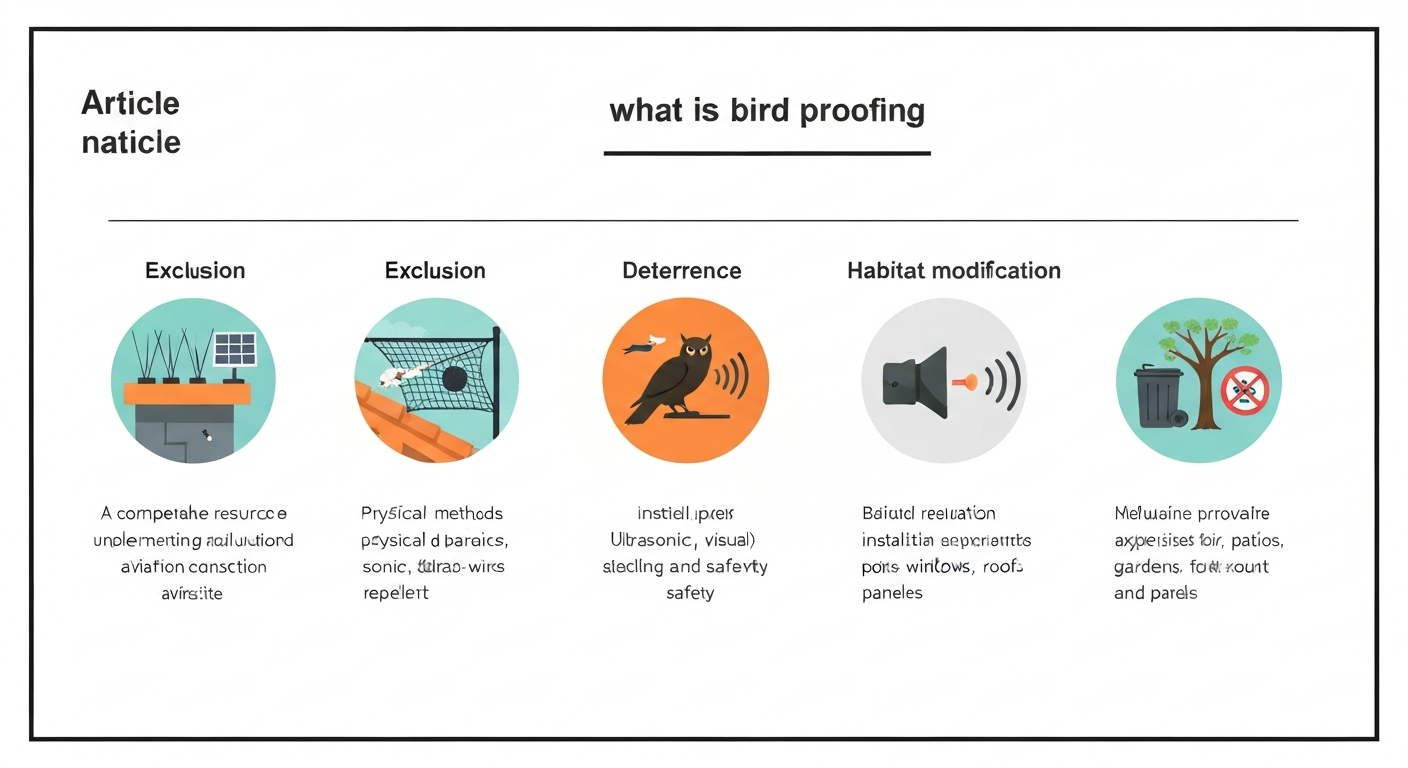
What bird proofing actually means
The term covers three overlapping strategies: exclusion (physically blocking access), deterrence (making a spot unpleasant or alarming), and habitat modification (removing whatever draws birds in the first place). Pest and facility managers draw a useful distinction between proofing and dispersal. Proofing means closing the gap, covering the surface, or blocking the cavity so a bird simply cannot get in. Dispersal means using sound, light, or visual triggers to chase birds off temporarily. If you want a near-zero bird result that holds up over time, exclusion is the foundation. Dispersal alone rarely lasts because birds are smart enough to figure out that a plastic owl or a recorded predator call poses no real threat.
The most common nuisance species in urban and residential settings are feral rock pigeons, European starlings, house sparrows, gulls, and corvids like crows and ravens. Each has different habits that determine which methods actually work. Pigeons, for example, are strongly attached to established roost ledges and will return repeatedly unless access is physically blocked. Starlings and house sparrows exploit building cavities and eaves. Gulls nest on flat roofs and associate buildings with easy food. Matching your method to the species and the specific behavior is what separates effective bird proofing from wasted effort.
Why bird proofing matters
Bird damage is more serious and more varied than most people expect until they have dealt with it directly. The problems break down into three categories: structural damage, health risks, and operational hazards.
Structural and property damage
- Bird droppings are highly acidic and degrade concrete, stone, paintwork, metal, and rubber roofing membranes over time.
- Nesting material in gutters, dryer vents, or HVAC intakes blocks airflow and drainage, leading to water damage or fire risk.
- Pigeons and starlings nesting under solar panels create debris buildup and can void manufacturer warranties by restricting ventilation.
- Gull and corvid nesting on flat roofs can block drains and add significant weight load to membrane roofing.
- Birds pecking at rubber seals around skylights, roof lights, or pipe boots can cause water ingress.
Health and safety risks
The CDC identifies bird droppings as a significant health hazard. Histoplasma capsulatum, the fungus that causes histoplasmosis, thrives in accumulated droppings, particularly from pigeons and starlings, and becomes airborne when dry material is disturbed. Psittacosis, a respiratory illness caused by Chlamydia psittaci, spreads through inhalation of dried droppings or secretions and carries occupational risk for anyone handling contaminated material. The practical takeaway: accumulated bird waste should never be dry-swept or blown with compressed air. Wet it first, wear an N95 or better respirator and disposable gloves, and bag the material. Better still, prevent accumulation in the first place.
Aviation hazards
For airports and airfields, bird strikes are a safety-critical issue. The FAA requires airports to conduct blank" rel="noopener noreferrer">Wildlife Hazard Assessments and, where risks are significant, to develop formal Wildlife Hazard Management Plans. ICAO and ACI provide internationally aligned guidance on bird-strike reporting and hazard reduction. The financial and safety stakes here are orders of magnitude higher than a pigeon problem on a rooftop, but the core principle is the same: remove attractants, exclude birds from critical areas, and use integrated methods rather than a single tactic.
Legal and wildlife-welfare rules you need to know
Before you install anything or touch a nest, you need to understand the legal framework. Getting this wrong can result in fines or criminal liability, not just a failed deterrent.
United States: the Migratory Bird Treaty Act
Under 16 U.S.C. Section 703, it is unlawful to take, kill, possess, transport, or disturb most native migratory birds, their eggs, or active nests without a permit. The US Fish and Wildlife Service administers permits and strongly recommends nonlethal exclusion and deterrence as the preferred approach. The practical implication: if you find an active nest (one with eggs or live chicks) in a location you want to bird proof, you generally need to wait until the nest is no longer active before removing it or installing exclusion. Proofing before nesting season is far simpler.
Worth noting: feral rock pigeons, European starlings, and house sparrows are not native species and are not protected under the MBTA, which gives you more flexibility in managing them. But if gulls, swallows, swifts, or other native migratory birds are involved, check with your local wildlife agency before acting.
European Union: the Birds Directive
In EU jurisdictions, Directive 2009/147/EC requires member states to protect wild birds, their nests, eggs, and habitats. Any bird control activity must comply with both the Directive and the national laws that implement it. The practical effect is similar to the MBTA: physical exclusion and nonlethal deterrence are the safest legal approaches, and interfering with active nests is generally prohibited without specific authorization.
Humane practice regardless of jurisdiction
Welfare organizations including the RSPB and Audubon consistently recommend exclusion and habitat modification over lethal methods. Beyond the legal requirement, this is also simply the most effective long-term approach. Lethal removal without exclusion creates a vacancy that new birds quickly fill. Block the access point and remove the attractant, and you solve the problem rather than cycling through it repeatedly.
When to bird proof: timing and seasonal cues
The best time to install bird proofing is before birds have established a roost or nest in the target location. Once a site is established, especially a pigeon roost, birds are highly motivated to return and much harder to displace. As a general rule, work ahead of the main nesting season in your region. In most of the US and Europe, that means completing installation in late winter or very early spring, before February or March activity picks up.
If birds are already present but have not yet nested, act immediately. If there is an active nest with eggs or chicks, check your local legal obligations before proceeding. In most cases you will need to wait until the nest is vacated, then install exclusion immediately after so the site is not reused.
Priority areas to address first are any that combine warmth, shelter, and proximity to food or water: roof cavities, soffits, solar panel undersides, chimney openings, dryer vents, HVAC intakes, loading dock overhangs, and flat roof plant rooms. For typical costs and system options, see our guide on how much to bird proof solar panels. These are the locations birds find most attractive and where accumulation of droppings or nesting material causes the most damage.
Who needs bird proofing
Bird proofing is not a niche product for specialist facilities. The range of people who genuinely need it is broad:
- Homeowners dealing with pigeons or starlings on rooftops, in roof spaces, or nesting under solar panels — a problem that compounds quickly and affects property value and roof longevity.
- Property managers and building owners responsible for commercial or multi-unit residential buildings, where gull or pigeon activity on flat roofs, ledges, and loading bays creates liability and maintenance costs.
- Solar installers and solar panel owners, where birds nesting beneath panels are one of the most common warranty and performance complaints in the industry.
- HVAC technicians and dryer-vent owners, where starlings and sparrows routinely nest inside vent ducts, blocking airflow and creating fire risk from accumulated lint and nesting material.
- Gardeners and smallholders protecting fruit crops, vegetable beds, and seed trays from corvids, pigeons, and smaller seed-eating birds.
- Facility managers at warehouses, food processing sites, and retail centers where bird ingress triggers hygiene compliance failures.
- Airport operators and airfield managers where formal wildlife hazard management is a regulatory requirement tied directly to flight safety.
Bird-control methods: a quick overview
Bird proofing draws on several categories of control. They work best when used in combination rather than in isolation, what professionals call an integrated approach. Here is what each category involves and where it fits.
Physical barriers and exclusion
These are the highest-reliability methods: spikes, netting, wire systems, screens, one-way doors, and mesh guards. They physically prevent birds from landing, roosting, or entering a space. Unlike deterrents, they do not rely on a behavioral response from the bird and they do not degrade in effectiveness over time due to habituation. Properly installed exclusion on solar panels, dryer vents, and roof cavities is considered the most effective long-term solution by pest management and wildlife management professionals alike.
Sensory deterrents
Visual deterrents (reflective tape, predator decoys, hawk kites, holographic pinwheels) and auditory deterrents (broadcast predator calls, distress calls, propane cannons) can provide short-term relief in open areas like gardens and agricultural settings. Birds habituate to static or repeated stimuli relatively quickly, so these need to be moved, varied, and combined with other methods to maintain any effect. Laser devices have shown some effectiveness in dispersing roosting birds at dusk and dawn in controlled conditions, but results are species-specific and beam visibility is critical. Ultrasonic devices marketed for bird control have very weak evidence behind them: most birds hear in the same range as humans and simply do not respond to ultrasonic frequencies. A review concluded High‑frequency sound devices lack efficacy in repelling birds, study/review (University of California repository), noting birds often cannot hear ultrasonic ranges and habituate to such sounds High‑frequency sound devices lack efficacy in repelling birds — study/review (University of California repository).
Chemical and taste repellents
Polybutene-based sticky gels make surfaces uncomfortable to land on. Methyl anthranilate (a grape-derived compound) is registered as a bird repellent for turf and water areas and can be effective for geese and some other species. These products have legitimate uses but require reapplication, can attract debris, and may affect non-target wildlife. They are generally best used as a supplement to physical exclusion rather than a standalone solution.
Habitat modification
This is the most underused and often the most important lever. Remove what attracts birds and many problems reduce on their own. Secure bins and dumpster lids, eliminate standing water, trim overhanging vegetation that provides roosting cover, and stop any direct or indirect feeding (including dropped food around outdoor dining areas or staff entrances). Habitat modification does not replace barriers but it dramatically improves their effectiveness.
Physical barriers in detail
Physical barriers are where most bird proofing budgets should be concentrated, because they deliver lasting results. Here is a closer look at the main options, how they work, and where they fit best.
Bird spikes
Spikes are rows of upward-pointing stainless steel or UV-stabilized polycarbonate rods attached to a base strip. They make flat ledges, gutters, window sills, and signage impossible to land on without causing discomfort. They do not injure birds but deny them a landing platform. Stainless steel spikes are more durable and weatherproof; polycarbonate versions are lower cost and less visible but can yellow and become brittle after several years of UV exposure. Spike width matters: narrow-based strips for thin ledges, wider bases for broad parapet walls or flat coping. Spikes are less effective in deep recesses where birds can land behind them, and they provide no protection against small birds like sparrows that can squeeze between the rods.
Exclusion netting
Netting is the most versatile exclusion system and the most effective for complex or large areas. UV-stabilized polypropylene, HDPE, or PVC-coated metal mesh netting can be tensioned over courtyards, loading bays, entire roof sections, solar arrays, fruit cages, and building facades. Mesh size is critical: 50mm (2 inch) mesh excludes pigeons but not sparrows; 19mm (3/4 inch) is needed for smaller species. For solar panel bird proofing specifically, PVC-coated steel mesh clip systems from brands like BirdBlocker, Bird-B-Gone, and SolaTrim are designed to attach directly to panel frames without drilling, creating a sealed perimeter that prevents nesting underneath. Properly installed netting with no gaps is the single most reliable way to achieve a near-zero bird result on a structure.
Tension wire and post systems
Parallel wires tensioned above a ledge at 8 to 10 cm (about 3 to 4 inches) prevent larger birds like pigeons and gulls from landing but are less effective for smaller birds. These systems are visually discreet and often used on heritage buildings or architectural stonework where spikes would be obtrusive. They require professional installation to set the correct tension and post spacing, and they need periodic inspection as wires can sag or corrode at anchor points.
One-way doors and cavity screens
For birds already roosting inside a roof space, loft, or cavity, one-way exclusion devices allow birds to exit but not re-enter. These are typically used during the period between nesting seasons when no active nest is present. After all birds have exited, the one-way device is removed and the opening permanently sealed. For smaller openings like dryer vents and HVAC intakes, mesh bird guards serve the same function: they allow airflow while preventing bird entry. For step-by-step guidance on measuring and fitting a mesh dryer-vent bird guard, see how to install dryer vent bird guard. For detailed product options and installation tips, see a guide to the best bird proof dryer vent solutions that compares vent guards, mesh screens, and one-way flaps. These are sometimes called dryer vent bird guards and are a straightforward DIY fix for one of the most common household bird problems. For simple DIY options and buying advice, see the best dryer vent bird guard b47cb9af-f53d-40d9-9f28-f34a6abc3280.
Comparison of physical barrier types
| Barrier type | Best for | Effective against | Lifespan | DIY-friendly | Limitations |
|---|---|---|---|---|---|
| Bird spikes (stainless steel) | Ledges, gutters, sills, signage | Pigeons, gulls, corvids | 10+ years | Yes | Ineffective in deep recesses; not for small birds |
| Bird spikes (polycarbonate) | Low-budget ledge protection | Pigeons, gulls | 3–5 years | Yes | UV degradation; shorter service life |
| Exclusion netting (polypropylene/HDPE) | Large roof areas, courtyards, solar arrays, fruit cages | All species (mesh-size dependent) | 7–15 years | Partial (professional tensioning recommended for large spans) | Requires proper tensioning; gaps reduce effectiveness; must check for entanglement risk |
| PVC-coated mesh (solar clip systems) | Solar panel perimeters | Pigeons, starlings, sparrows | 10+ years | Yes (clip systems) | Panel-specific sizing needed; leaves gaps at complex layouts without careful fitting |
| Tension wire systems | Heritage buildings, wide ledges, parapets | Pigeons, gulls | 5–10 years with maintenance | No (professional install recommended) | Not effective for small birds; requires tension checks |
| One-way exclusion doors | Occupied roof spaces, lofts, wall cavities | Pigeons, starlings, sparrows | Single-use (then seal opening) | Yes (for accessible openings) | Cannot be used when active nest is present |
| Mesh vent guards / dryer-vent guards | Dryer vents, HVAC intakes, weep holes | Starlings, sparrows, house martins | 5–10 years | Yes | Must be compatible with vent diameter; check airflow clearance |
Choosing the right physical barrier
The decision mostly comes down to three factors: the species causing the problem, the surface or structure involved, and your budget for upfront installation versus long-term maintenance. Spikes are the fastest and cheapest fix for open ledges with larger birds. Netting is the most comprehensive solution for complex structures or mixed-species problems. Vent guards and solar clip systems are highly specific products that solve well-defined problems and are generally straightforward to install yourself. If in doubt, start with exclusion at the highest-priority entry points and add sensory deterrents in the open areas around them.
Cost is a factor worth planning around carefully. Product and installation costs vary significantly by surface area, access difficulty, and whether you need professional installation. Dryer vent guards are a low-cost DIY item, while full netting of a commercial flat roof can run into thousands of dollars or pounds depending on the size and system used. For detailed estimates on how much does bird proofing cost, see our cost guide. Detailed cost breakdowns for specific scenarios including solar panel bird proofing are worth researching separately before committing to a solution.
FAQ
What is bird proofing and what are its primary goals?
Bird proofing (bird‑proofing) uses exclusion (physical barriers), deterrence (visual, auditory, sensory), and habitat modification to prevent birds from perching, roosting, nesting, or entering structures. Goals are to protect people and property, reduce health and safety hazards (droppings, slips, disease, fire risk), prevent structural damage and downtime (roofing, vents, solar arrays), and do so legally and humanely.
When should I consider bird proofing my property?
Consider bird proofing when you notice persistent roosting, nesting, droppings, clogged vents, damage to equipment (solar panels, HVAC), audible/visual nuisance, bird‑strike risk (airfields), or public‑health concerns. Also proactively for new installations (solar arrays, vents, building retrofits) and where local species behaviors (pigeons, starlings, gulls, corvids) create recurring problems.
What legal and welfare issues should I be aware of before acting?
Many native migratory birds, their nests and eggs are protected (e.g., U.S. Migratory Bird Treaty Act; EU Birds Directive). Disturbing or removing active nests can be illegal without permits. Always check national/local wildlife laws and avoid lethal or nest‑disturbing actions during breeding season; prefer nonlethal exclusion and consult wildlife agencies if unsure.
What are the main categories of bird‑control methods and how do they differ?
Three main categories: 1) Physical exclusion — spikes, netting, ledge covers, vent guards, mesh under solar panels; provides long‑term exclusion and is best for near‑zero solutions. 2) Sensory deterrents — visual (scare balloons, reflective tape, predator decoys), auditory (pyrotechnics, distress calls), lasers; tend to provide short‑term relief and birds can habituate. 3) Chemical repellents — taste/visual coatings and gels; limited use, species‑dependent, and require safe, approved products. Integrated approaches combining exclusion, habitat modification and selective deterrents work best.
Which physical products are most effective for homes, roofs and ledges?
Top physical options: stainless steel bird spikes for narrow ledges and signs; tight‑fitting bird netting or mesh for balconies, soffits and under eaves; metal or PVC ledge covers, and one‑way exclusion flaps for roof cavities. Use products rated for the species and exposure; ensure spikes are mounted flush and netting is taut and anchored to prevent entanglement.
What are the best solutions for bird proofing solar panels?
Effective solar protections: purpose‑made solar panel guards/skirts using UV‑stabilized polypropylene or stainless steel mesh, under‑panel wire‑mesh cages, and framed clip systems (BirdBlocker, Bird‑B‑Gone/SolaTrim). Netting or mesh should be installed with adequate clearance to allow panel airflow while preventing access underneath; avoid adhesives that void warranties; choose UV‑stable materials and professional kits when possible.