The best bird trap ever is the one matched to your specific bird, location, and goal. A walk-in funnel trap loaded with millet works brilliantly for house sparrows on a patio but does nothing for pigeons roosting under solar panels. A one-way exclusion door solves a starling nest in your eaves without any handling at all. Before you buy or build anything, you need to answer three questions: which bird, where exactly, and do you want to capture/relocate it or just stop it from entering? Everything else follows from that.
Best Bird Trap Ever: Choose and Set It Humanely Safely

Marcus Weatherby
5 Jun 2026
Start here: identify your bird, location, and actual goal
Getting this right saves you a lot of wasted effort. The most common problem birds in residential and commercial settings are house sparrows, European starlings, feral pigeons, and blackbirds (common grackle, great-tailed grackle). Each has different habits, different preferred baits, and different trap responses.
- House sparrows: small, bold, ground-foraging birds that cluster around patios, garages, and any structure with gaps or ledges. They eat millet, milo, and sunflower seed readily.
- European starlings: fast-moving, flock-oriented birds that nest in building eaves and window ledges, typically 6 to 60 feet off the ground. They are opportunistic feeders and can outcompete smaller birds.
- Feral pigeons: larger birds that favor broad ledges, parapets, signs, beams, and the underside of solar panels. They are persistent roosters and their droppings accumulate fast.
- Blackbirds and grackles: often a commercial or agricultural problem, congregating in large numbers around dumpsters, loading docks, and open grain areas.
Your goal matters just as much as the species. Capture and relocation is one approach, but it is worth knowing upfront that wildlife authorities including the North Carolina Wildlife Resources Commission consider relocation not particularly humane or effective for resolving wildlife conflicts, because birds often return or simply displace the problem elsewhere. Exclusion (blocking entry permanently) is usually the more lasting fix. In many cases the best trap ever is actually a one-way door or a net that prevents re-entry, not a live-catch cage. If you are still searching for the best bird trap in the world, start by considering a one-way door or net that prevents re-entry, since in many real situations that is what works longest. If you tried an OSRS bird snare and it still isn't working, the placement and target bird match are usually the real culprits, not the snare itself live-catch cage.
Legality and safety check before you do anything
This part is not optional. The Migratory Bird Treaty Act (MBTA) makes it unlawful to pursue, hunt, take, capture, kill, or possess migratory birds without authorization. The Migratory Bird Treaty Act is codified at 16 U.S.C. § 703 and generally prohibits pursuing, hunting, taking, capturing, killing, attempting to do so, or possessing migratory birds unless permitted by regulation The Migratory Bird Treaty Act (MBTA) makes it unlawful. The definition of 'take' under MBTA regulations explicitly includes trapping and capture. Most songbirds, including house sparrows and starlings in some interpretations, fall under this umbrella depending on regulatory updates, so check current USFWS guidance before setting any trap.
The practical safe list for unregulated trapping is short. Feral (non-native) rock pigeons, European starlings, and house sparrows are generally not protected under the MBTA and can be trapped without a federal permit. But state regulations vary, so always verify with your state wildlife agency before proceeding. For any native migratory bird, you need a permit.
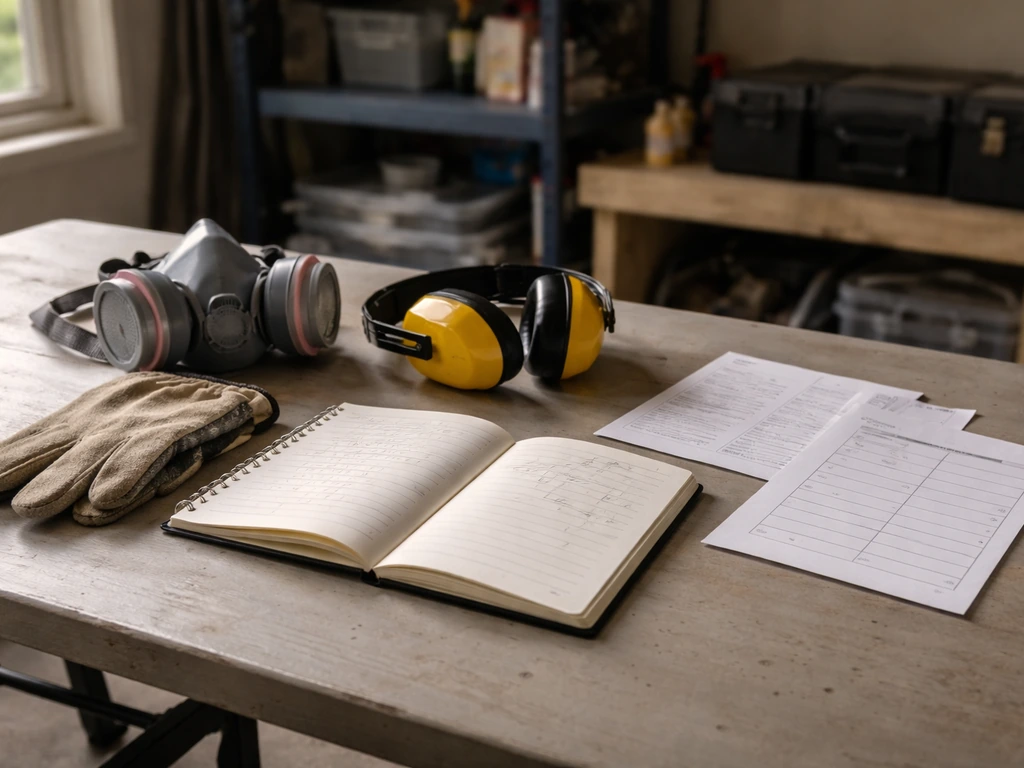
On the handling and health side, bird droppings carry real disease risk. Large accumulations of starling or pigeon droppings in soil can create histoplasmosis risk. When cleaning any trap or roosting area, wear gloves and a properly rated mask, avoid stirring up dry droppings (wet them down first), and never handle droppings with bare hands. Wash and disinfect traps after each capture, especially if you suspect a sick bird.
Avoid glue traps entirely. They are indiscriminate, catching non-target birds and other animals, and wildlife rehabilitators consistently report serious injuries from them. Deadfalls and snares are prohibited for wild birds in many states, including explicit rules in places like Virginia. Deadfalls and snares are prohibited for wild birds in many states, including explicit rules in places like Virginia. Stick to live-capture or exclusion approaches.
Best trap types by situation
There is no single universal trap. Here is how the main categories break down by situation.
Residential: patios, gardens, eaves, and windows
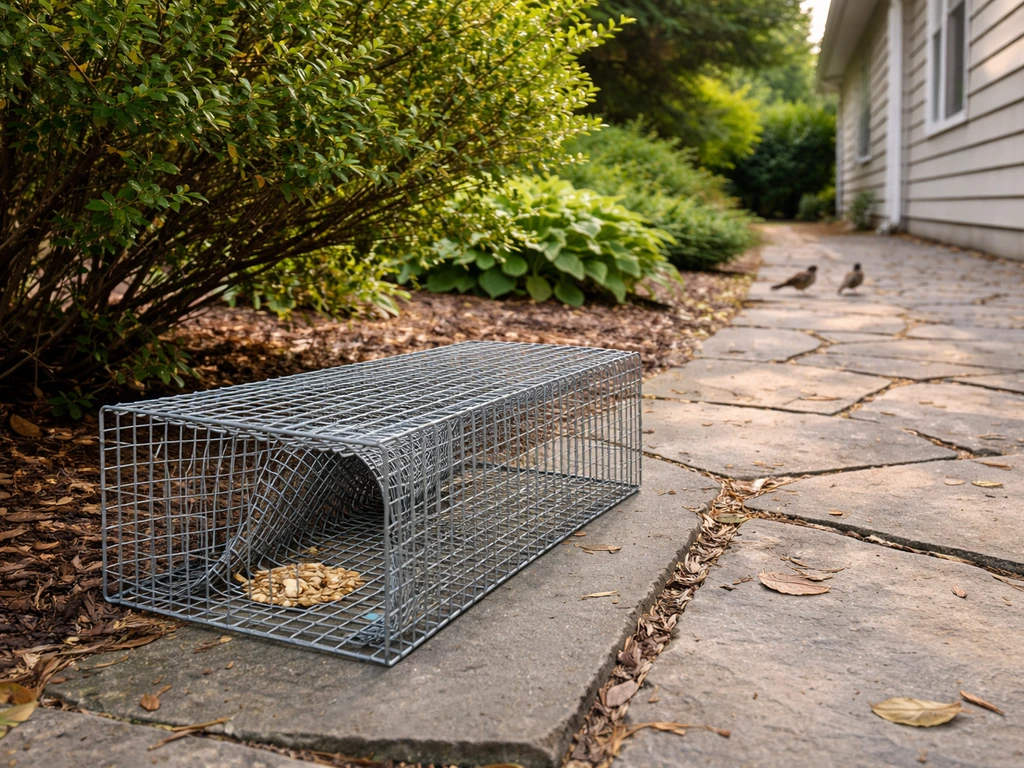
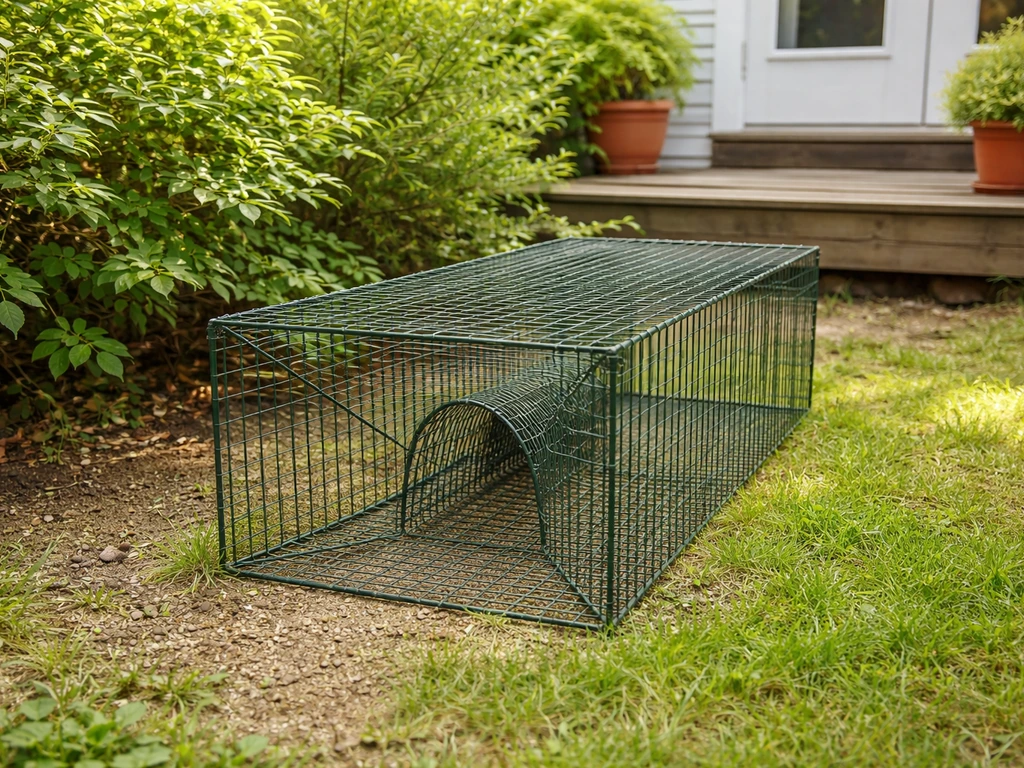
For small birds like sparrows around a patio or garden, a walk-in funnel trap (also called a sparrow or starling trap) is the most practical live-capture option. These are wire cage traps with an inward-facing funnel entry. Birds walk in following bait and have difficulty finding the exit. They are effective for single captures or small groups.
For starlings nesting in eaves, a one-way exclusion door attached directly over the entry point is often the cleanest solution. The bird exits, cannot re-enter, and you seal the gap permanently after confirming the space is empty. This avoids handling entirely. Maine IFW specifically recommends using visual verification to confirm animals have left before final sealing.
For pigeons on ledges, solar panels, or under roof overhangs, physical exclusion with bird netting is almost always more effective than trapping. Pigeons are too large and wary for most small cage traps, and they return persistently unless access is physically blocked.
Commercial: rooftops, loading docks, and building eaves
Commercial settings with starling or blackbird infestations often involve flocks, not individual birds. USDA APHIS notes the damage from large congregations includes significant health and property hazards from droppings at industrial sites, with large cleanup costs. At this scale, trapping individuals is rarely the right primary strategy. Large walk-in cage traps baited with grain and water can capture multiple birds at once, but this typically requires professional wildlife control operators with proper permits and equipment.
Exclusion using netting, bird coil wire, and spikes to deny access to ledges and parapets is the USDA APHIS-recommended core approach for commercial bird control. Trapping is used as a supplemental tool, not the main solution.
Aviation-adjacent and high-risk areas
Bird management near airports or aviation facilities is tightly regulated and almost always handled by certified USDA APHIS Wildlife Services personnel. If you are operating in or near this context, do not attempt DIY trapping. Contact your local USDA Wildlife Services office directly.
How to pick the right option for your specific problem
| Situation | Best approach | Trap type if needed | Key bait/attractant |
|---|---|---|---|
| House sparrows on patio/garage | Live-capture and exclusion | Walk-in funnel cage trap | White millet, milo |
| Starlings nesting in eaves | One-way exclusion door | One-way door (entry-blocking) | None needed |
| Pigeons on ledges or solar panels | Physical exclusion (netting/spikes) | Large walk-in cage trap (supplemental) | Grain, cracked corn |
| Blackbirds at commercial site | Professional trapping + exclusion | Large multi-catch cage trap | Grain, water source |
| Mixed small birds in garden | Live-capture for relocation | Walk-in funnel or decoy trap | Mixed birdseed |
Bird behavior is the deciding factor. Ask yourself where the bird actually spends its time: on the ground foraging, perching on ledges, nesting in cavities, or roosting in flocks at dusk? Ground foragers respond well to bait traps placed low. Cavity nesters are best handled at the entry point with exclusion doors. Ledge roosters need physical barriers more than bait traps.
Avoid unintended lure. If you bait a trap with birdseed in a yard that has a bird feeder nearby, you are going to catch every bird in the area, not just your target species. Use bait that is highly specific to your target, place it away from general feeding areas, and check the trap very frequently to release any non-target birds quickly.
DIY vs. hiring a pro: what to do and what goes wrong
DIY trapping is reasonable for non-protected species (sparrows, starlings, feral pigeons) in straightforward residential situations. It gets complicated fast when you are dealing with flocks, hard-to-access locations, unknown species, or commercial properties. Professional wildlife control operators have the permits, equipment, and experience to handle those cases correctly, and the cost of a professional is usually less than the cost of a failed DIY attempt plus cleanup.
Step-by-step DIY deployment for a live-catch cage trap
- Confirm your target species is not protected under the MBTA or your state regulations before setting any trap.
- Choose the right trap size: a sparrow-sized funnel trap for small birds, a larger multi-catch cage for starlings or pigeons.
- Place the trap in the bird's actual activity zone, not just somewhere convenient. For ground-feeding sparrows, that means flat on the ground near where they already forage.
- Pre-bait for two to three days without setting the trap mechanism. Let birds get comfortable feeding at the location first.
- Set the trap in the morning, when birds are most actively feeding.
- Check the trap at least every few hours, and always before leaving the area for the day. USDA APHIS directives require trap checks at regular intervals; do not leave a set trap overnight unless you can check it at dawn.
- Provide a small amount of water and shade inside or adjacent to the trap on warm days to reduce stress on captured birds.
- Wear gloves when handling any captured bird or cleaning the trap.
Common mistakes that kill your results
- Placing the trap somewhere convenient for you rather than where birds actually are. Location is everything.
- Skipping the pre-baiting step. Birds that are unfamiliar with an object in their territory will avoid it for days.
- Using too little bait or the wrong bait. Pigeons want grain (cracked corn, wheat). Sparrows want millet. Starlings respond to a variety of foods but also to decoy birds.
- Leaving the trap unattended for long periods. This causes unnecessary stress, risks injury to the bird, and will catch non-target species you then have to deal with.
- Not sealing the entry point after removal. Without exclusion, new birds will move in within days or weeks.
Placement, timing, and how to tell it's working
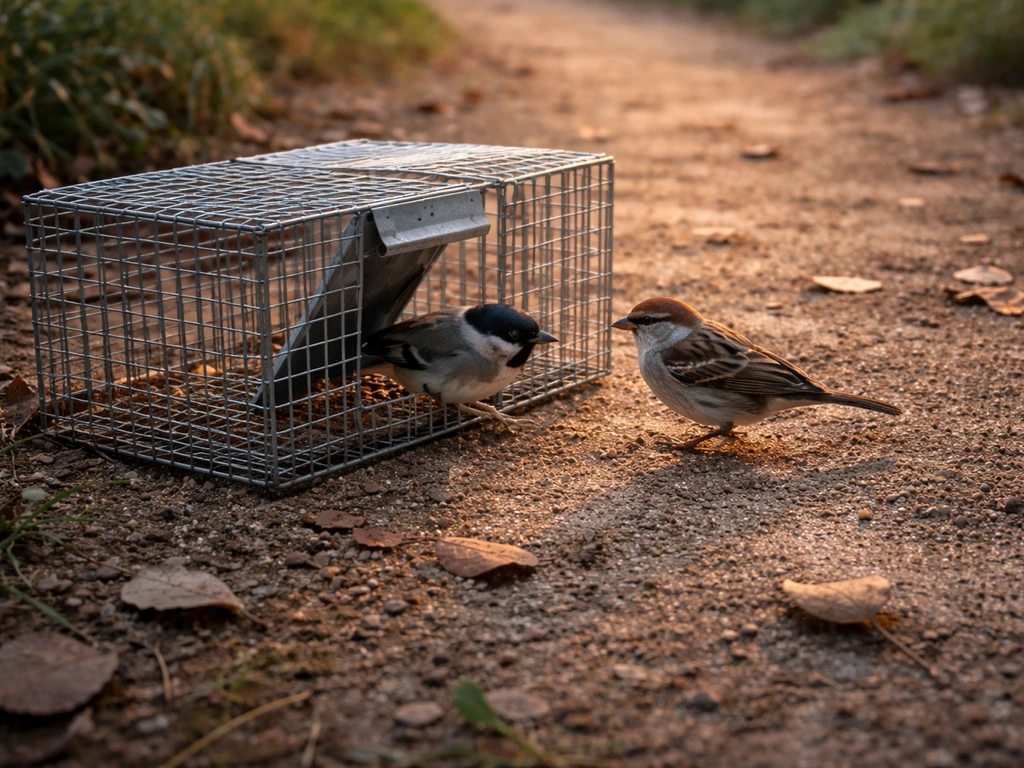
The best indicator that your trap placement is correct is seeing birds approach and investigate within the first hour or two of the first morning you set it. If nothing comes near it for a full day, move it. Birds that are already familiar with a feeding spot will approach much faster than birds in a new area.
Time your trap deployment to match bird activity. Most small birds feed heavily in the two hours after sunrise and again in the late afternoon. Set the trap during the first window and check it every one to two hours. If you are targeting roosting birds like starlings or pigeons, late afternoon near their roost entry point is more effective.
If you are using an exclusion one-way door instead of a live-catch trap, the sign of success is silence. No more sounds of movement from the space, no new droppings accumulating at the entry, and the door flap showing outward movement. Give it at least a full week before sealing permanently, and do a physical inspection with a light if you can access the space safely.
Humane release, cleanup, and making sure they don't come back
Releasing captured birds
For protected migratory birds caught accidentally, contact a licensed wildlife rehabilitator immediately. For legal captures of non-protected species where you intend to relocate, release the bird as quickly as possible. Stress in a captured bird is not a minor concern: prolonged confinement, noise, proximity to pets, and excessive handling can all cause life-threatening stress. Keep the trap covered with a cloth to reduce visual stimulation, minimize handling, and release in a quiet area away from the original problem site.
Cleaning up after the trap
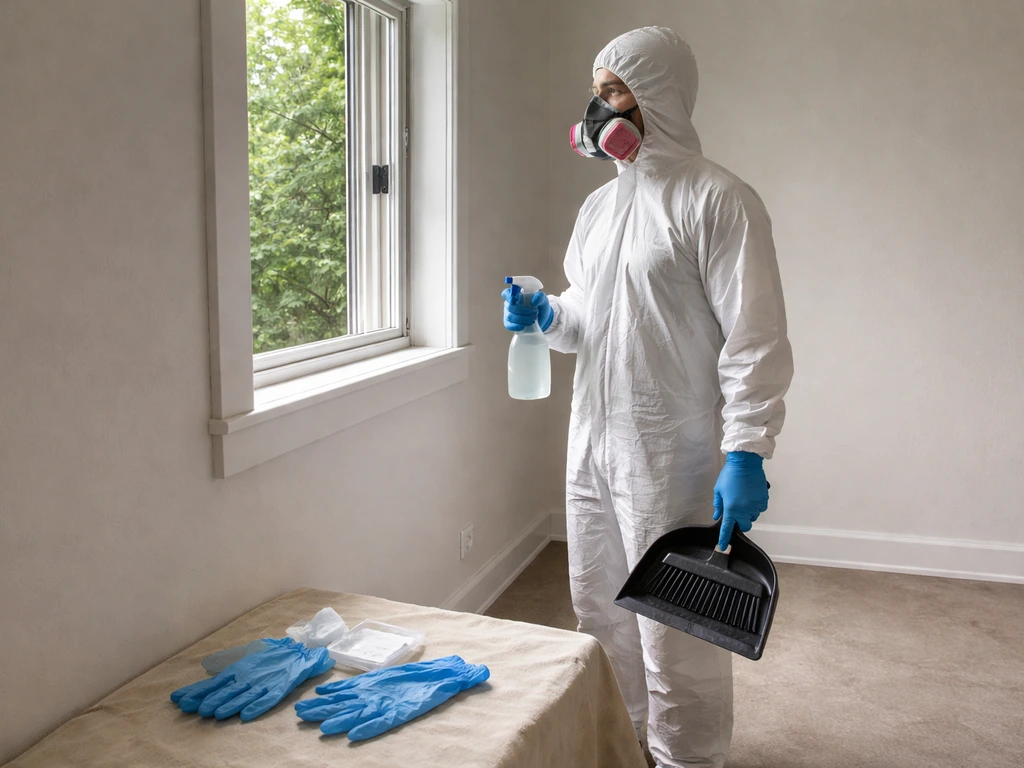
Wear gloves and a properly fitted N95 or P100 mask when cleaning droppings from the trap or the area where birds roosted. Wet the droppings down before sweeping or scraping to avoid aerosolizing particles. Use a disinfectant effective against influenza-type viruses (check the product label), and do not mix bleach with ammonia-based cleaners. Bag all waste and dispose of it in sealed bags. Wash your hands thoroughly after removing gloves.
Prevention so they don't come back
Trapping without prevention is a revolving door. If you are dealing with a coke can bird trap setup, use the same bird-specific planning, legality check, and exclusion-first thinking described throughout this guide. As soon as one bird is removed, another will find the same food source or nesting spot. The prevention layer is what makes the trap work worth keeping. { best cat collars to stop bird catching.
- Seal every gap, hole, or entry point birds were using. Use hardware cloth, caulk, or metal flashing depending on the opening size. Check that you have confirmed the space is empty before sealing permanently.
- Install bird netting over larger openings like eaves, solar panel gaps, or loading dock overhangs. Netting is one of the most reliable exclusion tools available.
- Add bird spikes to narrow ledges and parapets where pigeons or starlings like to perch. Spikes deny the landing surface without harming the bird.
- Use visual deterrents like reflective tape, predator silhouettes, or moving objects near entry points. These work best as a supplement to physical exclusion, not as a standalone solution.
- Consider sonic or ultrasonic deterrents in enclosed or semi-enclosed spaces where birds are reinvading after removal. These are most effective when combined with physical barriers.
- Remove food and water attractants: unsecured garbage, open compost, pet food left outside, and standing water near the problem area.
- If the problem recurs within a season, reconsider whether exclusion was thorough enough before redeploying a trap.
The best bird trap ever is not a single product. It is a well-chosen, correctly placed, properly baited, frequently monitored tool that is part of a larger plan ending in physical exclusion. Get the species right, check the legal status, deploy with the right bait and timing, and close every gap when you are done. That combination is what actually solves the problem.
FAQ
How can I tell if my trap is the wrong target bird before I catch anything?
Before setting, watch from a distance where activity is strongest (entry holes, ledges, ground foraging lanes) and what birds investigate the most. If you do not see approach behavior within the first hour or two of the first morning window, treat that as a placement or species mismatch and switch location or method rather than leaving it unattended.
What is the safest way to avoid catching non-target species (or protected birds) while using a live-capture trap?
Control the lure, not just the trap, by using the most bird-specific bait possible and placing it away from general feeding sources like open feeders, seed piles, or accessible birdbaths. Also check frequently and be ready to release any non-target bird immediately, since you reduce stress and injury risk by minimizing time in confinement.
Is it ever better to relocate birds after capture, or should I focus only on exclusion?
For most residential conflicts, exclusion is usually more effective because birds commonly return or move to nearby gaps if a bird is released elsewhere. If you do pursue relocation, plan it as a short, rapid release with minimal handling and expect that prevention, sealing entry points, and cleanup are still required to stop reinvasion.
What should I do if I accidentally capture a migratory bird or suspect it could be protected?
Stop handling and contact a licensed wildlife rehabilitator right away. Avoid keeping the bird longer than necessary, because stress and illegal possession can become issues quickly. If you can do so safely, keep the trap covered to reduce visual stimulation while you wait for help.
Can I use a trap if there are kids or pets in the area?
Yes, but only with strict controls: place traps in a location pets cannot access and use barriers or temporary fencing so no one can approach the trap area. Monitor constantly during peak activity windows, because even non-target wildlife incidents can happen fast once the trap is active.
How often should I check a trap, and what if I am at work during the day?
For active live-capture setups, checking every one to two hours during feeding windows is a practical safety target. If you cannot monitor that frequently, do not set the trap and rely on exclusion tools (netting, one-way doors with verification, or blocking entry) instead of leaving it unattended.
What’s the correct way to seal an exclusion one-way door, and how long should I wait?
Do not seal immediately after the first exit. Give it a full week of confirmation that no movement or new droppings appear at the entry, then do a careful inspection with a light if you can access the space safely. Sealing too early can trap the remaining bird inside or lead to re-entry.
Are there any situations where I should not do DIY trapping at all?
Yes, avoid DIY trapping near airports or aviation facilities, because bird management there is tightly regulated and generally handled by certified USDA Wildlife Services personnel. Also pause DIY if you have an unknown species, a hard-to-access cavity, or a flock-level problem on a commercial property where professional equipment and permits are typically required.
What should I do right after I capture a bird to reduce stress and risk?
Minimize handling time, keep the trap covered with cloth to reduce visual stimuli, and release in a quiet area away from the original conflict site (if relocation is legal and planned). For cleanup, wait until the bird is out, then wet droppings before disturbing them to prevent aerosolizing particles.
Why do traps sometimes “do nothing” even when placed correctly for the season?
Birds may already be using a nearby alternative food source or nesting gap. If you see no investigation within the first day, relocate or change bait strategy, and reduce unintended lure like feeder spillover. Timing also matters, set during the main activity windows (early after sunrise or late afternoon near roost entry points).
What should I do with droppings and trap waste after a capture?
Bag waste in sealed bags and dispose of it promptly. Wear gloves and a properly fitted N95 or P100 mask, wet droppings before scraping, and wash hands thoroughly after glove removal. Use a disinfectant effective against influenza-type viruses per the product label, and avoid mixing bleach with ammonia-based cleaners.
Why are glue traps, deadfalls, and snares a bad idea even if they seem like a fast fix?
Glue traps catch non-target animals and often cause severe injuries, which also increases cleanup and ethical problems. Deadfalls and snares are prohibited for wild birds in many states, and they also create higher risks to unintended species, so exclusion and properly matched trapping methods are the safer alternative.
Next Article
Best Cat Collars to Stop Bird Catching: A Practical Guide
Choose the best cat collars to reduce bird catching with safe, breakaway fit, visibility options, and testing plus backu