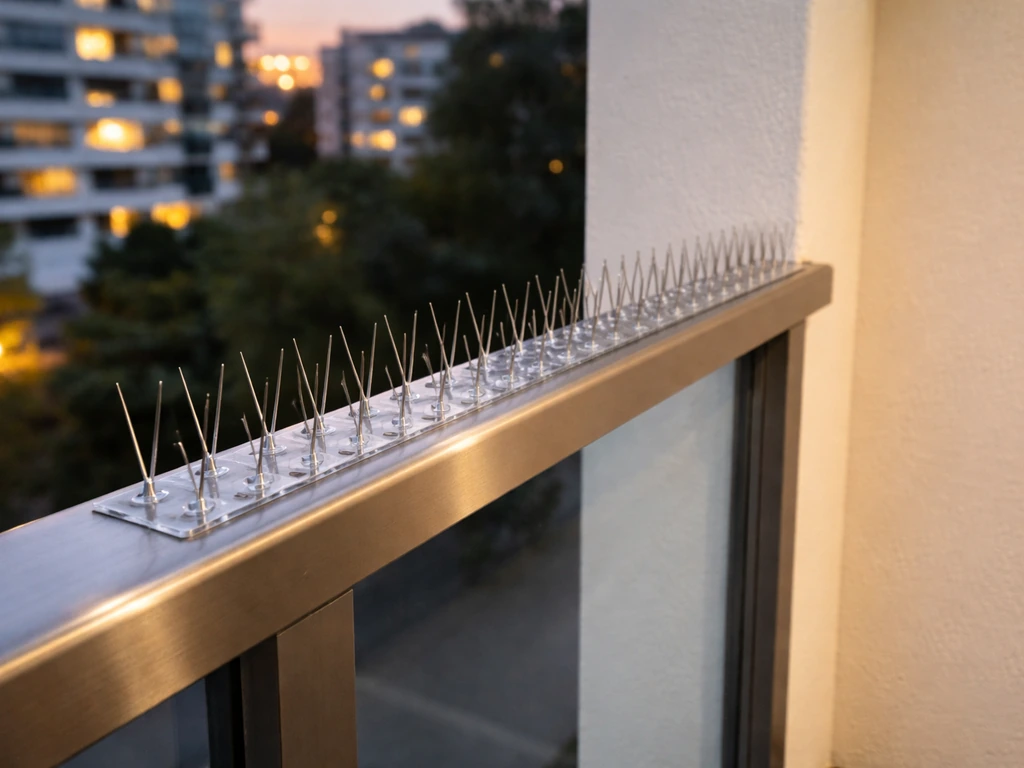
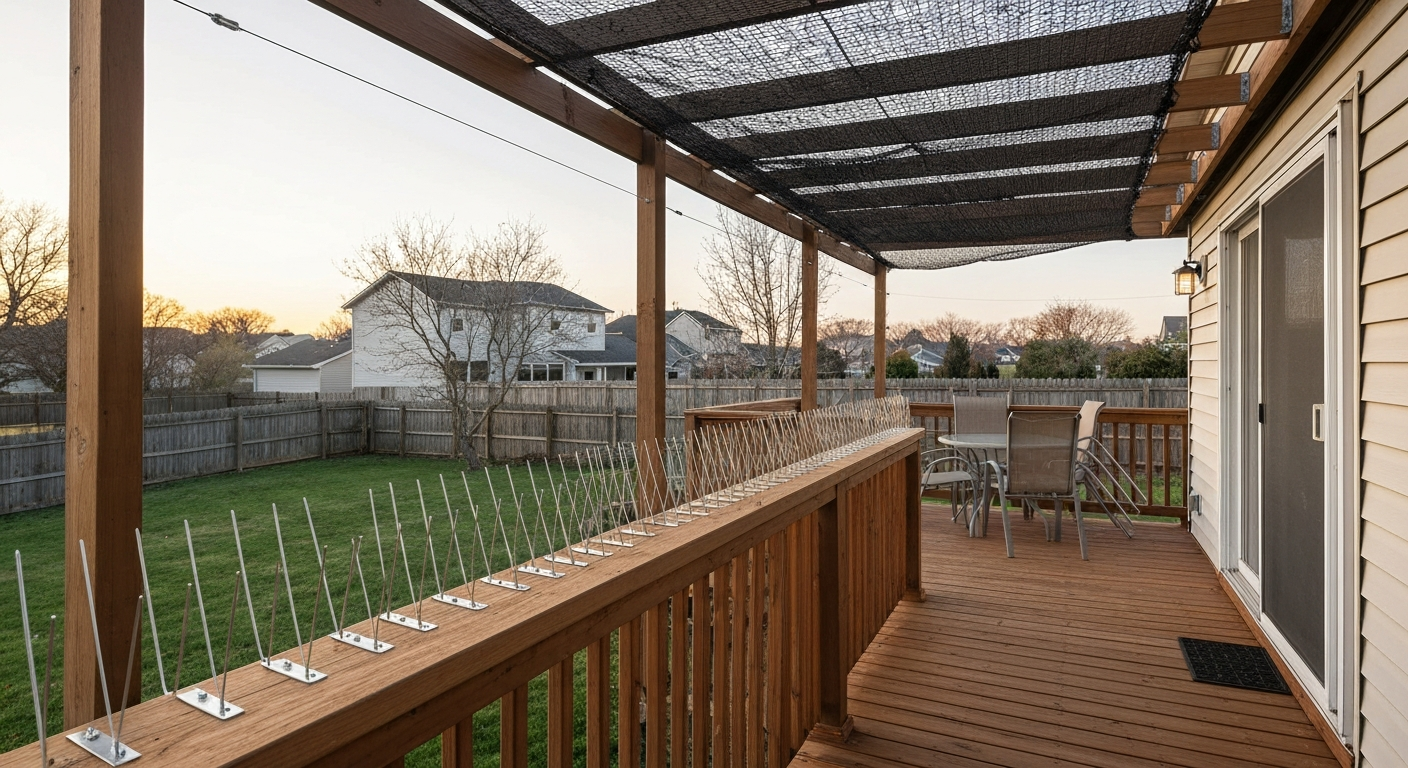
For most decks, the most effective bird deterrents are physical ones: stainless-steel or polycarbonate spikes on railings, UV-stabilized polyethylene netting over open roof sections, and tension wire systems strung across beams. These work because they physically prevent landing and roosting rather than hoping birds will be scared off. Sonic and ultrasonic devices sound appealing but consistently underperform in field tests, and visual decoys like owl statues lose their effect within days once birds habituate. If you pick the right physical barrier for the problem species and install it correctly, you can realistically expect years of protection without ongoing effort.
Best Bird Deterrent for Deck: A Complete Practical Guide

Marcus Weatherby
13 Jul 2026
Top picks at a glance
| Deterrent | Best for | Typical cost (DIY) | Expected lifespan |
|---|---|---|---|
| Stainless-steel spikes | Railings, ledges, beam tops | $12–$60 per small kit | 7–10 years (marine-grade 316 SS) |
| UV-stabilized polyethylene netting | Full deck coverage, pergola enclosures | $50–$200+ depending on area | Up to 10 years (heavy-duty) |
| Tension wire system | Open overhead beams, pergola rafters | $30–$80 for basic runs | 5–10 years with maintenance |
| Reflective tape / flash tape | Temporary or supplemental use | $5–$15 per roll | 1 season outdoors |
| Predator kite (hawk kite) | Large open decks, seasonal use | $15–$40 | 1–2 seasons |
| Distress call speaker | Active roosting flocks, medium pressure | $30–$150 | 3–5 years device life |
| Methyl anthranilate gel/spray | Flat surfaces, short-term deterrence | $20–$60 per kit | Weeks; requires reapplication |
Assess your bird problem first
Before buying anything, spend a few minutes identifying what you are actually dealing with. The species, behavior, and frequency of visits determine which deterrents will work and which will be wasted money. A single robin perching occasionally needs a different response than a flock of pigeons roosting under your deck overhang every night.
Species and behavior
- Pigeons (Rock Pigeons): roost and nest on ledges, beams, and flat surfaces; dropping accumulation is rapid and can be significant. Physical exclusion from the ledge or overhang is the priority.
- European Starlings: cavity-nesters that form large communal roosts; look for them squeezing into eaves, gaps under decking boards, or enclosed spaces. Blocking entry points is the most effective long-term fix.
- House Sparrows: nest in enclosed niches, gutters, and any gap large enough to enter; persistent and aggressive about nest sites. Cavity exclusion works; open-area visual deterrents do not.
- Seagulls and crows: strong, intelligent birds that return reliably to food sources; physical barriers plus removing food attractants is the most realistic approach.
- Swallows and smaller songbirds: often protected under the Migratory Bird Treaty Act (US) once nesting begins; intervene before a nest is established.
Severity and damage checklist
- Count how many birds visit and how often (daily roost vs. occasional landing).
- Check for droppings accumulation on railings, furniture, or flooring — volume indicates roosting, not just passing through.
- Look for nesting material in corners, under overhangs, in gaps between decking boards or joists.
- Note whether birds are eating food left outside, which draws them repeatedly.
- Record the time of day; pigeons roost at dusk and dawn, making those the key windows for observation.
- Assess any structural damage: droppings are acidic and degrade wood finishes and metal fasteners over time.
- Determine how long the problem has existed — established roosting habits require more persistent deterrent solutions than a recent arrival.
Decision checklist: match the solution to the situation
Running through five quick criteria before you buy will save you money and frustration. Many people skip this step and end up layering deterrent on top of deterrent because nothing seems to work, usually because the wrong type was chosen for the problem.
- Severity: Is this a single bird landing occasionally, or an established flock roosting nightly? Light pressure allows cheaper, temporary options. Heavy, persistent pressure almost always requires a physical barrier.
- Aesthetics: How visible is the deterrent from your living space or street? Spikes on railings are noticeable; tension wire and clear netting are much less so. Reflective tape looks messy to many homeowners.
- Permanence: Do you rent, or is this a seasonal deck? If so, choose removable options (tape, kites, motion-activated sprinklers). If you own and want a long-term fix, invest in spikes or netting.
- Budget: A stainless-steel spike kit for a 10-foot railing costs $30–$60 and lasts a decade. A full netting enclosure for a large pergola can run $150–$300 or more in materials alone, plus installation time. Factor in reapplication costs for chemical and gel products.
- Local regulations: Some municipalities restrict certain deterrents in heritage zones or restrict the use of chemicals near waterways. Check local bylaws before applying any pesticide-registered product, including methyl anthranilate sprays, near drainage or water features.
Overview of deterrent categories
Bird deterrents for decks fall into four broad groups. Physical barriers stop birds mechanically. Sensory devices try to make the environment unpleasant through sound, light, or water. Visual decoys and reflectors try to startle or frighten birds away. Chemical repellents make surfaces or areas unpleasant to land on or taste. In practice, physical barriers have the strongest evidence base. The others range from useful supplements to nearly ineffective, depending on species and context.
Physical barriers: spikes, netting, wire, and mesh
Physical deterrents work by removing the flat, comfortable surface that birds need to land and roost. They do not harm birds; they simply make the location unsuitable. This is why professional pest managers and multiple transport agency reviews consistently rank them as the most reliable long-term solution.
Bird spikes
Spikes are rows of stainless-steel or polycarbonate rods mounted on a base strip that attach to railings, ledges, and beam tops. They do not impale birds; the rods simply prevent a flat landing surface. Stainless-steel spikes, particularly 316 marine-grade, are the most durable option for outdoor decks near water or in coastal environments, with manufacturer-rated lifespans of around 7–10 years. Polycarbonate spikes are cheaper and less visible but degrade faster under UV exposure. Install them along the full top surface of railings and any horizontal beam where droppings accumulate. Leave no gaps: a 6-inch gap is enough for a pigeon to squeeze in and establish a roost. Kits typically come in 2-foot sections and cost roughly $12–$60 for small runs.
Bird netting
For deck areas with overhead pergolas, roof sections, or enclosed spaces where birds roost underneath, netting is often the most complete solution. UV-stabilized knotless polyethylene netting with a mesh size of 17–25 mm effectively excludes medium-sized birds like pigeons and starlings. Heavy-duty versions rated for up to 10 years of UV resistance are available from commercial suppliers. The netting needs to be taut enough that birds cannot push through sag points, and every edge must be fixed securely to a frame or structure. Loose or sagging sections will be exploited. A 25-by-50-foot section of quality netting typically retails in the low hundreds of dollars. Netting is also commonly used to protect pool surrounds from waterfowl, which overlaps with deterrent approaches used around similar outdoor spaces. For guidance tailored to pool areas and waterfowl, see our best bird deterrent for pool resource.
Tension wire systems
Tension wire systems run multiple parallel stainless-steel wires across open beam tops or ledges at heights of roughly 5–10 cm above the surface, creating an unstable landing zone. Birds attempt to land, find no stable footing, and move on. These systems are less visible than spikes and work well on architectural beams where the aesthetic of spikes would be unwelcome. They require proper tensioning hardware (screw eyes, turnbuckles) and should be checked annually for tension loss and corrosion.
Mesh, hardware cloth, and covers
For enclosed deck spaces, gaps under deck boards, or access points where starlings and sparrows nest, hardware cloth (galvanized welded mesh) cut to size and secured with staples or screws is a simple and permanent exclusion method. Quarter-inch or half-inch mesh works for small cavity-nesting species. Check under decks in late winter before nesting season begins. Covering access gaps before birds arrive is far easier than removing an active nest, and in the US, removing an active nest of most native migratory species mid-season requires compliance with the Migratory Bird Treaty Act.
Installation tips for physical barriers
- Clean and dry the surface thoroughly before attaching spike strips or wire mounts; adhesive bonds fail on dirty or wet surfaces.
- Use marine-grade stainless-steel fasteners outdoors; zinc screws corrode rapidly in wet environments.
- For netting, install a perimeter cable or wire frame first, then attach the netting with cable ties or hog rings every 6–8 inches to prevent gaps.
- After installation, inspect after the first heavy rain and after the first winter to check for lifted sections, corrosion, or sag.
- Replace any section that birds have found a way around rather than simply adding more product elsewhere.
Sensory devices: what the evidence actually shows
Sonic and ultrasonic devices are heavily marketed for decks and patios, but the evidence for their effectiveness in outdoor settings is consistently weak. Multiple systematic reviews and controlled field trials have found that birds habituate rapidly to repeated sounds, and high-frequency ultrasonic units have no demonstrated effect on pest birds outdoors because birds' hearing ranges and the physics of sound propagation in open spaces limit their reach. A 2024 peer-reviewed field trial at an industrial site tested multiple deterrent types and found ultrasonic bands ineffective even at short observation intervals. Older reviews (Bomford and O'Brien, 1990) reached similar conclusions. US university extension programs have stated plainly that ultrasonic consumer devices rarely drive pigeons or other established urban birds from their home ranges. A University of Nebraska extension review states that ultrasonic consumer devices rarely drive pigeons or other established urban birds from their home ranges and often perform no better than placebo in field tests US university extension and pest‑management reviews report that ultrasonic consumer devices rarely drive pigeons or other established urban birds from home ranges and often perform no better than placebo in field tests..
Distress call and predator call speakers
Recorded distress calls and predator calls perform better than ultrasonic units. The same 2024 industrial trial found that distress calls did reduce perching activity. However, habituation still occurs with repetitive playback, so these devices need varied call sequences, random timing, and should be combined with at least one physical deterrent for sustained effect. They are most useful for dispersing established flocks temporarily, for example during an outdoor event, rather than as a permanent standalone solution.
Motion-activated water sprinklers
Motion-activated sprinklers (such as the Orbit Yard Enforcer type devices) deliver a surprise burst of water when a bird lands or walks within sensor range. They work reasonably well for ground-feeding birds and waterfowl approaching a deck from a yard or pool area, and birds do not habituate as quickly as they do to sound, because the response is physically startling. They require a water connection, regular battery changes, and repositioning every week or two to prevent local habituation. They are not suitable for deck railings or overhead areas.
Lights and lasers
Flashing or strobe lights placed in roosting areas can disrupt birds at dawn or dusk, particularly in enclosed covered spaces. Handheld laser devices have been used in commercial settings (warehouses, rooftops) to disperse roosting birds at night, but they are not a practical passive deterrent for a residential deck. They require active use and are not legal to aim at aircraft or reflective surfaces. Their use is generally an adjunct to other methods, not a primary solution.
Visual deterrents and decoys
Visual deterrents exploit birds' instinct to avoid predators or unfamiliar moving objects. They work best when combined with other methods and when moved regularly. A stationary owl decoy placed on a post will be ignored within a few days; birds in urban environments have learned that static objects do not represent real threats.
Predator silhouettes and decoys
Three-dimensional predator models (great horned owls, hawks, falcons) with rotating or moving heads perform better than static versions. The 2024 field trial found moving predator models reduced perching. The key word is moving: a bobble-head owl that swivels in the wind is meaningfully better than a rigid plastic statue. Relocate the decoy every 3–5 days. For larger open decks, hanging a hawk kite on a pole that moves naturally with the breeze provides a more dynamic threat cue. Expect useful effect for one to two seasons before effectiveness degrades even with repositioning.
Reflective tape and flash tape
Holographic or reflective flash tape is cheap, fast to install, and provides moving light patterns that disturb birds. It works as a short-term or seasonal measure, particularly for small birds and in areas with good wind. The downsides are appearance (many homeowners find it looks messy), degradation in rain and sunlight within a season, and habituation within a few weeks. It is a reasonable supplemental tool in combination with spikes or netting, but not a standalone fix for any serious bird pressure.
Scare balloons and inflatable decoys
Mylar scare balloons printed with large eye patterns move in the wind and combine visual and physical movement cues. They are most effective in open areas (over garden plots, large patios, or pool decks) and need to be moved every few days. They are inexpensive, require no installation tools, and are easily stored off-season. Like other visual deterrents, their longevity against established birds is limited.
Chemical repellents and gels
Chemical bird deterrents fall into two main types: sticky physical gels that make surfaces unpleasant to land on, and taste or odor repellents (most commonly methyl anthranilate, or MA) that irritate birds' senses without harming them. All products in this category are non-lethal and, when applied correctly, are not intended to injure birds.
Sticky gel deterrents
Sticky gels (polybutene-based products like Tanglefoot or Bird-B-Gone gel) are applied in beads along ledges or railings using a caulking gun. Birds land, feel the tacky surface, and avoid the site. They are moderately effective for pigeons and other ledge-roosting species when applied to a clean surface at the right bead spacing (usually one or two parallel beads about an inch apart on a 4-inch ledge). The downsides are real: gels collect dust, debris, and insects over time, losing tackiness; they can trap small birds, lizards, or other small animals, which is an animal welfare concern; and they look unsightly on visible surfaces. Reapplication is needed every 6–12 months. They are best used on out-of-sight ledges and structural surfaces rather than on deck furniture or visible railings.
Methyl anthranilate (MA) repellents
Methyl anthranilate is a food-grade ester (it is a natural grape flavoring) that irritates the trigeminal nerve in birds, causing them to avoid the treated area. It is registered as a pesticide in the US and appears in products like Rejex-it Migrate, available as a fogger, spray, or gel. blank" rel="noopener noreferrer">EPA Pesticide Product Label / Registration information (examples referencing methyl anthranilate formulations) documents registered MA formulations and label requirements for products such as Rejex-it Migrate. The active formulations typically contain around 14.5% MA. It has a low acute toxicity profile and is not harmful to humans at normal application rates. However, the evidence for effectiveness is mixed: the 2024 industrial field trial found MA treatments ineffective at short observation intervals, consistent with earlier reviews suggesting efficacy varies strongly by species, delivery method, and frequency of reapplication. It also must not be applied directly to water or drainage areas, and labels require standard PPE for applicators. MA products are most useful as a supplement to physical deterrents, particularly in areas where installing hardware is impractical.
Safety and application notes for chemical deterrents
- Always read the full product label before applying any registered repellent; label requirements are legally binding in the US.
- Do not apply MA sprays or gels near ponds, water features, pools, or stormwater drains.
- Wear gloves and eye protection when applying sticky gels; polybutene is difficult to remove from clothing and skin.
- Store products out of reach of children and pets.
- Check local regulations: some states or municipalities have additional restrictions on pesticide use near waterways or in certain zones.
- If birds are federally or locally protected species, confirm that chemical deterrents are a permitted control method before use.
Comparing deterrent options side by side
| Deterrent type | Evidence strength | Habituation risk | Maintenance required | Aesthetics | Approximate DIY cost |
|---|---|---|---|---|---|
| Stainless-steel spikes | Strong | None | Annual inspection | Visible but tidy | $12–$60 per kit |
| Bird netting | Strong | None | Annual inspection, repairs | Moderately visible | $50–$200+ |
| Tension wire | Strong | None | Annual re-tensioning | Low visibility | $30–$80 |
| Distress call speaker | Moderate | Moderate (needs variety) | Weekly programming changes | Low | $30–$150 |
| Motion sprinkler | Moderate | Low-moderate | Battery/position changes | Low | $30–$80 |
| Moving predator decoy | Moderate | High within weeks | Relocate every 3–5 days | Moderate | $15–$40 |
| Reflective tape | Low-moderate | High within weeks | Seasonal replacement | Poor | $5–$15 |
| Ultrasonic device | Very weak | Very high | None needed (ineffective) | Low | $20–$100 |
| Sticky gel | Moderate | Low | Reapply every 6–12 months | Poor | $20–$60 |
| MA spray/fog | Low-moderate | Moderate | Frequent reapplication | Low | $20–$60 |
Installation and maintenance: practical steps
Spikes on railings and ledges
- Clean the surface with a wire brush and wipe down with isopropyl alcohol to remove grease and old droppings.
- Measure the total length to cover and cut spike strips to size with a hacksaw or tin snips.
- Apply exterior-grade adhesive (as supplied or recommended by the manufacturer) in a continuous bead along the base of the spike strip.
- Press firmly onto the surface and hold for 30 seconds; supplement with stainless screws through the base holes for permanent installations.
- Cover the entire surface with no gaps larger than 2 inches; birds will find and use any gap.
- Inspect after the first month and again each spring; replace any strips that have lifted or been damaged.
Netting over a pergola or overhead structure
- Measure the full area and add 12 inches on each side for attachment overlap.
- Install a perimeter wire or cable around the outer frame of the structure using screw eyes and tensioning hardware.
- Unroll the netting and stretch it over the area; attach to the perimeter wire using cable ties or hog rings spaced every 6–8 inches.
- Check for any sag in the center; add a support line across the middle if the span is more than about 10 feet.
- Trim excess netting cleanly and tuck or fold the edges so no loose material hangs where birds can grab and pull.
- Inspect each spring after winter weather; replace any section with tears or compromised attachment points.
Visual and sonic devices
- Position predator decoys at the highest point of the deck structure with an unobstructed view of the problem area.
- Move the decoy to a new position every 3–5 days without fail; stationary decoys lose effectiveness within days.
- For distress call speakers, program varied call sequences and randomized intervals; many units allow this via app or built-in settings.
- Hang reflective flash tape in strips of 12–18 inches where it will move freely in airflow; replace at the start of each season.
- Combine at least one visual or sensory deterrent with a physical barrier for meaningful, sustained effect.
Monitoring performance and troubleshooting
After installing any deterrent, give it two to four weeks before judging effectiveness, then check for fresh droppings in protected areas, which is the clearest sign birds are still landing or roosting. If you find droppings inside or under a netting installation, look for gaps, sagging sections, or tears. If spikes are installed but birds are landing on adjacent unprotected surfaces, extend coverage to those areas. If a visual deterrent was working and has stopped, move it to a new position and consider adding a second type.
- Fresh droppings in the deterred zone: birds have found a gap or worked around the deterrent.
- Nesting material in corners or under deck boards: use hardware cloth to close cavities before or immediately after the nesting season ends.
- Birds landing on deck furniture rather than railings: furniture covers, physical deterrent strips on furniture arms, or a motion sprinkler aimed at the furniture area.
- Deterrent working initially but failing after a few weeks: this is classic habituation with visual or sonic methods; switch to a physical barrier.
- Droppings on the deck but no visible roosting: birds may be landing briefly from a nearby perch; trace their flight path and address the nearest roosting site.
When to call a professional
DIY deterrents handle the majority of residential deck bird problems. But there are situations where a licensed pest control operator or wildlife management specialist is the right call. If you have a large established pigeon colony roosting under the deck structure or in wall cavities, the volume of droppings may represent a health hazard (histoplasmosis is a fungal disease associated with dried pigeon and starling droppings) that requires professional remediation before you install deterrents. If netting needs to be installed at height or on a complex structure, professional installation is safer and more likely to produce a gap-free result. If you are dealing with a species that may be protected under federal or state law and you are unsure of your options, a wildlife management professional can advise on compliant methods. Many pest control companies offer a free initial assessment.
Legal and environmental considerations
In the US, the Migratory Bird Treaty Act (MBTA) protects most native songbirds, swallows, and many other species. You cannot legally remove, destroy, or relocate an active nest containing eggs or chicks without a permit. This means the best time to install exclusion netting or close cavities is in late autumn or early spring, before nesting season begins. Pigeons, European Starlings, and House Sparrows are not protected under the MBTA and can be managed without a permit in most states, though local ordinances may vary. Methyl anthranilate sprays are registered pesticide products in the US, and applying them near waterways or outside their label specifications is a federal violation. Always read the product label as the binding legal document before any application.
Deck-specific bird problems share a lot in common with issues on adjacent outdoor structures. If birds are also accessing a roof overhang or nesting on the roofline above your deck, addressing only the deck will leave the larger roosting habitat intact. Similar physical exclusion strategies apply to rooftop and overhead structures. For related products and guidance, see our dedicated roof top bird deterrent resource. For covered patios with similar overhead exposure, the same netting and tension wire approaches used on decks apply directly. For advice specific to marine settings, see our guide on the best bird deterrent for boats.
Putting it all together
The most reliable outcome for a bird-free deck comes from layering a primary physical deterrent (spikes on railings, netting over overhead areas, mesh over cavity access points) with a secondary sensory or visual deterrent that adds disruption during the habituation period after installation. For advice tailored to smaller outdoor spaces, see the guide to the best bird deterrent for balcony. For product recommendations and porch-focused installation tips, see best bird deterrent for porch. For recommendations tailored to outdoor seating areas, see our guide to the best bird deterrent for patios. Skip the ultrasonic device; the evidence does not support it. If budget is limited, prioritize the physical barrier first and add supplemental methods as resources allow. Clean the surface before every installation, check for gaps, and inspect annually. That combination will outperform any single high-tech gadget at any price.
FAQ
What are the most effective humane bird deterrents for a deck?
Physical exclusion methods are the most reliable: bird netting to enclose an area, ledge/spike strips, and tension wire/guard systems for perching sites. Use UV‑stabilized knotless polyethylene netting sized to the target species and marine‑grade stainless or UV‑stabilized bases for spikes in coastal settings. Combine physical exclusion with visual disruption (reflective tape, predator decoys) for added short‑term reduction.
How do I choose between spikes, netting, tension wire and gels for a specific deck?
Match method to the problem: spikes or sloped inserts for narrow ledges and railings where birds perch; tension wire for long flat rails and roof edges; netting for fully enclosing a patio, balcony or under‑deck cavity; repellant gels for ledges where netting or spikes aren’t feasible, recognizing gels need reapplication and may be less durable. Consider species (pigeons and starlings need stronger exclusion), aesthetics, permanence, budget and rental/condo rules.
Do ultrasonic or sonic devices work on decks?
No reliable evidence supports ultrasonic/consumer sonic devices as effective outdoors. Birds habituate quickly and hearing limits make high‑frequency claims unreliable. Use physical exclusion and proven visual/behavioral techniques instead.
Which bird species should I plan for, and how does species matter?
Pigeons (Columba livia): prioritize ledge exclusion (spikes, tension wires, netting). Starlings: block cavities and roost sites (netting, sealing vents). House sparrows: seal niche sites (gaps, soffits). Smaller songbirds may be deterred with netting or fine mesh. Identify the species before choosing mesh size, spike strength and installation approach.
What are the cost and durability expectations?
Costs vary: small spike strips ≈ $12–$60 per kit; professional spike runs and heavy‑duty netting (25'×50') retail in the low‑hundreds. Marine‑grade stainless spikes and UV‑stabilized netting advertise 7–10 year lifespans under normal exposure. Budget for hardware, fasteners, and occasional replacement or re‑tensioning.
What are the safety, legal and environmental considerations?
Use humane, non‑lethal methods that do not injure birds. Avoid applying chemical repellents directly to water or food areas. Check local ordinances and HOA/condo rules about visible modifications. Do not modify or puncture solar panels or structural components — use non‑penetrative guards. Follow pesticide labels and MSDS for repellant gels/chemicals; use PPE and approved application sites.
Next Article
Best Bird Deterrent for Balcony: What Works Fast Today
Find the best balcony bird deterrent fast: proper placement of spikes, netting, lights and sound for perching and nestin