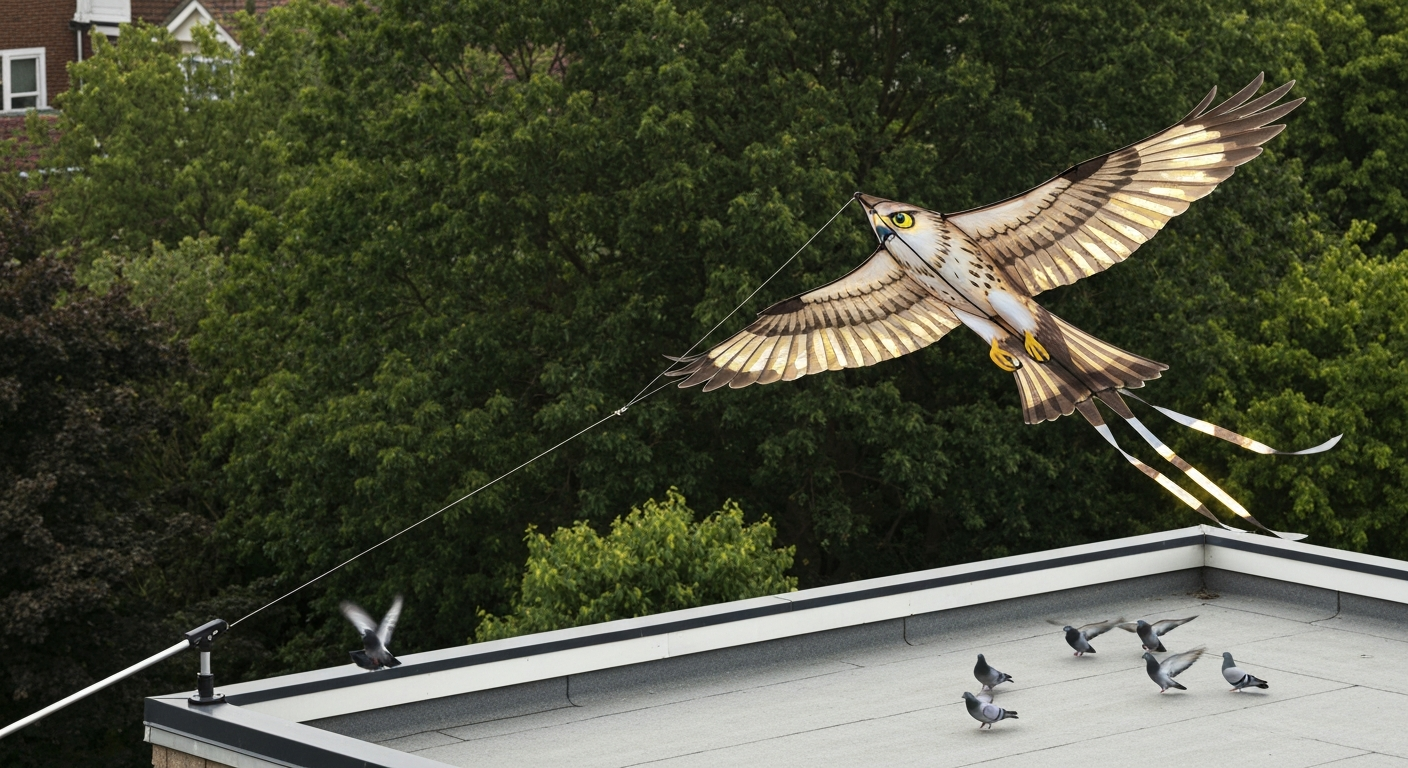
For most garden situations, a combination of a predator kite or hawk decoy with reflective tape or streamers gives you a solid starting point, but if birds keep coming back, exclusion netting over raised beds and fruit trees is the only method that reliably keeps them out long-term. No single device works forever on its own. Birds are smart, and they habituate quickly to anything that stays the same. The key is using more than one method, moving things around regularly, and matching the device to the specific bird you are dealing with.
Best Bird Scarer for Garden: Top Picks, DIY Plans & Safety

Marcus Weatherby
25 Jul 2026
Who this guide is for
This guide is written for homeowners, gardeners, property managers, and small-business owners who need to protect gardens, patios, rooftops, solar panels, and other outdoor areas from nuisance birds. Whether you are dealing with pigeons destroying a roof, starlings stripping your strawberry bed, or sparrows targeting seedlings, the advice here is practical and based on what the research and real-world field trials actually show works. I have included DIY options, product categories, installation steps, and guidance on when a professional is the better call.
Quick decision checklist before you buy anything
- What bird species are you dealing with? Different birds respond to different stimuli.
- Is the problem seasonal or year-round? Seasonal problems may need temporary solutions only.
- How large is the area you need to protect? Coverage area determines how many units you need.
- Do you need to protect crops, structures, or just deter roosting?
- Are there children, pets, or neighbors close enough to be affected by sound or chemicals?
- Is the bird species protected under the Migratory Bird Treaty Act or local law? Check before acting.
- What is your budget? Costs range from under $10 for DIY tin-can scarers to $500+ for solar-powered sonic systems.
- Can you commit to regular maintenance and repositioning? Static setups lose effectiveness within days to weeks.
Quick comparison: bird scarer types at a glance
| Device Type | Pros | Cons | Best Use | Approx. Cost |
|---|---|---|---|---|
| Reflective tape / streamers | Cheap, easy, immediate | Rapid habituation, needs repositioning | Seedbeds, fruit trees, patios | $3–$15 |
| Predator kite (bird-scarer kite) | Highly visible movement, low cost | Needs wind, tethering required | Open gardens, allotments, fields | $15–$60 |
| Hawk / owl decoy | No power needed, easy to install | Birds habituate fast if static | Small patios, entry points | $10–$50 |
| Sonic / distress-call unit | Targets species-specific hearing, programmable | Noise nuisance, habituation risk | Large gardens, open spaces | $50–$300 |
| Ultrasonic unit (standalone) | Silent to humans | Poor evidence for most pest birds | Limited use cases only | $20–$150 |
| Solar-powered electronic scarer | No wiring, weatherproof, programmable | Higher cost, coverage limits | Remote areas, rooftops, sheds | $80–$500 |
| Bird spikes | Long-lasting, low maintenance | Aesthetic concerns, installation effort | Ledges, roof ridges, fences | $10–$80 per metre |
| Exclusion netting | Near-complete protection when properly fitted | Labour-intensive to install | Raised beds, fruit cages, under solar panels | $20–$200+ depending on area |
| Chemical repellents (methyl anthranilate) | Non-lethal taste/smell deterrent | Short duration, reapplication needed | Lawns, turf, some crop surfaces | $15–$60 |
| Deterrent plants / habitat changes | Permanent, low cost | Slow to establish, indirect effect | Long-term garden redesign | Varies |
How to choose the best bird scarer for your garden
Picking the right bird scarer comes down to eight practical factors. Running through each one before you buy will save you money and frustration. For comparisons and reviews of top choices, see our guide to the best bird scarer.
Effectiveness and habituation risk
Systematic field reviews consistently show that static, single-method deterrents lose their effect quickly. Evaluation of the Efficacy of Products and Techniques for Airport Bird Control (Transport Canada, 1998) found many deterrents produce initial responses but are susceptible to rapid habituation and recommends integrated, rotating, or on‑demand systems for sustained efficacy at sensitive sites. Birds learn that a motionless owl decoy or a piece of reflective tape poses no real threat, often within a few days. Moving, unpredictable stimuli, such as a hawk kite that responds to wind or a programmable sonic unit that randomises call timing, outperform static alternatives over the medium term. Plan from the start to rotate or vary your approach every one to two weeks.
Target species
Bird hearing varies significantly by species. Pigeons and most common pest passerines (starlings, sparrows) have peak hearing sensitivity in roughly the 0.5 to 12 kHz range and have very limited response to frequencies above that threshold. This is why standalone ultrasonic devices (marketed at 20 kHz and above) tend to deliver poor results for these common garden pests. Geese and waterfowl, on the other hand, do respond better to methyl anthranilate on grass surfaces. Matching the deterrent to the bird matters more than most product marketing suggests.
Coverage area
Manufacturer claims for coverage areas (especially for sonic and ultrasonic devices) are often based on ideal open-field conditions. Hedges, walls, sheds, and plant growth all absorb and reflect sound. A unit claiming 1,000 m² coverage may only be effective over 200 to 400 m² in a typical enclosed garden. Measure your space and buy accordingly, erring toward more coverage rather than less.
Safety for people, pets, and wildlife
High-SPL sonic devices (some rated at 100 dB or more at one metre) can cause discomfort or hearing risk for nearby people and pets, particularly during installation or if sited near a frequently used outdoor area. NIOSH recommends keeping human exposure below 85 dB(A) for an eight-hour period. Chemical repellents require gloves and eye protection as a minimum, and stronger toxicants like 4-aminopyridine (Avitrol) are restricted-use pesticides not appropriate for homeowner use at all.
Legal considerations
In the United States, the Migratory Bird Treaty Act makes it illegal to harm, trap, or remove migratory birds or their active nests without a permit. Many garden birds, including swallows, warblers, and most songbirds, fall under this protection. Before removing a nest or using anything beyond passive deterrents, check the U.S. Fish and Wildlife Service guidance or contact your state wildlife agency. Passive deterrents that simply discourage landing without harming birds are generally legal, but confirm with local authorities if you are unsure.
Durability and weather resistance
Outdoor bird scarers need to handle rain, UV exposure, and wind. Check IP ratings on electronic units (IP44 is a minimum for outdoor use; IP65 or above is preferable). Stainless-steel spikes outlast polycarbonate versions in exposed rooftop positions. Reflective tape and mylar products degrade in UV over one to two seasons and need replacing.
Maintenance commitment
Almost every deterrent requires some ongoing effort. Predator kites need regular repositioning. Sonic units need programming checks and battery or solar-panel maintenance. Netting needs inspecting for gaps and tears, especially after winter. If you cannot commit to monthly checks at minimum, opt for low-maintenance physical barriers like spikes or netting over electronic or visual options.
Cost over time
Cheap visual deterrents cost almost nothing upfront but add up if you are replacing tape and streamers every season and still seeing bird damage. A properly installed netting system over a raised bed typically costs between $30 and $150 depending on size but can last five to ten years with minimal ongoing cost. Consider total cost of ownership rather than just the purchase price.
Overview of bird scarer categories
There are seven broad categories of bird scarer available for garden use. Each works through a different mechanism, suits different scenarios, and carries different trade-offs. Understanding where each fits helps you build a more effective multi-method approach.
- Visual scarers: reflective tape, predator kites, hawk decoys, flash tape, streamers, holographic bird-scare products.
- Sonic and ultrasonic scarers: distress-call speakers, predator-call units, ultrasonic emitters, motion-triggered alarms.
- Electronic scarers and solar-powered units: programmable multi-function devices combining sound, light, and motion triggers.
- Physical barriers: bird spikes, exclusion netting, tensioned wire systems, bird-proofing mesh for solar panels.
- Chemical repellents: methyl anthranilate-based sprays, gel repellents for ledges, taste aversion products for turf.
- Bird-scarer kites: wind-powered hawk or falcon silhouette kites flown above the protected area.
- Deterrent plants and habitat changes: removing food sources, using thorny or dense plants, modifying water features.
Visual scarers in depth
Visual deterrents exploit a bird's wariness of predators and unfamiliar moving objects. They are the most accessible category for gardeners and can be effective when used correctly, but they come with a hard ceiling on long-term performance.
Reflective tape and flash tape
Iridescent or holographic reflective tape works by creating unpredictable flashes of light as it moves in the wind. It is most effective when suspended so it can twist freely rather than laid flat. Run it across rows of vegetables, along fence tops, or between canes above fruit bushes. Use it in short lengths of 30 to 50 cm rather than long continuous strips, and reposition it every one to two weeks. Most tape lasts one season in direct sun before the reflective coating degrades.
Predator kites and bird-scarer kites
A predator kite, sometimes called a hawk kite or bird-scarer kite, mimics a soaring bird of prey at height. For step-by-step bird scarer kite instructions, including pole setup, swivel mounting, and recommended flying heights, see the bird scarer kite instructions guide. See our review of the best bird scarer kite for model recommendations, pole types, and placement tips. The combination of movement and silhouette is one of the more convincing visual deterrents available, particularly for open spaces like vegetable plots, allotments, and lawns. Models typically fly on a 3 to 10 metre telescopic or fibreglass pole and use a swivel mount so the kite rotates naturally with the wind. They work best in gardens with at least some air movement. In still conditions, the kite hangs motionless and quickly stops deterring birds. Moving the pole position every few days maintains effectiveness.
Hawk and owl decoys
Three-dimensional hawk or owl decoys mounted on fence posts or shed roofs can deter birds initially, but habituation often sets in within three to seven days if the decoy does not move. Models with rotating or bobbing heads powered by wind or batteries perform better. Mounting a static decoy on a swivel so wind movement creates motion extends usefulness. Combine with reflective tape for better results. Best used at small entry points, window sills, or over a single bed rather than as coverage for a large area.
Streamers and scare rods
Long mylar or foil streamers create both visual and light-flashing deterrence and are particularly useful along the tops of raised beds or draped over cane frames above crops. Holographic scare rods with multiple facets produce more random light patterns than simple tape. These are among the cheapest options available and work well as a supplementary layer alongside a predator kite or sonic unit.
Sonic and ultrasonic scarers: what actually works
Sound-based deterrents fall into two distinct categories that perform very differently, and it is worth understanding the difference before spending money.
Sonic units using distress and predator calls
Sonic devices that broadcast recorded distress calls and predator sounds in the 1 to 10 kHz range, within the hearing range birds use most, can substantially reduce bird presence in the short term. Field trials comparing programmable distress-call systems to static visual deterrents show the acoustic systems performing better, particularly when call timing and sequence are randomised to avoid habituation. Look for units with multiple call types, adjustable volume (typically 80 to 110 dB at the speaker), and programmable schedules so birds cannot predict when the sound will play. Commercial units from manufacturers like Bird-X list coverage of several hundred to several thousand square metres in open conditions, though real-world coverage in a typical walled garden will be lower.
Ultrasonic devices: the evidence is weak for common pest birds
Products marketed purely as ultrasonic bird repellers (emitting frequencies above 20 kHz) have a significant evidence problem. Pigeons and most common garden pest birds, including starlings and sparrows, have peak hearing sensitivity between roughly 0.5 and 12 kHz. Research on pigeon hearing shows their sensitivity drops off well before ultrasonic frequencies. In practice, this means a purely ultrasonic emitter is likely inaudible or at best mildly unpleasant to the birds you most want to deter. Ultrasonic units may have some effect on rodents or bats, but for garden bird control they are a poor investment on their own. Devices that combine audible sonic ranges with ultrasonic output perform better than ultrasonic-only products.
Settings and neighbor considerations
High-volume sonic units operating at 100 dB or above can carry over fence lines into neighboring properties. Before installing, check local noise ordinances and consider directional speaker placement aimed away from property boundaries. Set operating hours to daylight only. Most programmable units allow you to set active windows, which reduces nuisance and also prevents birds from simply timing their visits to periods of silence. Keep volume at the minimum effective level and increase only if necessary.
Electronic scarers and solar-powered units
Solar-powered and battery-operated electronic scarers combine multiple deterrent mechanisms in a single weatherproof unit. The best models include programmable distress and predator calls, motion-activated triggers, flashing LED lights, and sometimes a rotating visual component. Solar panels on these units typically need four to six hours of direct sunlight per day to maintain charge, which limits performance in shaded garden spots or during extended overcast periods.
Key features to look for
- Programmable schedule with randomised call sequences to reduce habituation.
- Motion sensor (PIR) trigger so the unit activates only when birds are present, conserving battery and reducing noise.
- Multiple call types covering the target species' hearing range (1–10 kHz for most garden birds).
- IP65 or higher weatherproof rating for year-round outdoor use.
- Solar panel with battery backup for continuous operation without mains wiring.
- Adjustable speaker direction to focus coverage on the problem area.
Placement guidance
Mount solar-powered units on a post or wall at a height of 1.5 to 2.5 metres, angled slightly downward toward the area you want to protect. Avoid placing them behind hedges or inside structures where sound will be absorbed before reaching open ground. For large gardens over 500 m², use two or more units angled to cover different zones rather than a single unit at maximum volume. Check panel orientation quarterly to ensure solar charging is not blocked by new plant growth.
Physical barriers: spikes, netting, and exclusion systems
Physical barriers are the most reliable long-term solution for bird control in gardens. University extension guidance and industry installation data consistently rank exclusion and physical deterrence above sensory methods for permanent protection. The right choice between netting and spikes depends on the specific application.
Bird spikes: best for ledges, ridges, and fence tops
Stainless-steel or UV-stable polycarbonate spike strips prevent birds from landing on flat or narrow surfaces. They work by making surfaces physically uncomfortable without harming birds. For garden use, they are particularly effective along fence tops, shed ridges, gate pillars, pergola beams, and wall tops where pigeons or larger birds regularly roost. Installation involves cleaning the surface, applying the adhesive base or fixing screws per manufacturer instructions, and ensuring continuous coverage without gaps wider than 3 to 5 cm at strip ends. Stainless-steel strips are the better investment in exposed positions, as polycarbonate can become brittle in prolonged UV exposure.
Exclusion netting: best for crops, raised beds, and solar panels
Properly installed netting provides close to 100% exclusion when fitted without gaps. For fruit trees and raised beds, use 19 mm (3/4 inch) mesh or smaller to exclude small birds like sparrows; 25 mm mesh is adequate for pigeons and larger birds. Support the netting above plants on a frame rather than draping it directly on foliage, which prevents birds from pecking through from the outside. For under-panel solar protection, purpose-built critter-guard mesh kits clip directly to the panel frame and seal the perimeter without voiding most manufacturer warranties. Check netting every spring and autumn for tears, sagging, and entry points where birds can work themselves inside.
Netting vs spikes: a quick comparison
| Factor | Bird Spikes | Exclusion Netting |
|---|---|---|
| Best application | Narrow ledges, roof ridges, fence tops | Crops, fruit trees, raised beds, under solar panels |
| Effectiveness | High for roosting prevention on hard surfaces | Near-complete exclusion when gap-free |
| Installation effort | Low to moderate (adhesive or screw fixing) | Moderate to high (frame and support required) |
| Maintenance | Low (annual inspection for debris) | Moderate (inspect for tears, sagging, and gaps) |
| Appearance | Visible but unobtrusive on most surfaces | Visible netting over plants |
| Cost | $10–$80 per linear metre | $20–$200+ depending on area covered |
| Durability | Stainless steel: 10+ years; polycarbonate: 3–7 years | UV-treated netting: 5–10 years |
Roof and solar panel considerations
Rooftop bird problems, particularly pigeon roosting on ridges and under solar arrays, often require a combination of spikes along roof edges and netting or critter-guard mesh panels sealed around the array perimeter. For focused rooftop solutions, see our guide to the best bird scarer for roof for product comparisons and installation tips. Bird droppings under solar panels are not just an aesthetic issue: soiling research quantifies output losses of 10 to 20% or more in some installations, and nesting debris poses a genuine fire risk from overheating. For roof and solar panel work specifically, installation at height carries safety risks and in many cases it is worth getting a professional installer involved rather than attempting DIY access on a pitched roof. Critter-guard systems designed for solar panels should be fitted without drilling into the panel frame itself, using clamp-based attachments designed for your specific panel model.
Tensioned wire systems
Parallel stainless-steel wires tensioned on spring-loaded pins across ledges and flat surfaces destabilise bird landings and are a low-visibility alternative to spikes. They are commonly used on architectural ledges where aesthetics matter. For typical domestic garden use on fence tops or shed ridges, spike strips are more straightforward to install and similarly effective.
Chemical repellents: when and how to use them
Chemical repellents occupy a narrow but useful niche in garden bird control. Methyl anthranilate (MA), a grape-derived compound, is the most common active ingredient in non-toxic bird repellent sprays. It creates an irritating sensation on birds' mucous membranes and is particularly effective on turf areas targeted by geese and waterfowl. It is exempt from residue tolerances for certain registered uses in the US, but you must apply it according to the specific product label. Wear gloves and eye protection during application, as MA can cause skin and eye irritation. Reapplication is typically needed every one to four weeks and after heavy rain, which limits its practicality as a primary method but makes it a useful supplement to physical barriers and visual deterrents.
Gel-based repellents applied to ledges create a sticky, uncomfortable surface that discourages landing. These are mildly effective but can trap small birds, insects, and debris, and they require regular reapplication and cleaning. They are best avoided in areas where small non-target birds, bats, or beneficial insects may land. Never use or consider Avitrol or similar toxicant baits for garden use. These are restricted-use pesticides requiring a certified applicator licence, and they carry significant risks of non-target bird mortality.
Predator kites and bird-scarer kites in detail
A bird-scarer kite is one of the better single-device investments for open garden protection. Flying a hawk or falcon silhouette kite at 3 to 8 metres above a vegetable plot or lawn keeps larger birds like pigeons and gulls away more reliably than most static decoys. The unpredictable movement driven by wind variation is key to its continued effectiveness compared to fixed decoys. Most kites mount on a collapsible fibreglass or aluminium pole and use a swivel top fitting to allow 360-degree rotation with the wind.
DIY bird-scarer kite: step-by-step
- Cut a hawk or falcon silhouette from a sheet of black or dark-brown polythene (heavy-duty bin bag material works). Aim for a wingspan of 60 to 80 cm with swept-back wings to mimic a hunting raptor.
- Reinforce the wingtips with tape to prevent tearing in wind.
- Punch a small hole at the centre of gravity (approximately one-third back from the head) and thread a swivel fishing clip through it.
- Attach a length of monofilament fishing line or strong twine from the swivel to the top of a 3 to 5 metre bamboo cane or lightweight fibreglass pole.
- Fix the pole securely in the ground using a ground spike or weighted base. The kite should fly freely above the protected bed.
- Check and reposition every three to five days to prevent birds from mapping the fixed location.
- Replace the silhouette every season as UV degrades the plastic.
DIY tin-can bird scarer: instructions
A tin-can scarer is one of the simplest and cheapest DIY deterrents you can make. It combines noise and movement to startle birds and works particularly well in a confined raised-bed area or along a fence line. For a simple DIY build and instructions, see the tin can bird scarer guide for step-by-step materials and mounting tips.
- Collect four to six empty aluminium cans (drinks cans or food tins with no sharp edges). Wash and dry them.
- Use a nail to punch two small holes on opposite sides near the top rim of each can.
- Thread a length of garden twine or fishing line through the holes of each can and tie it securely so the can hangs horizontally.
- Attach each can to a central horizontal string stretched between two posts or canes at approximately 1 metre height above the crop.
- Space cans roughly 30 to 40 cm apart along the line. Add a few pebbles inside each can for extra rattle noise in light wind.
- For additional effect, wrap the outside of each can with a strip of reflective tape or kitchen foil before threading.
- Reposition the line every week to a different location in the garden to prevent habituation.
Deterrent plants and habitat changes
Long-term bird management works best when you reduce the attractiveness of your garden to birds in the first place. This does not mean removing all wildlife, but targeting the specific resources that draw pest species.
- Remove or net standing water sources that attract bathing birds if waterfowl are the main issue.
- Harvest fruit promptly and use fallen-fruit netting under trees to remove the food reward.
- Use dense, thorny hedging plants (hawthorn, holly, berberis) along boundaries where birds habitually perch before entering the garden.
- Avoid leaving pet food or uncovered compost bins outdoors, which attract corvids and starlings.
- Consider planting lavender, rosemary, or marigolds near vegetable beds, as some gardeners report these deter small birds from ground foraging, though evidence for this is largely anecdotal.
Species-specific advice
Pigeons are among the most persistent and damage-causing birds in UK and US gardens. For pigeons specifically, exclusion netting on crops and spikes on roosting surfaces are the two most reliable solutions. For tested product recommendations and buying advice, see our guide to the best bird scarer for pigeons. Predator kites have some effect in open areas but pigeons are relatively bold compared to smaller passerines and will often return if the deterrent is static. For rooftop pigeon problems, the guidance on roof-specific methods goes into more detail on spike placement and netting installation for ridges and soffits.
Starlings and sparrows causing damage to seedbeds and fruit respond well to fine-mesh exclusion netting (19 mm or smaller) and reflective tape. Sonic distress calls targeted to passerine distress calls can shift them temporarily but consistent exclusion netting is more reliable for protecting seedlings and soft fruit. Corvids (crows, magpies, jackdaws) are highly intelligent and habituate especially fast to visual deterrents. For corvid problems, a combination of food source removal, cage traps (where legal and appropriate), and randomised sonic units gives the best results.
Combining methods for better results
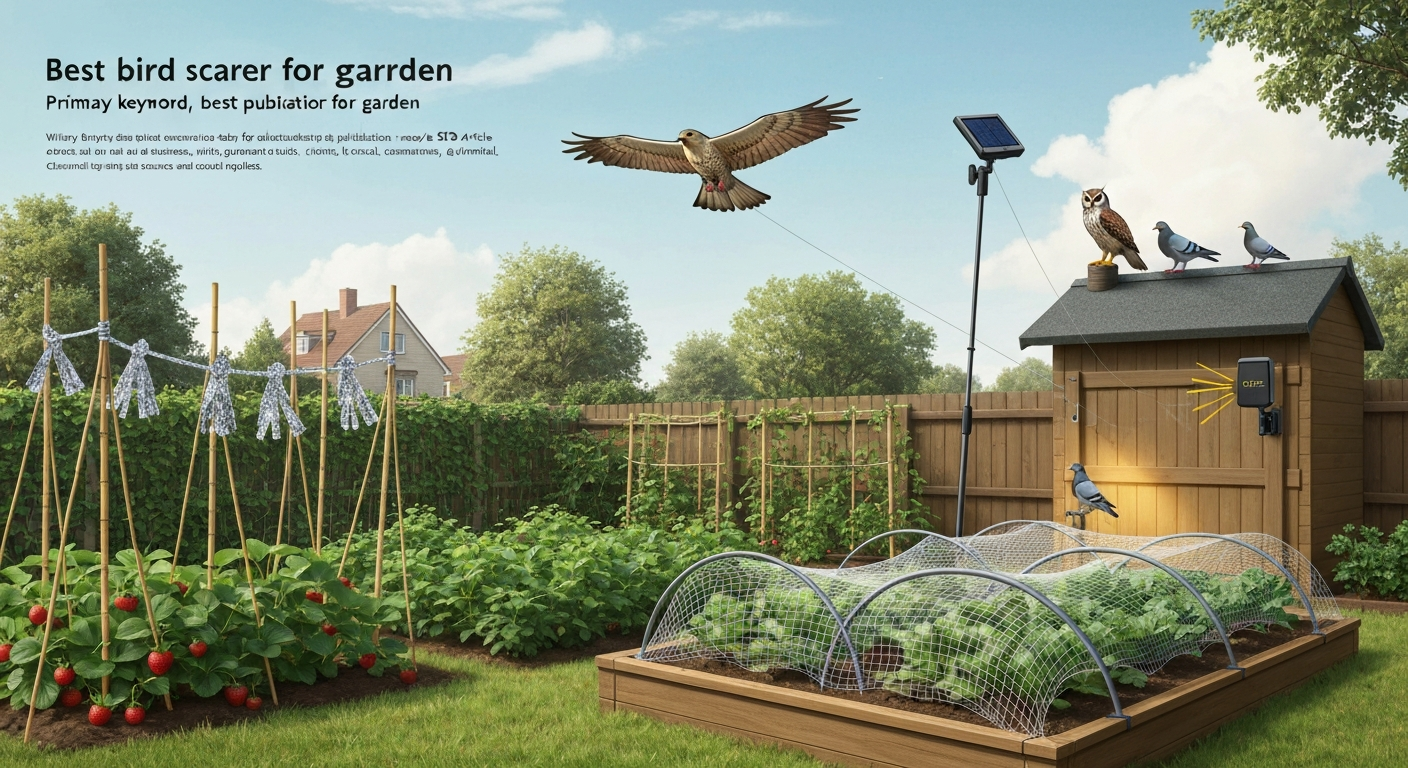
The research evidence is consistent on this point: single-method approaches fail faster. The most effective garden bird management programs combine at least two or three methods simultaneously and vary them over time. A practical multi-method setup for a typical medium-sized vegetable garden might look like this: exclusion netting over the most vulnerable beds, a predator kite flying above the open plot, reflective tape along fence tops, and a programmable sonic unit set to random distress calls during daylight hours. For reviews of the best bird scaring device options and concise buying guidance, see the product comparison. Each element addresses a different bird behaviour, and together they create an unpredictable environment that is much harder for birds to habituate to.
Troubleshooting common problems
| Problem | Likely Cause | Solution |
|---|---|---|
| Birds returning within days | Habituation to static deterrent | Move the device, add a second method, randomise sonic timing |
| Predator kite not flying | Insufficient wind or wrong kite angle | Recheck swivel, try a higher pole, use a lighter silhouette material |
| Netting not stopping birds | Gaps at corners or ground level | Inspect and seal all edges; use pegs or weighted base |
| Sonic unit triggering pets/neighbors | Volume too high or misdirected speakers | Lower volume, redirect speakers, set tighter operating hours |
| Spikes collecting debris and still used by birds | Accumulated debris covering spike points | Clear debris every 2–3 months; check adhesive has not lifted |
| Chemical repellent washing off quickly | Rainfall or irrigation frequency | Reapply after rain; try gel formulation on ledges for longer duration |
| Birds going around deterrent area | Deterrent coverage too narrow | Expand coverage zone; protect adjacent landing spots |
When to call a professional
Most garden bird scarer installations are reasonable DIY projects, but there are several situations where professional help is worth it. Any work at roof height or on a pitched roof to install spikes, netting, or solar-panel critter guards should be assessed carefully for safety. If you have a persistent, large-scale pigeon or starling roost causing structural damage or health concerns (pigeon guano can carry fungal pathogens), a licensed pest control company can conduct a full survey and recommend or install integrated solutions including physical barriers and habitat modification. Professionals also have access to restricted-use products and legal removal options that are not available to homeowners. If you suspect an active nest of a protected species is involved, stop all deterrent activity at that site and seek guidance from your state wildlife agency before proceeding.
Environmental and safety summary
- Always confirm whether the target bird species is protected under the Migratory Bird Treaty Act or state/local law before acting.
- Use physical exclusion and passive visual deterrents as your first option; they carry the lowest risk to birds, pets, and people.
- For sonic units: stay within safe sound levels near regularly occupied areas and set directional speakers away from boundaries.
- Chemical repellents must be applied per label instructions with appropriate PPE; do not use restricted-use pesticides without certification.
- Check netting regularly to ensure no birds have become trapped; small birds can enter gaps and become unable to exit.
- Avoid gel repellents in areas frequented by small birds, bats, or beneficial insects, as they can cause unintended trapping.
- Solar panel critter guards and exclusion mesh must be installed using clamp-based systems that do not damage panel frames or void warranties.
FAQ
What are the most important selection criteria when choosing a bird scarer for gardens, patios, roofs or solar panels?
Use these evidence‑based criteria: effectiveness (peer/evidence support and real‑world trials); species targeted (pigeons, starlings, sparrows, gulls differ in hearing/visual sensitivity); coverage area and placement (device-rated coverage vs. real site geometry); habituation risk (static devices habituate; prefer variable or rotating stimuli); safety to people, pets and wildlife (noise/SPL limits, non‑lethal methods, product SDS); legal issues (MBTA and local laws restrict harming migratory/protected species and nest removal); physical compatibility (roof/solar warranties, mounting options); permanence and maintenance (weatherproofing, battery/solar power, reapplication intervals); cost (upfront, installation, recurring); and environmental impact (non‑toxic vs pesticide use). Combine criteria to match species, site, and budget.
Which broad categories of bird scarers work best, and what are their strengths/limits?
Main categories: visual (reflective tape, predator kites, moving decoys) — low cost, immediate effect but high habituation unless movement/variation used; sonic/sonic+ultrasonic (programmable distress/predator calls, directional speakers) — can be effective if in species hearing range and variable; ultrasonic‑only units — largely unsupported by trials for pigeons/passerines; physical barriers (netting, spikes, tensioned wire) — highest reliability for permanent exclusion; chemical repellents (methyl anthranilate) — effective for crops/localized feeding deterrence when label‑used; bird‑kites/raptor decoys — moving predator models show good short‑term reductions; electronic active systems (remote‑triggered or motion‑activated cannons, lasers) — effective for larger sites when used unpredictably; integrated multi‑method systems — best long‑term results to reduce habituation. Choose based on species, site permanence and safety.
What specific products or product types should I consider (and which are 'best for' common scenarios)?
Category picks and typical 'best for': - Best for quick garden/patio deterrence: reflective tape, holographic streamers + motion predator kite (low cost). - Best for pigeons on roofs/ledges: stainless steel spikes or polyurethane spike strips (permanent exclusion). - Best for solar arrays: exclusion netting/under‑panel mesh and critter guards; combined with perimeter spikes/tensioned wire. - Best for large lawns/grounds: programmable sonic systems with directional speakers and variable predator/distress calls (commercial Bird‑X/BirdXPeller style) used in rotation. - Best for farms/fruit beds: exclusion netting (3/4"–1" mesh) and methyl anthranilate sprays for feeding deterrence. - Best for stubborn roosting (industrial/airport scale): integrated active hazing (pyrotechnics, propane cannons, lasers) handled by pros. Note: ultrasonic‑only devices are not recommended for pigeons/passerines as primary control.
What are evidence‑based picks for pigeon control on roofs and ledges?
Top choices: - Stainless‑steel bird spikes or polyurethane spike strips installed along ledges and parapets (most reliable for perching prevention). - Tensioned wire systems (‘hawk wires’) that create unstable perching lines. - Netting for deep eaves or open ledge cavities. - If access is needed or nest removal required, consult wildlife/agency rules first; non‑lethal exclusion is preferred. Combine with habitat modification (remove food/water, seal access points). Avoid ultrasonic devices as a sole measure for pigeons.
How should I protect solar panels from nesting and soiling?
Recommended approach: - Install exclusion netting/mesh beneath arrays and between panels with proper support to avoid sagging; choose corrosion‑resistant materials. - Use 'critter guards' or enclosed rail covers to block under‑panel access while not shading panels or voiding warranties — check manufacturer guidance. - Apply physical perimeter exclusion (netting or spikes) and remove perching points. - Regular visual inspections, scheduled cleaning for droppings, and design details that prevent debris build‑up. For utility/commercial arrays consult PV manufacturer and NREL/DNV guidance to ensure warranty and safety compliance.
Are ultrasonic bird scarers effective?
Independent studies show ultrasonic‑only devices generally have mixed to poor results for pigeons and many passerines because target species have limited sensitivity >12 kHz. Devices that combine audible distress/predator calls in the 1–12 kHz range and vary timing/locations perform better. Therefore, avoid relying solely on ultrasonic units for residential pigeon/starlings problems.
Next Article
Bird Scarer Kite Instructions: Build, Rig, Deploy Guide
Bird scarer kite instructions: step-by-step DIY build, rigging, placement, safety, maintenance & buying tips.