
Reflective bird deterrents do work, but only in the short term and only under the right conditions. Most birds respond to the flashing light and movement during the first few days, but they figure out pretty quickly that nothing bad is actually happening. Expect 7 to 14 days of solid deterrence before habituation starts to set in. For a low-pressure bird problem in a garden or on a patio, that can be enough. For a persistent problem on a roof, solar panels, or a commercial site, reflective deterrents alone won't cut it long-term, and you'll need to combine them with physical barriers or other methods.
Do Reflective Bird Deterrents Work? What Actually Helps

Marcus Weatherby
24 May 2026
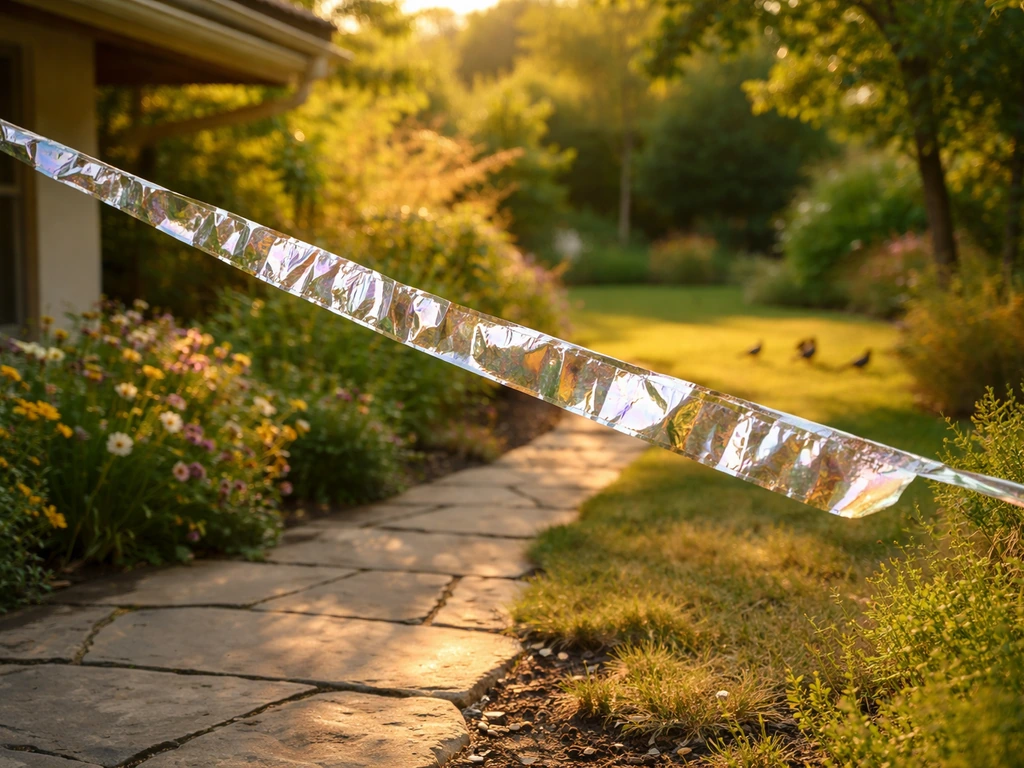
What reflective bird deterrents are and how they work
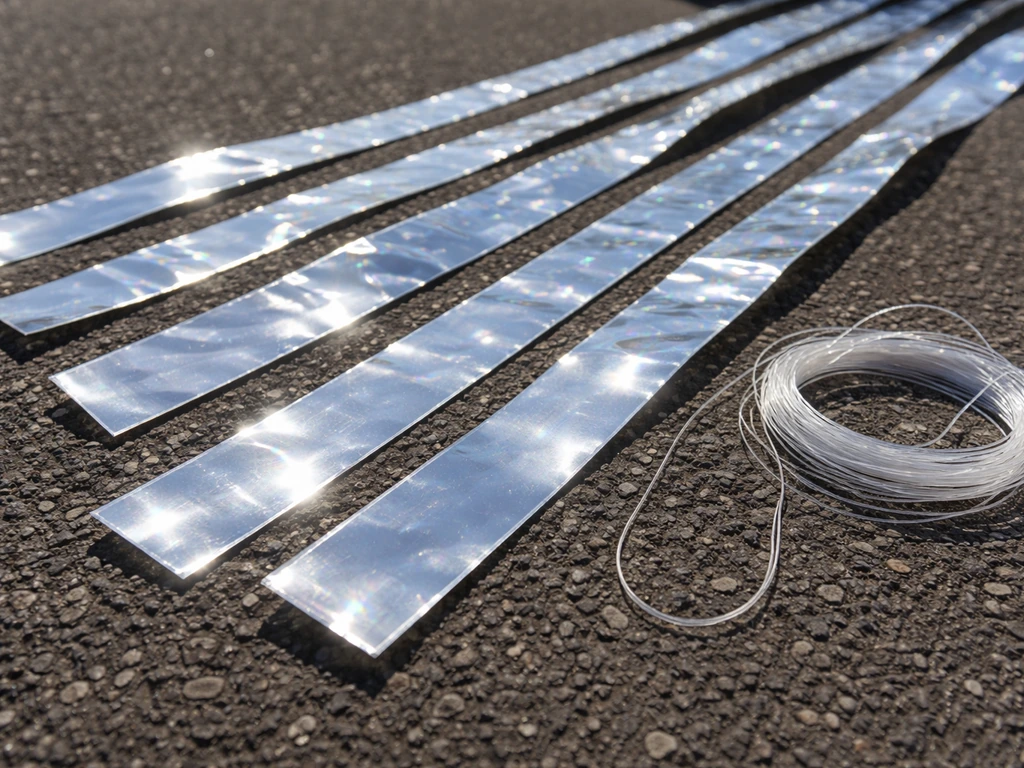
Reflective bird deterrents are visual scare devices that use light and movement to make birds uncomfortable enough to leave an area. The most common types are reflective Mylar tape (also called bird tape or scare tape), aluminum foil strips, mirrored or holographic spinning discs, reflective ribbon, and shiny ornaments or pinwheels. Some products combine reflective surfaces with metallic rattling sounds, which adds an audio dimension.
The theory behind them is straightforward. When sunlight hits a reflective surface and the material moves in a breeze, it throws erratic, unpredictable flashes of light across the surrounding area. Birds have wide-angle, color-sensitive vision and are naturally wary of sudden visual disturbances. That flashing light mimics the kind of unpredictable movement that signals potential danger in the wild, triggering a flight instinct.
Two things need to happen for this to work: the material has to catch enough direct sunlight to produce a strong flash, and there has to be enough breeze to keep it moving. A strip of Mylar tape pinned flat against a surface in a shaded spot does almost nothing. Hung so it can spin and flutter freely in an open, sunny area, it becomes a genuinely startling stimulus for birds approaching that zone.
Do they actually work? Real results by location, species, and situation
The honest answer is: sometimes, for some birds, in some places. Extension services and federal wildlife agencies describe reflective deterrents as widely used but note that formal research evidence for their long-term effectiveness is limited. Industry sources claim initial success rates of 70 to 85 percent in the first week, which lines up with field observations, but that number drops sharply as habituation sets in around days 10 to 15.
Smaller, more skittish birds like sparrows, finches, and starlings tend to respond better than confident urban birds like pigeons, crows, or gulls. Pigeons especially are notoriously hard to move with reflective-only approaches. Woodpeckers fall somewhere in the middle. Penn State Extension also cites Cornell research that tested multiple products for woodpecker damage, including Irri-Tape bird repellent ribbon, as part of visual deterrent approaches Woodpeckers fall somewhere in the middle.. Virginia Tech extension research notes that stationary visual deterrents generally do little for woodpeckers, but reflective or holographic tape hung so it moves freely near the center of the affected area can help.
Location matters just as much as species. Here's how results tend to play out across the most common settings:
| Location | Typical Effectiveness | Key Limitation |
|---|---|---|
| Garden / vegetable beds | Moderate (short-term) | Habituation within 1–2 weeks |
| Fruit trees / berry bushes | Low to moderate | Netting outperforms tape for small fruits |
| Patio / deck | Moderate | Works best with regular relocation |
| Roof / gutters | Low | Limited movement, fixed surfaces reduce flash |
| Solar panels | Low to moderate | Birds find sheltered spots beneath panels; physical exclusion preferred |
| Pool / water feature | Moderate | Combine with decoys and water-movement deterrents |
| Commercial property | Low long-term | High habituation; needs escalation plan |
| Airport or airfield | Not appropriate alone | FAA guidance explicitly classifies as short-term only |
One important limitation: reflective deterrents only work during daylight and only when there's enough sun to produce a flash. On overcast days or in shaded areas, you're relying mostly on movement, which is a much weaker stimulus. This is why they're classified as a supplemental tool rather than a stand-alone solution in most professional wildlife management contexts.
Why reflective deterrents fail: habituation, placement, and gaps in coverage
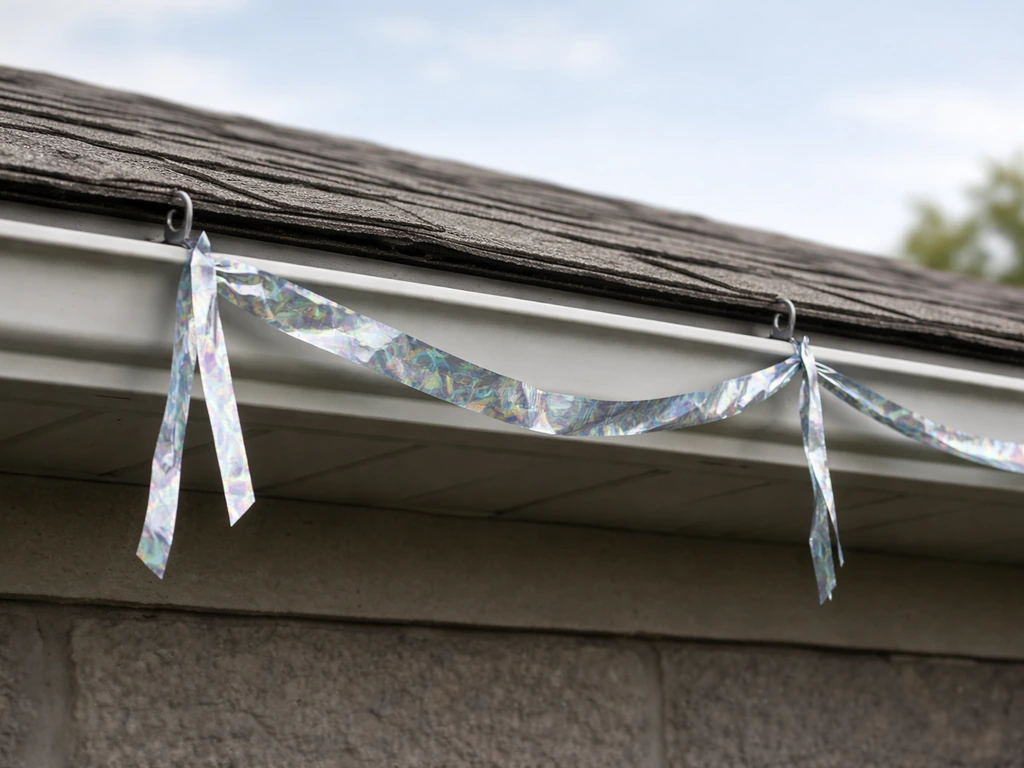
Habituation is the main problem
Birds are smart. Once they've visited your roof, garden, or patio enough times without anything bad actually happening near that shiny tape, they stop treating it as a threat. UC ANR's Bird Hazing Manual describes this clearly: even a good initial response can fade fairly rapidly because there's no real danger associated with the flashing. A bird that has established a feeding or roosting routine on your property is much harder to move than one that hasn't settled in yet. This is why deploying reflective deterrents early, before birds have formed habits around your space, gives you the best results.
Placement mistakes that kill effectiveness
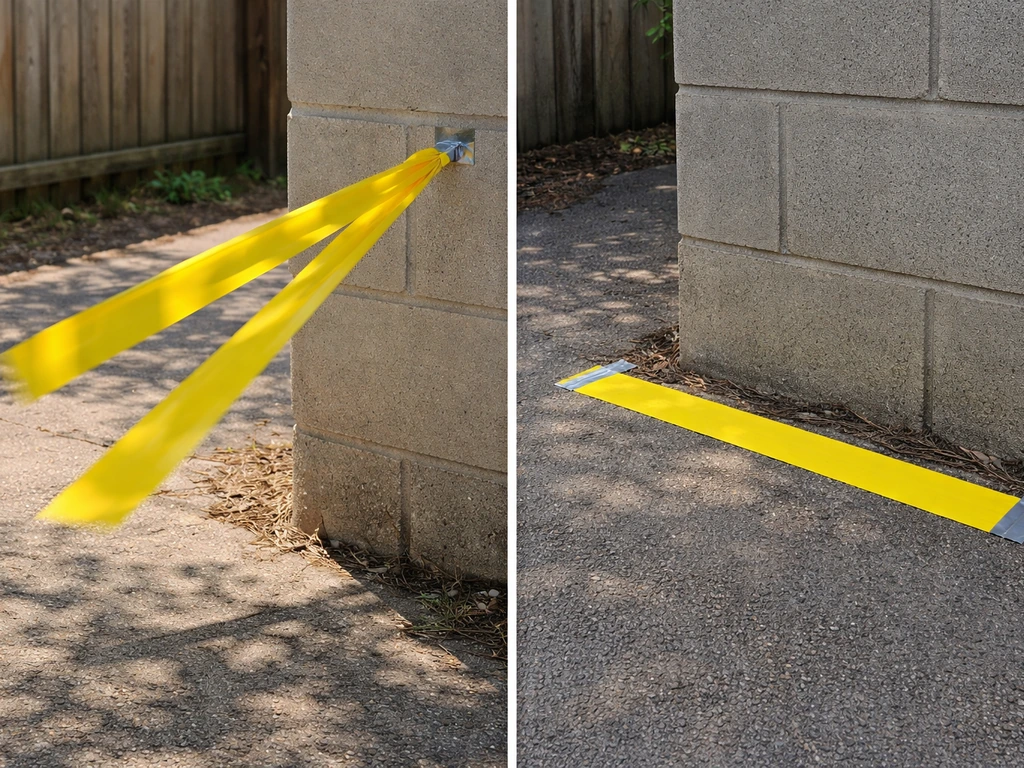
- Hanging tape flat against a wall or fence where it can't move freely in the wind
- Placing deterrents in shaded spots where sunlight rarely hits them directly
- Using too few strips for the area, leaving wide gaps birds can pass through unbothered
- Not hanging strips at bird eye level or at the entry points birds actually use
- Leaving the same deterrent in the same spot for weeks without rotating it
Weather and lighting gaps
Reflective deterrents are essentially useless at night and significantly weaker on cloudy or overcast days. If your bird problem peaks at dawn or dusk, or in shaded parts of your property, a pure reflective setup will underperform. USDA APHIS notes that the flashing effect depends directly on sunlight reflecting off the surface, which means sun angle throughout the day affects how consistently the stimulus is delivered.
Coverage gaps let birds route around the deterrent
Birds approaching from angles not covered by reflective material will simply walk or fly around the deterrent. This is a common failure mode when people hang a single strip of tape at one point on a fence or roof line and expect it to protect a whole area. Coverage needs to be consistent across the entire perimeter birds use to approach the target zone.
How to install reflective deterrents for maximum impact
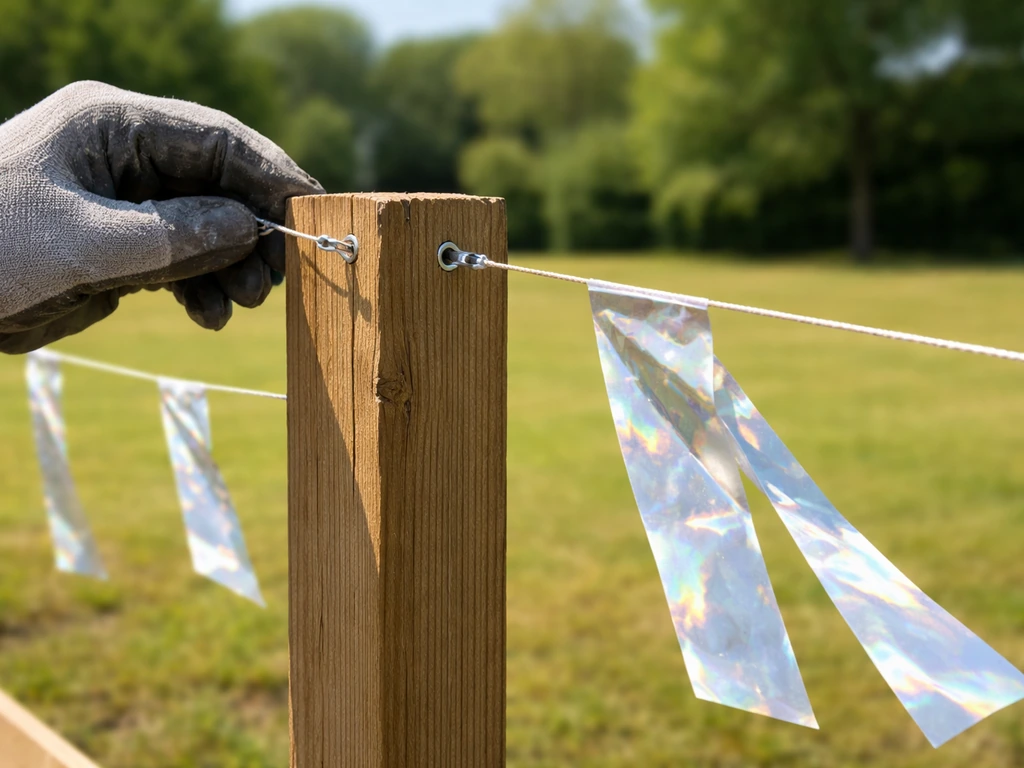
Setup quality makes a huge difference. Here's a practical checklist based on extension guidance and field best practices:
- Choose a sunny, open location: Position deterrents where they'll receive direct sunlight for most of the day and catch wind movement. Avoid placing them flat against backing surfaces.
- Hang tape and ribbon so the ends are free: Missouri Extension specifically recommends allowing free-hanging ends so the material flutters and twists in even light breezes. Tie one end to a post or string, and leave the other end loose.
- Space strips 3 to 4 feet apart along the perimeter: This closes the gaps birds use to enter without triggering the deterrent. For a 10-foot-wide garden bed, use 3 to 4 strips positioned to create a visual barrier from the bird's approach angle.
- Use multiple deterrent types in the same area: Combine tape with spinning reflective discs or pinwheels to create variation in the visual signal. A single uniform stimulus habituates faster than mixed stimuli.
- Install at the height birds are targeting: If birds are hitting your blueberries at knee height, that's where the reflective material needs to be, not 6 feet in the air.
- Check and replace degraded materials regularly: Mylar tape weathers and loses its reflective quality after a few weeks in sun and rain. Faded tape does almost nothing.
- Rotate placement every 7 to 10 days: Move strips to different points around the protected area. Penn State Extension and OSU Extension both emphasize rotation as the single most effective way to slow habituation.
- Remove attractants at the same time: Reflective deterrents work much better when combined with food source removal, pruning dense cover birds use to hide near the target area, and clearing water sources if applicable.
How long to wait and how to tell if it's working
Give your setup 5 to 7 days before drawing conclusions. In the first few days, you should see a clear reduction in bird activity in the protected area. If birds are still visiting at the same frequency after a week with no improvement, your coverage has gaps, the placement is wrong, or these particular birds are already habituated to the stimulus.
A simple way to track results: spend 10 minutes in the morning and evening observing the area for 3 to 4 days before installing any deterrents. Note how many birds you see, where they land, and what they're doing. Repeat those observations after installing the deterrents. If activity drops by 50 percent or more in the first week, the deterrent is working. If it creeps back up toward baseline by day 14, habituation has set in and it's time to rotate placement or bring in a second deterrent type.
If you're still seeing the same bird activity after two weeks despite regular rotation and good placement, reflective-only deterrents aren't going to solve this problem on their own. That's your signal to escalate.
When to combine reflective deterrents with other bird control methods
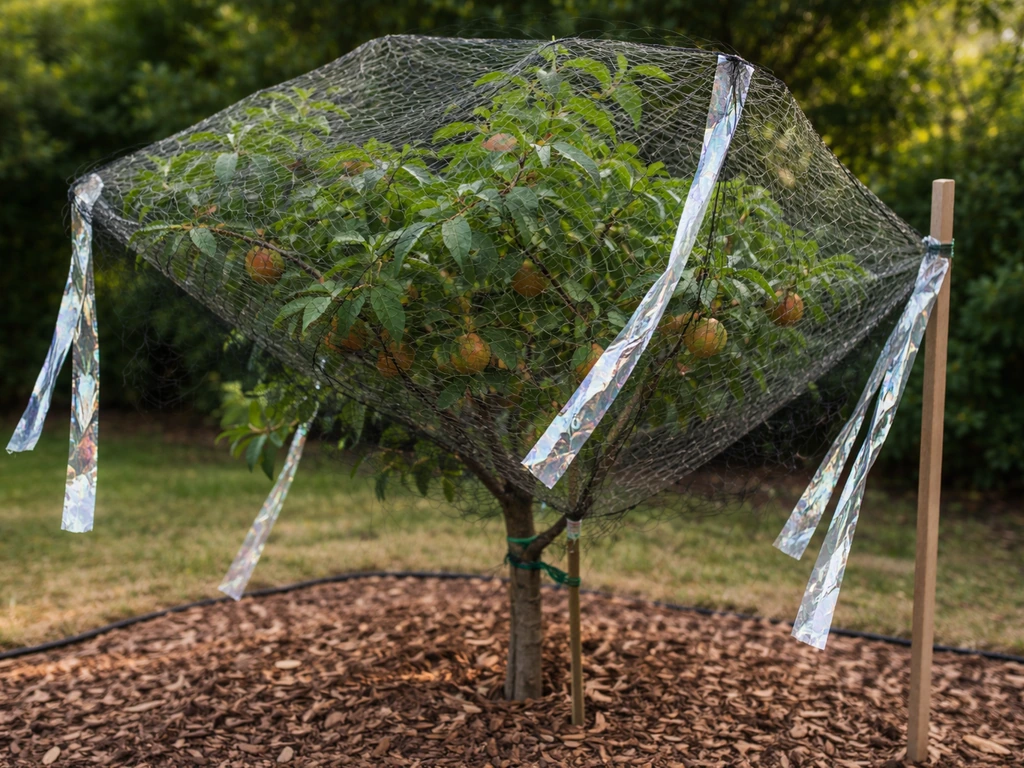
Reflective deterrents work best as one layer in a multi-method approach, not as a standalone fix. If you want the best reflective bird deterrent approach, plan to rotate and combine options so birds do not habituate quickly reflective deterrents. Here's how to pair them with other tools based on your specific situation:
Physical barriers: netting and spikes
For fruit trees, berry bushes, and isolated garden beds, Penn State Extension is clear that netting is the most effective way to reduce bird damage. Reflective tape can supplement netting by deterring birds from approaching, but if your primary concern is protecting a harvest, netting is the foundation and tape is the addition, not the other way around. For rooftop roosting, ledge spikes are far more reliable long-term than reflective tape, which birds will simply ignore once they've habituated to it.
Sensory deterrents: sonic and ultrasonic
Combining reflective deterrents with sonic or ultrasonic devices adds a second sensory channel that birds have to process simultaneously. If you want a longer-lasting option, consider a solar powered ultrasonic animal and bird repeller manual as part of your sensory-deterrent setup. If you are wondering whether do sonic bird repellers work, the key is whether the birds keep getting hit with consistent distress or predator cues long enough to prevent habituation. Since the two stimuli work through different mechanisms, pairing them slows habituation more effectively than either alone. Sonic repellers that broadcast distress calls or predator sounds tend to be more effective than ultrasonic devices for most bird species. For a full solution, the best ultrasonic bird deterrent is usually paired with other deterrent types to reduce the risk of birds habituating Sonic repellers. A properly chosen sonic bird repeller can help you keep birds away by adding predator or distress audio to your deterrent setup Sonic repellers. If you're already researching visual deterrents, it's worth looking at how sonic and ultrasonic options perform in your specific context, since the right combination depends heavily on the bird species involved. Do ultrasonic bird repellers work, and how do their results compare to sonic devices for your specific bird problem?
Other visual deterrents: decoys and motion-activated devices
Predator decoys (hawk or owl silhouettes) paired with reflective tape create a more complete threat signal than either alone. The key with decoys, just like with reflective tape, is regular repositioning to prevent habituation. A plastic owl that never moves gets ignored within a week. Motion-activated sprinklers or lights add a real consequence to bird approach behavior, which is something reflective tape on its own cannot provide.
Chemical repellents
Taste-aversion repellents like methyl anthranilate (a grape-derived compound used in food-grade bird repellents) applied to turf or specific surfaces can work alongside reflective deterrents for ground-feeding birds like geese or starlings. The reflective material deters approach while the repellent discourages landing and feeding. This combination is particularly useful around pools and commercial turf areas where physical exclusion isn't practical.
Escalation path for persistent problems
Penn State Extension notes that highly habituated birds sometimes require approaches that involve real consequence, such as pyrotechnics or exploders, which require permits and trained operators. USDA Wildlife Services provides professional wildlife management for airports, farms, and commercial sites through trained personnel meeting FAA standards. If you've exhausted DIY options and the problem persists, that's the appropriate next step for serious or high-stakes situations.
Safety, durability, and legal considerations
Safety for birds and property
Reflective Mylar tape and foil strips are physically harmless to birds. They create a visual and sometimes auditory deterrent without trapping, injuring, or killing. That said, loose tape should be secured so it can't entangle birds or small animals. Check installations after storms, since wind can tangle loose ends into a hazard. For windows, avoid setups that cause birds to fly directly into the glass trying to escape the reflective stimulus.
Durability and maintenance
Most Mylar tape products hold up for 4 to 8 weeks in outdoor conditions before UV degradation and weather reduce their reflective quality significantly. Spinning disc deterrents typically last a full season if the hardware is stainless or galvanized. Budget for regular replacement if you're using tape as a primary deterrent, and inspect everything after heavy wind or rain.
Legal considerations for migratory birds
In the United States, most common pest birds (pigeons, starlings, house sparrows) are not protected under the Migratory Bird Treaty Act and can be deterred without permits. However, if birds near your property include protected migratory species, woodpeckers, or raptors, passive deterrents like reflective tape are generally fine, but trapping, relocating, or harming them requires permits. When in doubt, contact your state wildlife agency before doing anything beyond passive deterrence.
Aviation and airport-adjacent properties
This is where reflective deterrents hit a hard wall. The FAA's Wildlife Hazard Management at Airports manual explicitly classifies Mylar reflecting tapes as short-term only and inappropriate as a long-term solution for airport bird management. FAA Advisory Circular 150/5200-33C provides guidance on hazardous wildlife attractants near airports, and any deterrent program at or near a public-use airport needs to be evaluated within that framework. If your property falls within the wildlife hazard management zone of an airport, a DIY reflective-only approach isn't appropriate regardless of how well it's installed. USDA APHIS Wildlife Services has trained personnel who work to FAA standards for exactly these situations, and that's who you should contact.
Michigan DNR guidance for airport-adjacent landowners also emphasizes that removing attractants like prey species and food sources is more effective than any visual deterrent in high-stakes bird strike zones. Reflective devices can play a minor supporting role, but they cannot be the primary tool.
FAQ
Do reflective bird deterrents work on every bird species, or are some birds basically impossible to scare off?
They work best on smaller, skittish birds, but confident species like pigeons, crows, and gulls often ignore them once they realize there is no real consequence. If your problem birds keep landing and calmly feeding, switch to physical exclusion (netting, ledge spikes, or hardware cloth) or add a second deterrent type rather than relying on reflective only.
How long does it usually take before I know whether reflective tape is working?
Give it about 5 to 7 days before judging. You should see a noticeable drop in visits early, and then it may start to recover around day 10 to 15 if habituation is setting in. If activity stays the same after a full week, it usually means gaps in coverage, insufficient sun, or birds have already established habits.
Does cloudy weather or shade completely ruin reflective deterrents?
They become much less reliable. On overcast days you get movement, but weaker flashing, so results often look inconsistent through the day. If your area is frequently shaded or gets only low sun angles, plan on combining reflective tape with another method that does not depend on strong sunlight.
What’s the most common reason reflective tape “fails” even when it’s installed correctly?
Coverage gaps. If birds can approach from angles not covered by the reflective material, they will route around it. A single strip placed at one point often protects a small area, not the entire approach path birds use.
Do reflective bird deterrents work at night or around dawn and dusk?
They are essentially useless after dark because they rely on sunlight to create flashes. They can still help during the first daylight window, but if your birds are most active at dawn or dusk in low light, a reflective-only setup will underperform unless you add a different deterrent that works in low light.
Should I rotate or change the placement of reflective tape to prevent habituation?
Yes. Even with good placement, birds can habituate when the stimulus stays predictable. Rotating the tape pattern or moving it to a slightly different perimeter angle every couple of weeks can help delay habituation, especially if you’re seeing activity creep back toward baseline.
Can I use reflective tape inside near windows, or will it risk hurting birds?
Use caution. Birds may repeatedly fly into glass while trying to escape the perceived threat or confusion caused by reflected light. If you are using it near windows, ensure it does not direct intense reflections into flight paths, and consider adding a window strike solution (like coverings or decals) instead of relying only on deterrence.
How long do Mylar tape and spinning reflective discs last outdoors?
Mylar and foil style tapes typically lose effectiveness in about 4 to 8 weeks due to UV degradation and weathering. Spinning discs usually last longer for a full season if the hardware resists rust, but you still need to inspect them after storms because wind can stop movement or loosen hardware.
Is reflective tape safe for birds and other wildlife, or can it cause harm?
The reflective materials are physically harmless, but loose tape can tangle or entangle birds and small animals if it is not secured. After storms, check for flapping or loose ends, and keep setups away from areas where animals could get trapped or where tape could interfere with movement.
Do reflective deterrents work on rooftop roosting or ledges, like for pigeons?
They are often less reliable on roosting spots because birds can habituate quickly to visual cues there. Ledge spikes (or other exclusion hardware) tend to be far more dependable for rooftop roosting, while reflective tape works better as a supplement during the initial disruption phase.
If reflective tape works only short term, when should I escalate to a more serious solution?
If you have good placement, enough sun, and correct coverage, but birds return at baseline levels by around two weeks, it’s a sign reflective only is not enough. At that point, escalate to exclusion (netting or spikes), add a second deterrent channel (audio or motion-activated consequence), or involve professional wildlife management for persistent or high-stakes cases.
Are reflective deterrents allowed everywhere, including near airports?
Near airports, DIY reflective-only approaches are not appropriate for long-term wildlife hazard management. If your property is within an airport wildlife hazard area, follow airport hazard guidance and contact the appropriate trained wildlife office. For other protected species, stick to passive deterrence and confirm permit requirements with your state wildlife agency before doing anything beyond visual/physical deterrence.