
Bird decoys do work, but only under the right conditions and usually not for long on their own. The honest answer is that a realistic, well-placed predator decoy can clear pigeons from a balcony or scatter gulls from a rooftop for days at a time. However, birds habituate fast, research shows habituation can begin as quickly as 7 days after first exposure, and a static owl sitting in the same corner for three weeks will eventually be treated as furniture. Decoys are a legitimate tool, not a complete solution, and they perform best when combined with movement, other deterrents, and consistent rotation.
Do Bird Decoys Work? Practical Guide for Homes, Farms, Solar & Airports

Marcus Weatherby
28 Jul 2026
How decoys actually work on birds
Birds rely on visual cues to assess predation risk constantly. When a bird spots what looks like a hawk, falcon, or owl, it triggers an evolved fear response: flee now, assess later. This is the core mechanism behind any predator-mimic decoy. The bird's nervous system is wired to treat even an approximate threat silhouette as real enough to avoid, especially in open or exposed environments where escape routes are limited.
Territorial cue decoys work differently. Placing a crow or goose decoy can signal to incoming birds that a space is already occupied, discouraging landing, the same principle that makes a flock of plastic geese appealing to hunters but can also deter new arrivals from settling. Dead-bird or distress-posture decoys exploit an additional fear response: seeing what appears to be a dead flock member signals danger in the area.
A 2024 meta-analysis on non-lethal predator fear cues confirmed that visual predator stimuli do produce measurable anti-predator responses in birds. Importantly, a separate meta-analysis found that multimodal cues (visual plus acoustic together) consistently produce larger effect sizes than visual cues alone. That finding is worth keeping in mind: a decoy paired with a sonic or ultrasonic repeller outperforms a decoy standing alone. For more on the effectiveness of ultrasonic devices, see do ultrasonic bird repellers work. If you're asking do sonic bird repellers work, see our separate guide on sonic and ultrasonic deterrents for evidence and practical tips. For product recommendations, see our guide to the best ultrasonic bird deterrent.
Types of decoys and how effective each one is
Not all decoys are built the same, and their effectiveness varies considerably by construction, movement, and realism. Here is a practical breakdown of the main categories.
Static predator models
These are the classic plastic owls and hawk silhouettes sold at garden centers. They provide an initial deterrent effect and are cheap (typically $10–$40), but their fixed position and lack of movement are exactly why birds learn to ignore them quickly. If you use one, mount it on a swivel or pivot so wind creates some motion, and relocate it every 3 to 5 days.
Moving and kinetic decoys
Decoys with rotating heads, spinning wings, or motorized movement hold up much better against habituation than static models. A 2025 field trial using a raptor-like robot (the RobotFalcon) showed it produced immediate collective escape responses in approximately 500 feral pigeons and around 8,000 roosting gulls, with some bird groups not returning to treated sites for 3 to 4 hours post-exposure and showing reduced return rates across successive days. That is a powered, realistic moving model, a far cry from a plastic owl, but the principle applies: movement matters enormously.
Inflatable and balloon decoys
Inflatable owls and eye-spot balloons move naturally in the breeze and are inexpensive to deploy over large areas like crops or ponds. The motion helps, but the visual realism is lower than a molded predator model. Eye-like stimuli have specific value for some species: a 2026 study found that eye-like patterns reduced foraging in urban European herring gulls, with around 50% of tested individuals continuing to avoid the stimulus in the short term. These work best when the balloon is moving and positioned at eye level or just above the birds' typical flight path.
Silhouette decoys
Flat cutout silhouettes of hawks or falcons, often hung in windows or suspended from lines, are primarily used to prevent window collisions rather than to deter birds from landing. Their effectiveness as territorial deterrents is limited compared to three-dimensional models, but they are the right tool for their specific job.
Reflective visual decoys
Some decoys incorporate reflective surfaces or holographic foil, which creates unpredictable flashes of light. These overlap in function with reflective bird deterrents more broadly. The light disturbance adds a sensory layer beyond shape recognition and can extend the useful life of a decoy setup. They tend to work better outdoors in full sun and are less useful in shaded or covered areas. For a quick buyer's guide to the best reflective bird deterrent options and how to deploy them effectively, see our roundup of top reflective bird deterrents. For more on mirror- and foil-based products, see do reflective bird deterrents work.
| Decoy Type | Realism | Habituation Risk | Best Use Case | Approx. Cost |
|---|---|---|---|---|
| Static plastic owl/hawk | Moderate | High (within days) | Short-term deterrence, small patios | $10–$40 |
| Moving/motorized model | High | Low to moderate | Rooftops, open areas, persistent problems | $40–$200+ |
| Raptor-like robot | Very High | Very low (short exposure) | Airports, large open sites (professional use) | $500–$5,000+ |
| Inflatable/balloon with eye spots | Low to moderate | Moderate | Gardens, crops, ponds | $10–$30 |
| Silhouette cutout | Low | High | Window collision prevention | $5–$20 |
| Reflective decoy | Low to moderate | Moderate | Open sunny sites, supplementary use | $10–$50 |
Which bird species respond to decoys (and which don't)
Pigeons, starlings, and sparrows
Feral pigeons show initial responses to raptor decoys but are among the fastest to habituate, especially in urban environments where they have prolonged exposure to humans and unusual objects. Starlings and sparrows are similarly quick learners. For these species, decoys alone rarely provide lasting results. They work best as part of an integrated setup that also includes sonic deterrents and physical exclusion like spikes or netting. For examples of effective acoustic devices to pair with decoys, see our guide to the best sonic bird repeller for recommended models and deployment tips.
Gulls and terns
Gulls are intelligent and adaptable. Research at landfill sites has shown that some common deterrents, including rubber shot hazing, fail to reduce gull numbers significantly, underscoring how resilient these birds are. That said, eye-like stimuli and moving raptor decoys have shown measurable short-term effects on herring gulls. Gulls at marinas, rooftops, and coastal commercial sites tend to respond better to decoys when combined with hazing and attractant removal.
Crows and corvids
Crows are among the most cognitively advanced birds and are notoriously resistant to simple decoys. They will often investigate and even mob a static owl. Dead-bird or distress-posture crow decoys can produce a short-term avoidance response, but corvids assess novel objects quickly and return to normal behavior fast. For crows, decoys are a poor primary tool and work better as one part of an active harassment program.
Waterfowl and geese
Canada geese and other waterfowl respond reasonably well to coyote and predator decoys placed near water edges, particularly during nesting season. Virginia Cooperative Extension guidance on Canada goose management lists decoys among multiple non-lethal tactics, but strongly emphasizes that removing attractants like accessible turf and standing water is essential for any deterrent to succeed. A predator decoy on a manicured lawn next to an open pond has a hard hill to climb.
Raptors and large birds
Raptors (hawks, eagles, vultures) generally do not respond strongly to predator decoys since they are themselves predators. Territorial decoys can work in some cases: placing a territorial raptor model may deter a resident bird from a specific perch, but this is inconsistent. For large birds at solar farms or airports, decoys are rarely used as the primary tool; habitat management and active hazing take priority.
Where decoys work well (and where they struggle)
Patios, balconies, and gardens
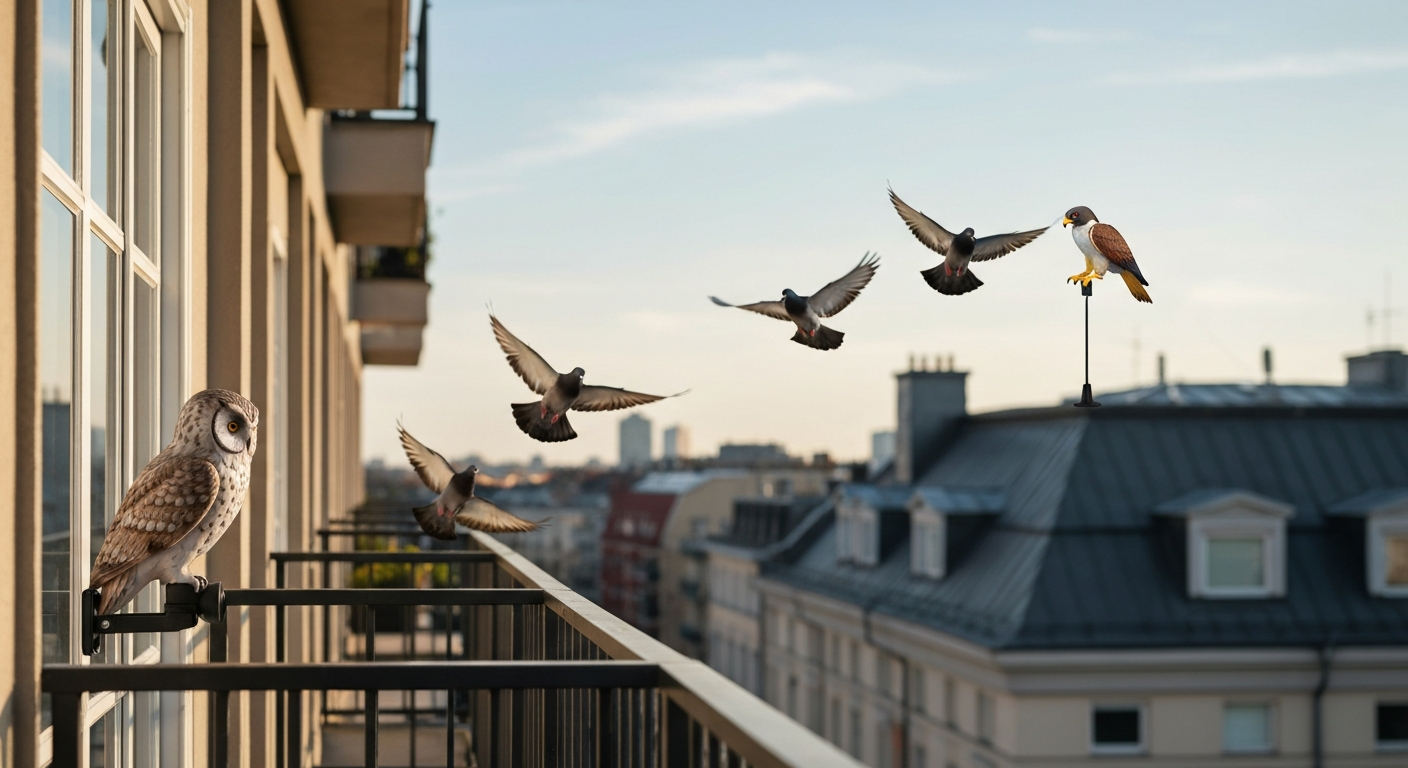
This is probably the most common homeowner use case, and decoys are reasonably practical here with proper rotation. A moving or swivel-mounted hawk or owl model placed at railing height, repositioned every 3 to 5 days, can meaningfully reduce pigeon and starling presence on a balcony. Small enclosed spaces actually benefit from decoys more than large open areas because there are fewer alternative landing spots and the decoy covers more of the bird's visual field relative to the space.
Roofs and vents
Rooftops are challenging because birds have the high-ground advantage and can observe the decoy for a long time before landing. Moving decoys mounted on chimney stacks or roof ridges work better than static ones. For persistent pigeon roosting on vents and ledges, decoys are usually a secondary measure while spikes or exclusion netting address the actual roost sites.
Pools and ponds
Coyote and heron decoys near water are popular for deterring geese, ducks, and fish-eating birds like herons. A single plastic heron placed near a garden pond can deter other herons (territorial response) for a few weeks. Coyote decoys along pool edges and pond banks work similarly for geese. The key limitation: once birds learn the decoy never moves, they return. Relocating it every few days is essential.
Solar panels and arrays
This is an area with a real evidence gap. Recent literature reviews of birds at utility-scale solar facilities report limited empirical data on deterrent efficacy, and current evidence does not support a decoy-only solution for reducing bird collisions with or attraction to photovoltaic arrays. Some species may be attracted to the polarized light reflections from panels, which creates a draw that a simple decoy is unlikely to overcome. Multimodal approaches (visual plus acoustic plus physical exclusion under panel rows) are the direction the research recommends, though even those lack strong controlled-trial data at solar scale. For practical guidance on deploying ultrasonic deterrents at solar installations, see the solar powered ultrasonic animal and bird repeller manual.
Farms and fields
Agricultural review literature rates exclusion (netting) and physical barriers as the most consistently effective crop protection methods; visual frightening devices, including decoys, show highly variable results and are prone to habituation. That does not mean decoys are useless on farms, but they work best as one rotating element in an integrated bird management program alongside noise cannons, pyrotechnics, or reflective tape. On large fields, density and coverage become a problem: one or two decoys cannot credibly cover several acres.
Commercial properties and airports
FAA wildlife hazard management guidance lists visual deterrents, decoys, and falconry as legitimate operational tools but explicitly emphasizes combined strategies, monitoring, and adaptive management over single-tool reliance. FAA operational guidance and strike data are summarized in Wildlife Strikes to Civil Aircraft in the United States from 1990 to 2024 (FAA) blank" rel="noopener noreferrer">FAA operational guidance and strike data are summarized in Wildlife Strikes to Civil Aircraft in the United States from 1990 to 2024 (FAA).. Transport Canada's airport bird control evaluation similarly classifies decoy methods as having variable efficacy by species and context. Transport Canada’s TP13029 evaluation (1998) reviewed many bird control products and techniques used at airports and concluded that efficacy varies by species and context, classifying methods as recommended, limited, or not recommended. At airports, where bird strikes carry serious safety consequences, decoys are one component of an integrated program that includes habitat modification, radar monitoring, active hazing, and regular assessment using strike database records. No airport relies on decoys alone.
Why decoys stop working: the main failure modes
- Habituation: Birds assess a stationary, non-threatening object over repeated encounters and stop treating it as a predator. The 2024 meta-analysis found habituation onset averaging around 7 days when it occurred. This is the single most common reason decoys fail.
- Food attractants: If birds have a strong enough reason to be in a location (reliable food, nesting sites, water), they will push past fear responses. Removing the attractant is often more effective than any decoy.
- Poor placement: A decoy placed too low, in shadow, or facing away from the bird's approach angle loses most of its impact. Birds approach from above and at angles; placement needs to reflect that.
- No movement: A completely static decoy in a still spot gives birds no reason to keep assessing it as a live threat. Even minimal wind-driven motion significantly extends effectiveness.
- Wrong species match: A hawk decoy will not reliably deter crows. A heron decoy will not deter geese. Matching the predator or territorial model to the target species matters.
- Weather and visibility: Heavy rain, fog, and low light reduce the visual range over which a decoy can work. In covered or enclosed spaces (like under solar panels), standard decoys provide little to no benefit.
- Overuse without rotation: Leaving the same decoy in the same position for weeks teaches birds the exact outline and location to ignore.
Exact placement rules, spacing, and rotation schedules
Good placement is the difference between a decoy that works for three weeks and one that stops working in three days. These guidelines are drawn from field application experience and the research literature.
Placement and density
- Height: Position predator decoys at the highest practical point in the target zone — roof ridge, fence post top, or raised pole. Birds scan from above, and a decoy at ground level has reduced visibility and credibility.
- Angle and visibility: The decoy should be visible from all primary approach directions. If birds typically approach from the south, the decoy face should be oriented to greet that approach.
- Spacing: For open areas like gardens or fields, place one decoy per 30 to 50 square meters of target area. One decoy is rarely sufficient for areas larger than about 100 square meters without supplementary deterrents.
- Elevation: For balcony or patio use, mount at railing height or just above — 0.9 to 1.2 meters above the surface birds are landing on. For rooftop use, ridge or chimney height works best.
- Clear sightlines: Do not block the decoy with furniture, planters, or equipment. It needs a full 180 to 270 degrees of unobstructed visibility.
- Near but not at perch sites: Place the decoy within 2 to 3 meters of the preferred landing or roosting spot, not far away in an unrelated area.
Rotation schedule
Rotate decoy position every 3 to 5 days as a baseline. If you are seeing birds return within 2 days of placement, move to a 2-day rotation. Change both position and orientation (the direction the decoy faces) at each rotation, do not just shift it a foot to the side. Once a month, consider swapping the decoy model entirely to present a different silhouette and color profile. In high-pressure situations with persistent flocks, daily repositioning may be necessary.
Seasonal pressure matters too. During nesting season (typically March through July in North America), birds are more motivated to stay near a site and will push past fear responses more aggressively. Increase rotation frequency and consider adding a second deterrent type during peak nesting pressure.
How to choose the right decoy for your situation
The right decoy depends on the species you are dealing with, the site, your budget, and how much ongoing maintenance you are willing to do. Here is how to think through the decision.
Decision criteria by species, site, and budget
| Scenario | Recommended Decoy Type | Key Supplement | Budget Range |
|---|---|---|---|
| Pigeons on balcony | Moving/swivel hawk or owl model | Rotate every 3–5 days; add reflective tape | $20–$60 |
| Gulls on commercial roof | Large moving raptor model or eye-spot balloon | Sonic deterrent; regular repositioning | $40–$150 |
| Geese near pool or pond | Coyote or alligator decoy at water's edge | Remove accessible turf food; add harassment | $25–$80 |
| Herons at garden pond | Plastic heron (territorial) at pond edge | Cover pond with netting for reliable protection | $20–$50 |
| Crows in garden/yard | Distress-posture or dead-bird crow decoy | Noise hazing; remove food attractants | $15–$40 |
| Starlings and sparrows in garden | Owl or hawk model with reflective elements | Reflective deterrent strips; sonic repeller | $15–$50 |
| Birds at solar panels | Raptor model mounted above array (limited data) | Physical exclusion mesh under panels is primary solution | $30–$100+ |
| Farm crop protection | Multiple raptor effigies or balloons across field | Integrate with noise cannons and netting | $50–$200+ |
| Airport/commercial aviation | Professional raptor robot or trained falconry | Full integrated wildlife management program | $500–$5,000+ |
Realism, movement, and mounting options
If you can afford only one upgrade, choose movement over realism. A modestly realistic decoy that rotates in the wind outperforms a highly detailed static model. Look for decoys with swivel bases, pivot mounts, or motorized rotation. For fixed mounting on a roof, a pole-mounted model that allows 360-degree rotation is ideal. For balconies and patios, a weighted base with a swivel top is the simplest effective option.
Quick selection checklist for buyers and DIYers
- Identify the target species before buying — check which predator is actually feared by that bird in your region.
- Choose a model with built-in movement (swivel head, spinning wings) or plan to mount it on a separate swivel stake.
- Confirm the decoy is UV-resistant and weatherproof if it will be outdoors year-round.
- Plan your rotation schedule before installation — decide now where the four or five repositioning spots will be.
- Assess whether a food or water attractant is drawing birds to the site; address that first or alongside the decoy.
- If dealing with a species known for fast habituation (crows, urban pigeons, gulls), budget for a secondary deterrent from day one — sonic repellers or reflective deterrents pair well with decoys.
- Set a review date two weeks after installation to check whether bird activity has decreased, stayed the same, or increased; adjust placement and rotation if needed.
When to call a professional
If you have tried consistent decoy rotation combined with at least one other deterrent type for four to six weeks and are still seeing significant bird pressure, the situation likely warrants professional assessment. This is especially true for nesting birds (which may be legally protected), large colony roosts, or sites where bird activity creates safety or health risks. A professional bird control contractor can assess attractants you may have missed, recommend physical exclusion work, and help design an integrated program. For airports and utility-scale solar, professional integrated wildlife management is the baseline, not the upgrade.
FAQ
Do bird decoys work?
Yes — but 'it depends.' Decoys can cause immediate avoidance or flushing in many species, especially when they mimic predators or use motion. Short‑term displacement is common; long‑term reduction in bird use is much less reliable unless decoys are part of a rotating, integrated program that reduces attractants and varies stimuli to prevent habituation.
Which decoy types are most effective — static or moving?
Moving decoys (mechanical, robotic, or flown raptors) produce larger, faster behavioral responses than static effigies. Static predator models can work briefly but are more prone to rapid habituation unless periodically repositioned or combined with other cues.
Are predator‑style decoys (hawks, owls) better than reflective or eye‑pattern decoys?
Predator decoys and biologically salient motifs (e.g., eye patterns) tend to be more effective at provoking avoidance than simple reflective devices. Reflective tapes and shiny objects have mixed results and usually perform best when paired with motion or acoustic cues.
How quickly do birds habituate to decoys?
Habituation commonly begins within days to weeks. A meta‑analysis reported mean habituation onset around seven days in studies that observed it. Rotating decoys, changing locations, and combining modalities (visual + acoustic) slows habituation.
Which species respond best to decoys?
Species that rely heavily on visual risk assessment — pigeons, starlings, gulls, and some corvids — often show rapid avoidance reactions. Breeding colony species and large flocks may be harder to deter long‑term. Responses are species‑ and context‑dependent.
Do decoys work on patios, roofs, gardens and pools for homeowners?
They can reduce nuisance birds short‑term. For patios, roofs, and pools, use predator decoys that move or are repositioned daily, add reflective elements and remove food/water attractants. Expect the need for rotation and periodic reinforcement with noise or human activity for lasting results.