
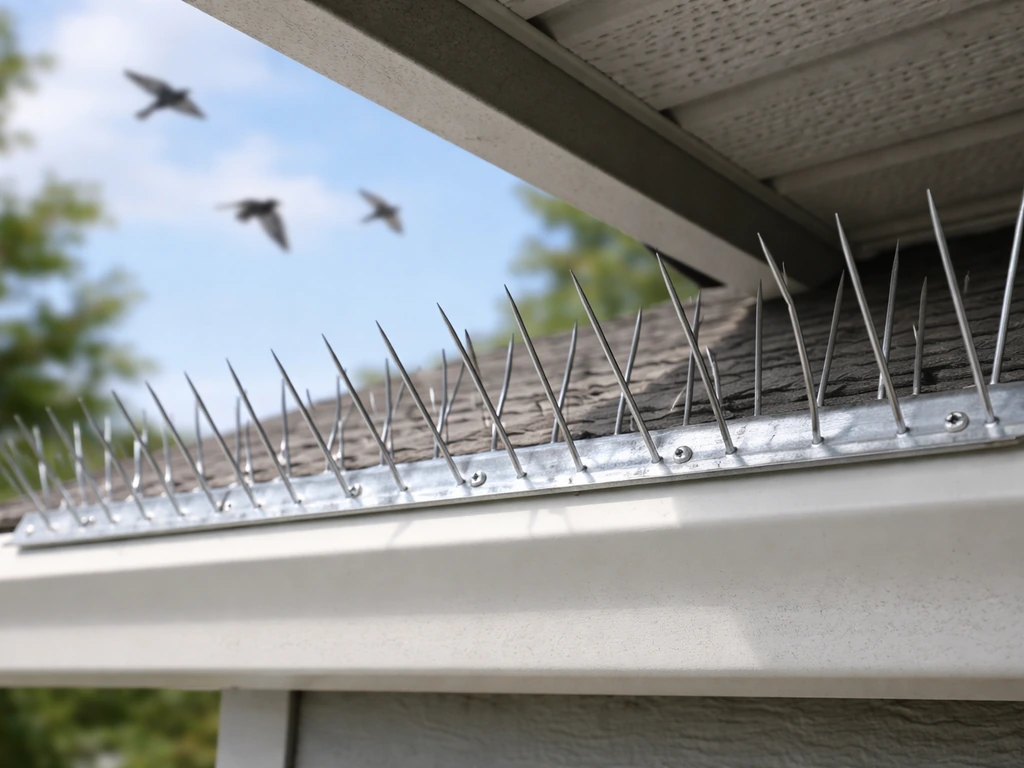
For swallows, narrow polycarbonate or stainless steel spikes with a 2.5-inch to 5-inch base width, installed tight against every eave edge, ledge, and beam without gaps, are the most effective physical deterrent available today. Stainless steel spikes on a UV-stabilized polycarbonate base are the gold standard for outdoor durability, and the key to making them work is full coverage: no skipped sections, no gaps between strips, and spikes that extend at least half an inch past the exposed edge of whatever surface swallows are using.
Best Bird Spikes for Swallows: Choose and Install

Marcus Weatherby
14 Jun 2026
How to confirm you're dealing with swallows and where they're roosting
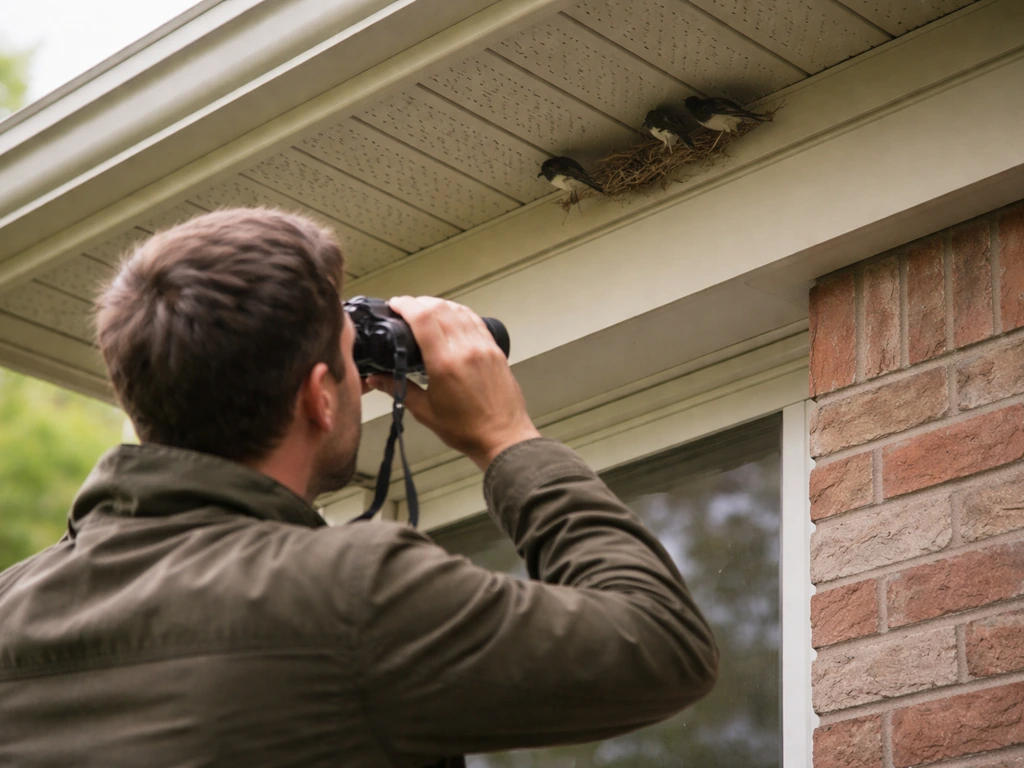
Before buying a single spike strip, spend a few minutes watching the birds and inspecting the surfaces they're using. Swallows are easy to misidentify because they share airspace with swifts, house martins, and sand martins. Barn swallows have a distinctive rusty-orange throat and a deeply forked tail. House martins have a white rump patch and a pale underside. Swifts, by contrast, are almost entirely dark brown and spend almost no time perched. If you see birds resting on ledges or building cup-shaped mud nests on vertical or angled surfaces under overhangs, you're looking at swallows or martins, not swifts.
Walk the perimeter of your building and look up. Swallows favor sheltered, south or east-facing surfaces that are out of direct rain: the undersides of eaves, horizontal beams, balcony overhangs, window sills, and the tops of light fixtures or signage brackets. Note every spot where you see mud smears, droppings, or old nest material. These are the exact surfaces you need to treat. Mark them with tape or take photos, because it's easy to forget a beam on the far side of the building when you're back at the hardware store.
Bank swallows are obligate colony nesters, and barn swallows return to the same sites year after year. That means if swallows used a ledge last season, they will almost certainly return to it. Critter Control recommends inspecting for swallow activity in late winter or very early spring, before birds arrive and claim their spots. Critter Control advises homeowners to inspect for swallow nests in late winter or very early spring, before breeding begins inspect for swallow activity in late winter or very early spring. That timing window is important for legal reasons covered later in this article.
How bird spikes work and what makes them effective against swallows
Bird spikes work by making a surface physically impossible to land on comfortably. If you are asking what are anti bird spikes, this guide explains how they work and why they are effective for keeping swallows from roosting on building surfaces. The upward-pointing stainless or polycarbonate pins don't injure birds; they just prevent a flat landing zone from existing. Swallows are small, agile birds, which means they can exploit surfaces that would stop a pigeon or gull. This is where spike selection actually matters.
What makes a spike system genuinely effective for swallows comes down to four things: spike density, base width, coverage continuity, and weather resistance. Swallows don't need much space to perch, so you want a spike density that leaves no usable flat area. Bird B Gone's stainless spike system is rated for up to 40 spikes per foot, which is appropriate for small birds like swallows. A wide-spaced pigeon spike with large gaps between pins gives a swallow enough room to squeeze in and land anyway.
For small bird exclusion specifically, narrower base strips in the 2.5-inch to 5-inch range are more useful than extra-wide strips, because they conform to the narrower ledges and beams swallows actually use. If you're covering a wide surface, it's better to run multiple narrow rows side by side than to rely on a single wide strip with fewer pins. The best bird spikes for small birds, as a category, prioritize this kind of pin density over raw width.
Choosing the right spike: material, base, height, and weather rating
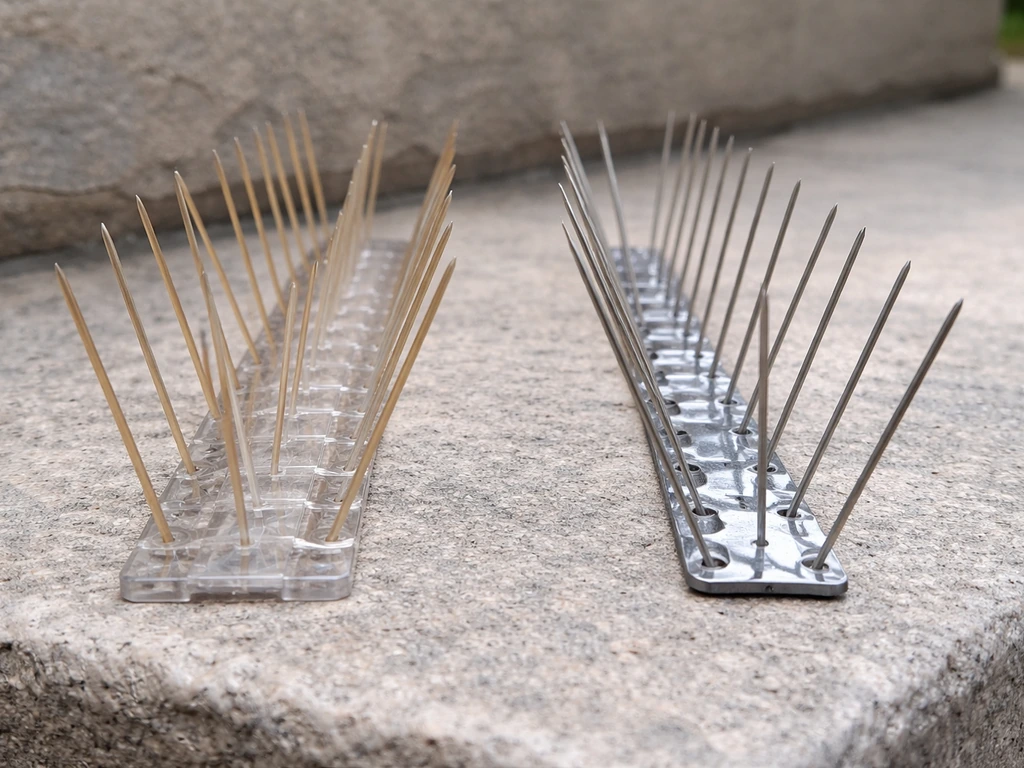
You have two main material choices for the spikes themselves: polycarbonate (plastic) pins or stainless steel pins. For a permanent outdoor installation exposed to sun, rain, and temperature swings, stainless steel wins every time. Polycarbonate pins can become brittle in UV exposure over time, even in products labeled UV-resistant. The base, however, is a different story.
A polycarbonate base with UV inhibitors is standard even on stainless spike systems, and it works well. [Bird-X's Stainless SPIKES use exactly this combination: a UV-inhibited polycarbonate base with ST302 hard surgical grade stainless pins. ](https://bird-x. com/filebin/pdf/StainlessSpikes.
pdf) That's a practical benchmark. The best adhesive for bird spikes depends on the system you choose, but in most cases you should prioritize a manufacturer-approved mounting method rather than relying on glue alone.
| Feature | Polycarbonate Spikes | Stainless Steel Spikes |
|---|---|---|
| Pin material | UV-treated plastic | ST302 surgical grade stainless steel |
| Pin durability outdoors | Moderate (can become brittle) | Excellent (10+ year lifespan typical) |
| Base material | UV-stabilized polycarbonate | UV-stabilized polycarbonate |
| Best for swallows | Short-term or sheltered areas | Long-term outdoor use on eaves/beams |
| Typical base widths | 2.5" to 8" | 2.5" to 8" |
| Mounting options | Screws, adhesive, zip ties | Screws, adhesive, zip ties |
| Cost | Lower | Moderate to higher |
For base widths, Bird Barrier's Dura-Spike comes in three sizes: Narrow (2.5 inches), Wide (5 inches), and Xtra-Wide (8 inches). The narrow and wide options are most relevant for swallow exclusion because the surfaces swallows use tend to be relatively narrow. If you're covering a beam that's 4 inches wide, a single narrow strip may not quite cover it; run one narrow and fill with a second partial strip, or use the 5-inch wide option.
Pin height matters less for swallows than pin density, but choose a system where the pins are at least 3 to 4 inches tall. Very short pins on a wide-base strip can leave enough clearance for a small bird to crouch between pins on a gusty day.
Where to install spikes for swallow exclusion
Based on your inspection walk, you should already have a list of specific surfaces. Here are the most common swallow landing and nesting locations and what to do about each.
Eave edges and soffits
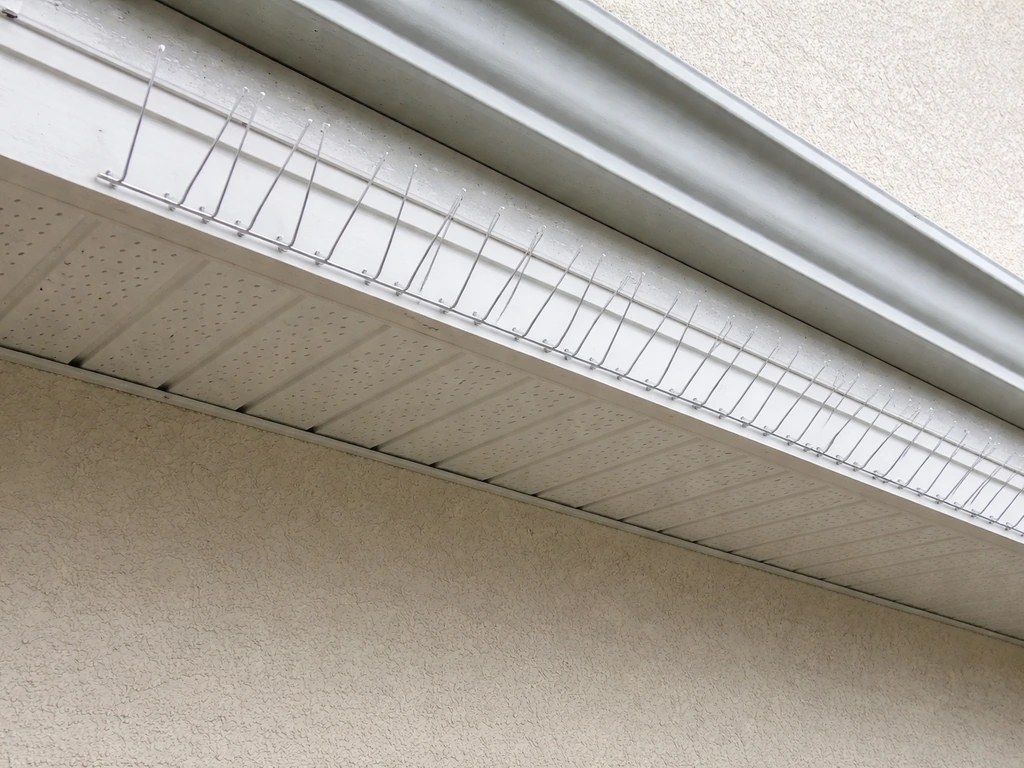
The horizontal edge at the bottom of an eave is a prime swallow perch. Run spikes along the full length of the eave edge, flush against the fascia board. The spikes should extend at least half an inch past the exposed edge, which is a specific installation requirement from Bird-X's installation manual. If swallows can land just outside the spike zone, they will.
Horizontal beams and rafters
Exposed beams in carports, barns, open-sided warehouses, and covered patios are classic nest sites. Cover the top face of every beam the birds have targeted. For beams wider than 5 inches, run two rows of narrow spikes side by side with no gap between the bases.
Balcony overhangs and ledges
Balcony railings and the undersides of balcony overhangs are harder to treat because the surfaces are irregular. Spikes work well on the top rail and the ledge edge. For the underside of an overhang where swallows are attaching mud nests, spikes are less practical; bird netting is typically better for large flat undersides.
Window sills and door frames
Narrow window sills are easy to treat with a single strip of narrow-base spikes. Make sure the strip runs the full width of the sill with no exposed corners at the ends.
Light fixtures, signage, and HVAC equipment
These are often overlooked. Birds use the flat tops of outdoor light boxes, sign brackets, and conduit runs as landing spots. Wrap spike strips around the top surfaces. For anything irregularly shaped, cut strips to fit or use a flexible spike strip product rather than rigid sections.
How to install bird spikes correctly: step by step
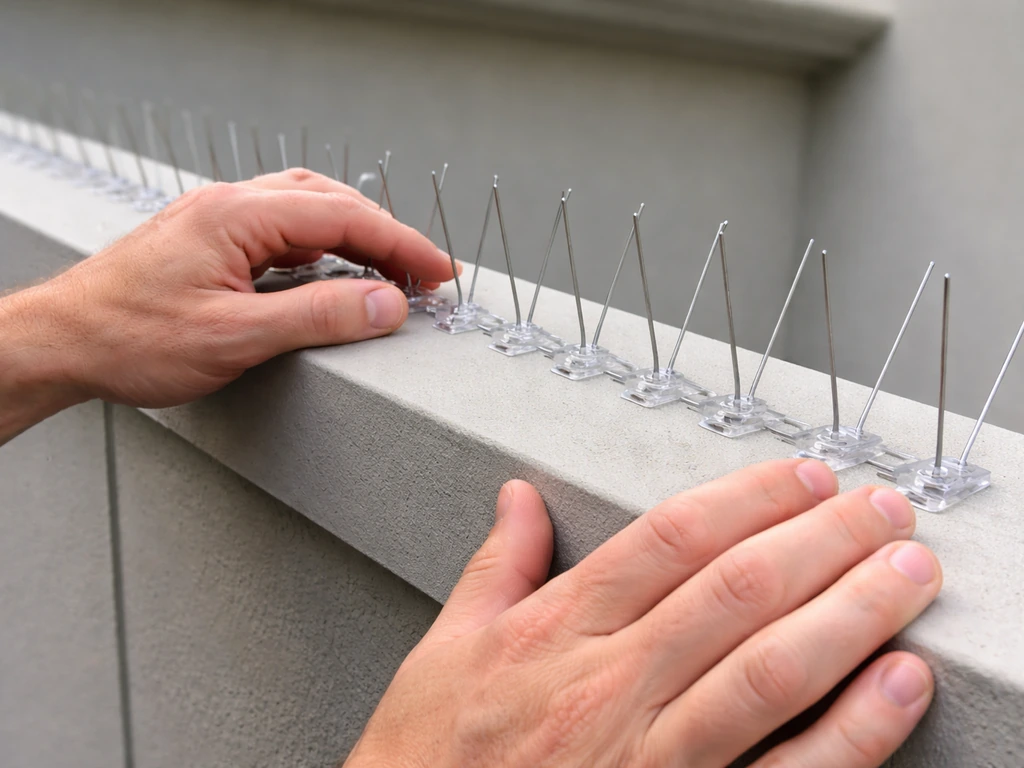
- Clean the surface thoroughly. Remove all old nest material, dried mud, and droppings. Scrub with a stiff brush, rinse, and let it dry completely. Adhesive won't bond to dirty or damp surfaces, and residual nest scent can attract swallows back.
- Measure and plan your layout. Measure the full length of every surface you're treating. Calculate how many strips you need, adding 10 percent for end cuts and corners. Plan where joints will fall so you don't create a gap at a corner or curve.
- Choose your mounting method. On wood fascia boards and beams, use #8 wood screws (ten per strip is the guidance from Bird B Gone's spec sheet). On masonry, concrete, or metal, use construction adhesive or anchored screw/bolt systems. Adhesive alone is acceptable on smooth surfaces but use screws for any surface exposed to heavy vibration or extreme temperature swings.
- Apply adhesive if using it. Run a continuous bead of UV-resistant exterior construction adhesive along the center channel of the spike strip base. Don't leave dry spots.
- Position the strip and fasten. Press the strip firmly onto the surface. If screwing, pre-drill pilot holes through the mounting holes in the base. Drive screws flush, not over-tightened, or you'll crack the polycarbonate base.
- Butt strips end to end with zero gap. Bird Barrier's Dura-Spike documentation explicitly warns that any space left between strip ends becomes a landing opportunity. Trim the last strip to fit exactly.
- Extend past the edges. Make sure spikes project at least half an inch past every exposed edge of the surface, per Bird-X's coverage guidance. This prevents birds from landing just outside the spike zone and reaching into it.
- For widths over 5 inches, add a second row. Follow the Bird-X rule: one row for every 5 inches of surface width. Two rows for 6 to 10 inches, and so on.
- Inspect for gaps and access points. Walk the treated area and look at it from the bird's perspective. Any uncovered section of flat surface longer than about 2 inches is a potential problem for a small bird like a swallow.
Safety, legality, and timing: what you need to know before you start
This is the most important section if you're dealing with swallows specifically, because swallows are migratory birds protected under the U.S. Migratory Bird Treaty Act (MBTA). The U.S. Fish & Wildlife Service is clear: it is generally illegal to destroy a nest that contains eggs or live chicks, or to take (harm, kill, or capture) migratory birds or disturb active nests. This applies to barn swallows, cliff swallows, bank swallows, and most other swallow species common in North America.
The legal and humane window for installing spikes is before nesting begins. In most of the U.S., swallows arrive and begin nest building between March and May depending on your region. Critter Control specifically recommends late winter or very early spring inspections for exactly this reason. If you can get your spikes installed before the birds return, you're both legally protected and genuinely effective. Once a nest has eggs or chicks, you have to wait until the chicks fledge and the nest is no longer active before doing anything to that surface.
State and local regulations may add additional restrictions on top of the federal MBTA baseline. New Jersey's DEP Fish & Wildlife, for example, explicitly discourages approaching or disturbing active nests. Check your state wildlife agency's guidance before taking any action near a nest with eggs or young birds. When in doubt, consult a licensed wildlife professional.
On the humane side: properly installed spikes do not injure swallows. The pins are blunt enough to prevent landing, not to impale. The goal is exclusion, not harm. If you find a completed nest with no eggs yet, you are in a gray zone legally. Some jurisdictions allow removal at that stage; others do not. Check local rules before acting.
What to expect from spikes, and what to do if swallows keep coming back
When installed correctly with full coverage and no gaps, bird spikes are highly effective at preventing swallows from landing and nesting on treated surfaces. But spikes are a surface-specific solution. They do nothing about adjacent untreated surfaces, nearby structures, or the airspace above. If you treat your eaves and swallows move to the beams in your carport instead, the treatment was incomplete, not ineffective.
Realistic expectations: spikes are a permanent physical barrier, not a repellent. Once in place and maintained, they work indefinitely. They don't wear out the way sonic or visual deterrents can, and birds don't habituate to them the way they do with noise or reflective tape. But they require complete installation to work. For homeowners comparing options, the best bird deterrent spikes are those with dense, continuous coverage and weather-resistant materials like stainless steel on a UV-stabilized base. Partial coverage is the single most common failure mode.
Common reasons spikes fail and how to fix them
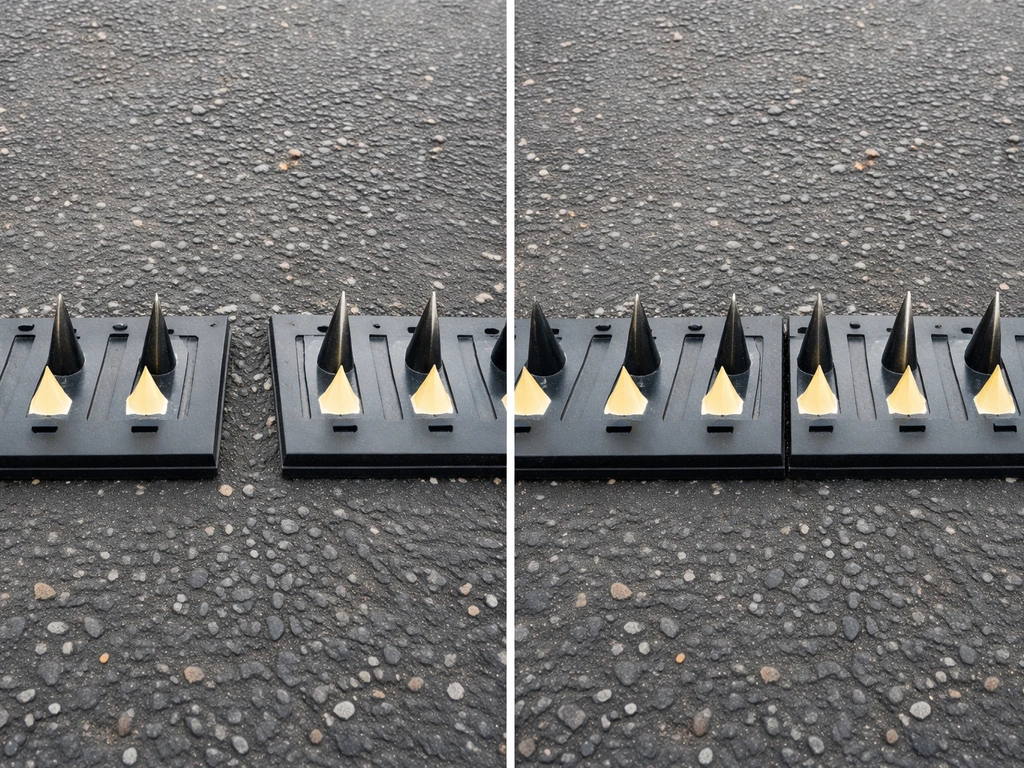
- Gaps between strips: go back and butt strips together with no gap, or fill short gaps with a cut section of spike strip.
- Spikes don't reach the edge: add an extra strip along the exposed edge, ensuring at least half an inch of overhang past the surface edge.
- Wrong width for the surface: swallows are landing between two rows of spikes on a wide beam. Add a third row or switch to a wider base strip and reinstall.
- Birds nesting on adjacent untreated surfaces: extend the treatment to every surface within a few feet of the original nest sites.
- Strips have come loose: re-adhere with fresh exterior construction adhesive and add screw anchors if you only used glue the first time.
- Nest material is bridging the spikes: some swallows, particularly cliff swallows, build mud nests that can partially encapsulate spikes over time. Remove accumulated mud promptly and consider adding a secondary deterrent like gel repellent on treated surfaces nearby.
If spikes alone aren't solving the problem after a thorough installation, the next step is usually a secondary deterrent on the same surfaces: bird netting to exclude access to an entire overhang, or a physical barrier like bird slope panels on angled surfaces where spikes are hard to mount. If spikes don't fully solve the problem, an alternative to bird spikes like bird netting or slope panels can help block access where spikes are difficult to mount. Sonic deterrents and visual deterrents like reflective tape can help discourage birds from approaching the area, but they're rarely sufficient on their own for established swallow colonies. Spikes plus netting on the most problematic overhang sections is the most reliable combined approach.
Maintenance is minimal once spikes are installed. Check them each spring before swallows return: look for loose strips, cracked bases, accumulated debris filling the spike zone, or any new surfaces that weren't treated the year before. A 20-minute inspection walk each February will catch problems before nesting season begins and keep your installation working year after year.
FAQ
Can I install best bird spikes for swallows if there is already a nest on the building?
If you already see active nests, do not install spikes on that specific spot. Under MBTA rules, you generally must wait until the nest is no longer active (eggs have hatched and chicks have fledged). If you find a nest with no eggs yet, it can still be regulated differently by jurisdiction, so check your state wildlife guidance or use a licensed wildlife professional before touching that surface.
What’s the most common reason swallow spike installations fail, even when the spikes are the right type?
Swallows can perch on surprisingly small ledges, so “mostly covered” often fails. Before you start, measure each targeted landing area, then add spares to fill short gaps at inside corners, transitions between beams, and the ends of eaves. After installation, inspect from several angles (standing back and looking along the edge) to confirm there is no continuous flat strip where a swallow could land comfortably.
Will bird spikes work on curved or irregular areas like porch soffits and ornate trim?
Yes, but only if the design still prevents landing. A rigid spike strip is easiest on straight fascia edges and beam tops; on irregular undersides, netting or slope panels are usually more reliable. If you must use spikes, use cut-to-fit sections so the bases fully contact the surface and the pin zones remain continuous, otherwise birds can use the unspiked transition areas.
Are stainless steel spikes always better than polycarbonate pins for swallows, even in harsh sun and freezing temperatures?
Stainless pins should remain effective for long-term outdoor use, while the base needs to resist sun exposure too. Polycarbonate bases can become brittle over time even when labeled UV-resistant, so prefer UV-inhibited bases from the same system and avoid mixing random base types with different pins unless the manufacturer approves the combination.
How do I choose pin height for swallows, and what if the pins look short on a wide ledge?
Don’t assume pin height solves the problem. For swallows, density and coverage continuity matter more than tall pins. Choose systems with sufficiently long pins for the targeted surface, and make sure they extend far enough over the exposed edge, especially on eave lips where birds can land just outside the barrier if the coverage ends early.
My spikes are installed, but swallows still show up. How can I tell if it’s a coverage problem or a behavior problem?
If swallows are still using untreated neighboring areas, spikes may appear ineffective. Check for alternate landing spots at the perimeter, including adjacent eaves, signage brackets, light fixtures, conduit runs, and the opposite side of the building. If the birds simply shifted locations to an untreated surface, treat that new surface using the same full-coverage approach.
What maintenance should I do so best bird spikes for swallows keep working year after year?
Gusty conditions and debris buildup can effectively create a landing surface if the spike zone gets clogged. Plan to remove leaf litter and nests from the treated edge, and after heavy storms confirm the bases are still fully seated. A yearly spring check plus a quick midseason look is usually enough to keep the deterrent consistent.
What’s the best time of year to install swallow spikes, and what if I can only work later?
Swallows often return to the same colony sites, so timing matters. For the best results and lower legal risk, do your inspection in late winter or very early spring, then install before the birds begin nest building. If you missed the window, you may need to wait until nests are inactive before treating the exact occupied surfaces.
How should I spike a beam wider than the common 2.5-inch or 5-inch strip sizes?
Yes, but you should treat it like a specific exclusion project rather than a “spot fix.” For wider beams, use two closely spaced rows (with no gap between bases) or multiple narrow rows side by side so there is no flat landing zone. If you cover only part of the beam top, swallows can land near the untreated portion and still attach mud nests.