
A bird snare is any device designed to capture a bird by entangling, confining, or restraining it, typically without killing it. The word 'snare' usually refers to a noose or loop that tightens around a bird's legs or body, but in everyday use it covers a much wider family of tools: mist nets, cage traps, drop traps, bal-chatri traps, and more. If you've landed here wondering whether a snare is the right solution for a nuisance bird on your property, or you just need to understand the terminology before deciding on a bird-control strategy, this guide walks through everything from basic definitions to legal requirements and safer alternatives.
What Is a Bird Snare: Types, Uses, Safety & Legal Guide

Marcus Weatherby
10 Aug 2026
Who this guide is for and why safety comes first
This article is written for homeowners dealing with pest birds, landlords managing commercial properties, aviation and solar-panel facility managers, pest-control technicians, field researchers, and DIYers curious about capture methods. Bird snares and traps span a wide spectrum of complexity and risk, from a simple wire cage bought online to a research-grade mist net requiring a federal permit. Before you set anything, the most important thing to understand is that in the United States (and most other countries), capturing wild birds, including common 'pest' species, without the right authorization can result in serious legal penalties. We'll get to the specifics in the legal section, but keep that framing in mind throughout.
What a bird snare actually is, and what it's called
The Merriam-Webster definition of 'snare' is a trap, often a noose, for entangling birds or small mammals, or more broadly any contrivance for capturing animals. In practice, the word has picked up a range of informal and technical synonyms depending on who is using it and why.
A traditional bird snare is a loop of cord, wire, or monofilament anchored to a fixed point so that a bird stepping into or through it pulls the noose tight around its leg or neck. Historically these were called 'fowler's snares,' and the person who set them was a fowler, a term that survives today in the broader phrase 'bird catcher.' Modern usage stretches the word 'snare' to cover almost any passive capture device aimed at birds.
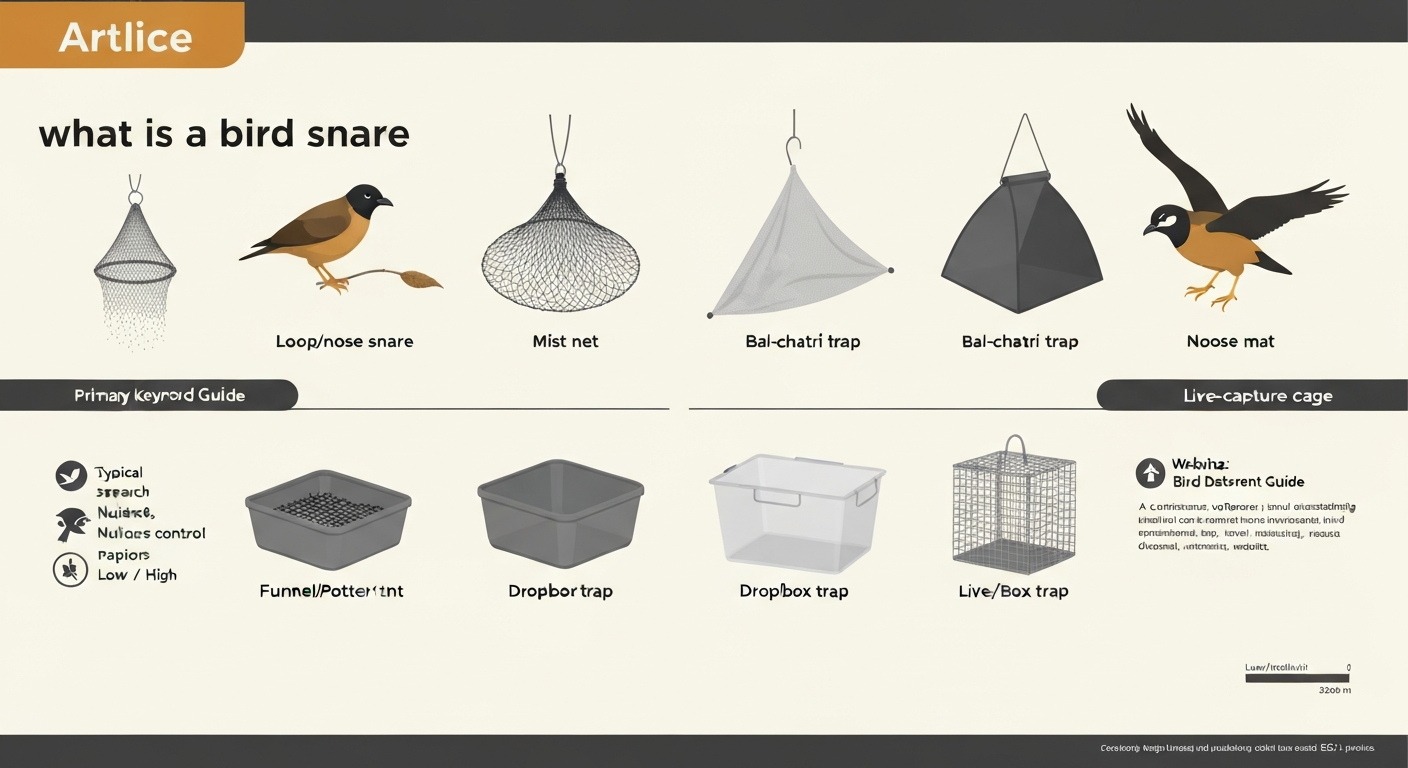
- Bird snare: the broad umbrella term; technically a noose-type device but used loosely for any capture tool
- Bird trap: a cage, box, or enclosure that holds a bird once it enters; usually implies live capture
- Mist net: a fine-mesh net suspended between poles that tangles birds in flight
- Bal-chatri: a portable baited cage covered in small slip-nooses on its outer surface, used mainly for raptors
- Live-capture cage / funnel trap / Potter trap: mesh enclosures that guide birds into a holding compartment through a one-way funnel or drop door
- Noose mat / noose carpet: a flat mat covered in monofilament nooses for capturing shorebirds or ground-feeding birds
- Dho-gaza: a net suspended between poles that collapses when struck, used to catch territorial raptors near a lure
- Bird catcher: the person who operates these devices professionally or for research
How snares, nets, and traps actually capture birds
All bird capture devices exploit one of three basic mechanics: entanglement, confinement, or a combination of both. Understanding the mechanics helps you evaluate which tool, if any, fits your situation.
Entanglement devices
Mist nets and noose-based snares work by letting a bird move normally until it contacts the device. A mist net is made of very fine nylon, terylene, polyester, or monofilament mesh strung loosely between poles so that it forms horizontal 'pockets' or shelves. A bird flies into the net, falls forward into a pocket, and becomes tangled by its wings, legs, or head. Typical ground-level avian mist nets run 6 to 12 meters long and 1.2 to 3.2 meters high, with mesh sizes around 16 to 20 mm for passerines. The mesh is almost invisible in low light, which is what makes it effective and also what makes it a hazard to non-target birds.
Noose-type snares and noose mats operate differently: the bird lands on or walks across a mat or past an anchored loop, and the loop closes around its foot or leg as it moves. The principle is passive, relying entirely on the bird's own movement to set the snare. This simplicity is also the main welfare concern, because a snared bird can injure itself struggling before anyone checks the device.
Confinement devices
Cage traps, funnel traps, Potter traps, and drop/box traps all work by luring a bird inside an enclosure and then preventing it from leaving. The blank" rel="noopener noreferrer">North American Banders' Manual for Raptor Banding Techniques / Banders' Study Guide (trap descriptions and handling procedures) describes common live‑capture cage, funnel/Potter/box and walk‑in traps and emphasizes taxon‑specific construction (mesh size, funnel dimensions, door mechanisms) and operating protocols such as routine checks, single‑bird holding when necessary, and rapid processing to reduce stress. Funnel traps use a cone-shaped wire entrance that is easy to enter from outside but hard to locate from inside. Drop traps use a trigger mechanism (manual or automated) that closes a door once a bird is in position. The bird is alive and largely uninjured as long as the trap is checked frequently.
Hybrid designs
The bal-chatri combines both mechanics. The cage in the center confines the lure (often a live mouse or small bird, though blank" rel="noopener noreferrer">mechanical lures are preferred for welfare reasons). The outside of the cage is covered in dozens of small monofilament slip-nooses, typically 4 to 12 cm in diameter, so a raptor that dives at the lure snags one or more feet in the nooses. The trap must be anchored or weighted heavily enough that the raptor cannot fly off with it. Trap sizes typically run 25 to 50 cm.
The main types of bird snares and traps
| Type | How it works | Typical use | Skill level needed |
|---|---|---|---|
| Loop/noose snare | Fixed noose tightens around leg or neck when bird steps through | Historical pest control; now rarely recommended | Low to set, but high welfare risk |
| Mist net | Fine mesh tangles birds in flight in horizontal pockets | Research, banding, field surveys | High; requires training and permits |
| Bal-chatri | Baited cage with external nooses catches raptor feet on strike | Raptor research, falconry trapping | High; continuous monitoring required |
| Noose mat | Flat mat with many small nooses tangles feet of landing birds | Shorebird and ground-bird research | Moderate; site-specific setup |
| Dho-gaza | Net collapses or detaches when struck; used near a lure | Territorial raptor capture near nests | High; trained team needed |
| Funnel/Potter trap | One-way funnel guides bird into mesh cage | Pest species removal, research | Low to moderate |
| Drop/box trap | Trigger drops door once bird enters; manual or remote close | Nuisance birds, feeder trapping | Low to moderate |
| Live-capture cage | Baited enclosed cage with spring or pull-cord door | Nuisance control, relocation | Low; frequent checking essential |
When bird snares and traps are actually used
Pest and nuisance bird control
Property managers dealing with invasive species, such as European starlings, house sparrows, or feral pigeons in specific jurisdictions, sometimes use live-capture cage traps as part of an integrated management plan. These non-native invasive species have fewer legal protections in the US than native migratory birds, which makes trapping more legally accessible, though rules still vary by state. The trap is baited with grain or the bird's preferred food, set in a location with known bird activity, and checked at least once or twice daily.
Scientific research and field surveys
Ornithologists and ecologists use mist nets, bal-chatri traps, noose mats, and dho-gazas routinely to capture birds for banding, health assessments, GPS tagging, and population studies. This is the context where the most sophisticated trap designs are used, and it is also the context that requires the most rigorous permits and training. A large multi-site study across 22 banding organizations covering 620,997 captures found an average injury rate of about 0.59% and mortality rate of about 0.23%, which shows that properly trained operators can keep risks very low, but that risks are never zero.
Aviation and infrastructure protection
Airports and airfields use live-capture traps as one tool within a broader wildlife hazard management program to remove birds from active runway areas. Solar farm operators sometimes face bird congregation problems. In both settings, trapping is typically only one component alongside physical deterrents like netting and spikes, and sensory deterrents like sonic and visual repellents. A professional wildlife biologist or licensed pest controller is almost always involved in aviation contexts because the regulatory requirements are strict.
DIY nuisance removal
Homeowners sometimes attempt homemade trap designs for birds raiding feeders or nesting in problematic locations. Simple drop traps and funnel-style cage traps can be built from wire mesh, and improvised versions using soda cans or bottles as counterweights have circulated online as low-cost DIY solutions. For a simple DIY example, see the coke can bird trap which shows how soda cans can be adapted as counterweights and triggers. These can work in the right circumstances, but the same legal rules apply as for commercial traps: you need to confirm the target species is legal to trap without a permit in your jurisdiction before you set anything.
When to use a snare or trap, and when not to
Trapping makes sense when you need to physically relocate a bird, band it for research, or remove it from a high-risk zone like an active runway, and when you have confirmed it belongs to a species and situation covered by your permit or local exemptions. It also makes sense when passive deterrents have already been tried and failed.
Trapping is the wrong tool when the bird problem is about discouraging presence rather than removing individuals, when the site is too large or open to monitor a trap reliably, when you do not have the time to check the trap every few hours, or when the target species is a protected migratory bird and you do not have authorization. In most residential and commercial bird-control scenarios, physical barriers like spikes and netting, or sensory deterrents like sonic or visual repellents, will solve the problem more cheaply, more safely, and without any legal exposure.
A common troubleshooting situation worth addressing here: if you've set a trap or DIY snare and it's not working, the most frequent causes are incorrect bait placement, bait that doesn't match the target species' diet, a trap positioned away from the bird's actual feeding or resting route, or a trap that has been disturbed enough to make birds wary of approaching it. For tips on choosing effective lure options, see our guide to the best bait for bird traps. Patience and repositioning solve most of these problems. For unrelated, game-specific troubleshooting (for example, issues titled "osrs bird snare not working"), consult a dedicated Old School RuneScape troubleshooting guide or forum for targeted help. Covering a new cage trap with natural vegetation or burlap for a day or two can reduce wariness significantly.
Snares and traps vs. deterrents: which is right for your situation
Before deciding on any capture device, it's worth weighing it honestly against the alternatives. Here's a practical comparison across common scenarios.
| Scenario | Best approach | Why trapping may not be needed |
|---|---|---|
| Birds roosting on ledges or rooflines | Physical spikes or wire deterrents | Roosting is a presence problem, not a capture problem |
| Birds entering roof cavities or vents | Exclusion netting or wire mesh | Block entry rather than trap individuals |
| Birds damaging a garden or solar panels | Visual/sonic deterrents, netting over crops or panels | Numbers are typically too large for trapping to have impact |
| Single injured or grounded bird | Contact local wildlife rehabilitator | Handling requires a permit; rehabilitation is covered under separate authorization |
| Invasive species (starlings, house sparrows) at a feeder | Live-capture cage trap (check local rules) | These species have fewer protections; trapping can be viable |
| Airport or airfield bird hazard | Integrated wildlife management program with licensed professional | Regulatory complexity requires expert involvement |
| Raptor research/banding | Bal-chatri or dho-gaza with federal banding permit | No legal alternative for live capture in this context |
Pros, cons, and the bycatch problem
Advantages of live-capture traps and snares
- Allow physical removal or relocation of individual problem birds
- Enable research data collection (banding, health sampling, GPS tagging)
- Non-lethal when operated correctly and checked frequently
- Selective designs can target a single species with minimal disturbance
- Reusable and relatively low-cost for cage trap designs
Disadvantages and risks
- Passive traps (especially mist nets) capture non-target species at significant rates
- Unchecked traps cause stress, injury, or death: birds can overheat, dehydrate, or injure themselves struggling
- Noose snares present a high injury risk from self-tightening restraint if not checked very frequently
- Legal exposure is real: capturing a protected migratory bird without a permit can result in criminal penalties
- Live lures used in bal-chatri-style traps raise their own welfare concerns
- Does not address the root cause of bird presence, so the problem often returns
Bycatch: the non-target capture problem
Bycatch is one of the most serious practical problems with broad passive capture devices. Mist nets and baited cage traps are not species-specific: any bird that flies through the net or enters the trap can be caught. Research comparing a remotely-closing selective feeder trap against mist nets found zero bycatch with the selective trap versus notable bycatch with nets, which illustrates how much trap design matters when protecting non-target species. If you are setting any kind of trap in an area with diverse bird species, including protected ones, you are responsible for what gets caught, not just what you intended to catch.
Legal and regulatory requirements: what you must know before setting anything
In the United States, the Migratory Bird Treaty Act (MBTA, 16 U.S.C. 703-712) makes it unlawful to take, kill, capture, possess, transport, or sell most migratory birds or their parts, nests, and eggs without federal authorization. 'Take' explicitly includes trapping and live capture. The US Fish and Wildlife Service (USFWS) implements MBTA permitting under 50 CFR Part 21, which covers scientific collecting, depredation orders, rehabilitation, banding, and several other categories.
The practical implication is straightforward: if the bird you are trying to trap is a native migratory species, you almost certainly need a permit from USFWS before you legally set a trap. Permit applications are handled through the USFWS Migratory Bird Permits program and submitted via the agency's ePermits online portal at epermits.fws.gov. Permit types include scientific collecting permits (for researchers), depredation permits (for damage control situations), and various authorization letters for specific situations.
Outside the US, equivalent legislation applies in most countries: the EU Birds Directive, the UK Wildlife and Countryside Act, Canada's Migratory Birds Convention Act, and Australia's Environment Protection and Biodiversity Conservation Act all restrict capture of wild birds. The specific rules differ, and what is permitted in one jurisdiction may be prohibited in another, so always check your country's and state or province's current regulations before proceeding.
A few species have historically had fewer federal protections in the US because they are non-native invasives: European starlings, house sparrows, and feral rock pigeons are not covered by the MBTA in the same way as native migratory birds. However, state laws and local ordinances may still restrict trapping methods or require permits, so checking at the state level is still essential.
How to check and stay compliant
- Identify the bird species causing the problem as precisely as possible before taking any action
- Check whether that species is covered by the MBTA or your country's equivalent legislation
- Visit the USFWS Migratory Bird Permits page (or your national wildlife authority's site) to determine which permit type applies to your situation
- Submit a permit application through the ePermits portal if a permit is required, and wait for authorization before setting any device
- Check your state's fish and wildlife agency rules for any additional state-level restrictions
- If you are unsure, contact your regional USFWS permit office directly, they can advise on the correct authorization pathway
Safety, disease precautions, and humane handling
Whether you are a researcher checking a mist net or a property manager removing a trapped starling from a cage, handling wild birds carries genuine health risks. Birds can carry Salmonella, Campylobacter, avian influenza, Newcastle disease, and other pathogens. The risk increases with stressed or sick birds, and with species known to congregate in large numbers like pigeons and starlings.
Personal protective equipment (PPE)
- Wear nitrile or latex gloves whenever handling a wild bird or cleaning a trap
- Use an N95 or equivalent respirator when working with pigeons, starlings, or any large congregation species, especially in enclosed spaces
- Wash hands thoroughly with soap and water after any contact with birds, traps, or droppings
- Avoid touching your face while handling birds or equipment
- Wear eye protection if birds are likely to peck or flap aggressively
Minimizing stress and injury during capture
The single most important rule in humane trap operation is to check traps frequently. Under most professional banding and research protocols, mist nets must be checked at least every 30 minutes, and more often in hot weather or direct sunlight. Cage traps should be checked at least every few hours. A trapped bird that overheats, dehydrates, or injures itself struggling is a welfare failure regardless of intent.
When you approach a trap, move slowly and avoid sudden movements or loud noises that could cause the bird to struggle harder. Extract a bird from a mist net using proper extraction technique: support the body fully, work the mesh over the wings and feet patiently rather than pulling. If you are not trained in extraction, the bird can sustain wing or leg injuries that are worse than the entanglement itself. For cage traps, use a handling bag or cloth cover to calm the bird before opening the door to prevent escape or injury.
Transport and release
If the bird is to be released on-site, do so as quickly as possible after any required processing. Transport in a darkened, ventilated box or bag reduces stress significantly compared to open containers. Release the bird at or near the capture site unless relocation is specifically authorized and the destination habitat is suitable. Releasing a bird in unsuitable habitat is not a humane outcome, and for research applications it may also compromise data quality.
If you find an injured bird in a trap, do not attempt to treat it yourself unless you are a licensed wildlife rehabilitator. Contact your local wildlife rehabilitation center or state wildlife agency for guidance. Attempting unlicensed rehabilitation of a migratory bird carries its own legal exposure under the MBTA.
When to call a professional or contact wildlife authorities
Hire a licensed wildlife removal professional or pest-control technician if the target species is protected, if the scale of the problem is beyond what a single cage trap can address, if you are not confident in humane handling techniques, or if the location is safety-critical like an airport. These professionals carry the permits and liability coverage that protect you as well as the birds.
Contact your state or federal wildlife agency directly if you encounter a large number of sick or dead birds, if you find an endangered or rare species in a trap, or if you are unsure whether your planned action is legally permitted. Acting first and asking questions later is the approach most likely to result in a violation.
Choosing between traps and deterrents: a practical decision guide
For most homeowners and property managers, the honest answer is that deterrents solve bird problems more reliably and with less legal risk than traps. For comparisons and top-rated options, see a guide to the best bird trap in the world. For product recommendations and comparisons, see our guide to the best bird trap for common nuisance species. Physical barriers like spikes, exclusion netting, and wire systems prevent birds from accessing a location permanently without any ongoing management burden. Sensory deterrents, including sonic devices and visual repellents, work well in open areas like patios, rooftops, and around solar panels where netting is impractical.
Trapping becomes the right choice when a specific individual bird needs to be removed physically (such as a bird trapped inside a building), when you are conducting authorized research, or when you are managing a confirmed invasive species with appropriate authorization. In every other situation, it is worth exhausting deterrent options first. They are cheaper to operate, require no permits for most standard products, and address the problem at the access or preference level rather than through reactive individual removal. For homeowners seeking to reduce cat predation on birds, see our guide to the best cat collars to stop bird catching.
If you do decide to use a trap, match the design to the species, check it far more often than you think is necessary, have a plan for what you will do with the bird once caught, and confirm the legal picture before you set the first device. For examples and buyer recommendations, see the guide to the best bird trap ever. Done correctly, live-capture trapping is a legitimate and humane tool. Done carelessly, it causes bird deaths, legal problems, and solves nothing long-term.
FAQ
What is a 'bird snare' and what are common names for these devices?
A bird snare is any device designed to capture birds by entanglement, confinement, or restraint. Common terms used in practice and literature include snare, noose mat, mist net, bal‑chatri, dho‑gaza (net collapse), live‑capture cage, funnel/box trap, Potter trap, and baited/remote feeder traps. In general usage ‘snare’ often implies a slip‑noose mechanism but the term is sometimes applied broadly to other capture contrivances.
How do different bird capture devices work (basic mechanics)?
Mist nets: fine mesh suspended between poles forming loose pockets that entangle flying birds. Bal‑chatri: a small baited cage with many external monofilament nooses that tangle a raptor’s feet. Noose mats: flat mats or carpets with many small slip‑nooses that catch legs of birds that walk over them. Dho‑gaza/net‑collapse traps: nets suspended or rigged to collapse around a bird when it strikes a lure. Live‑capture cages/potter/funnel traps: funnel entrances guide birds into a holding compartment; doors close behind them. Remote/feeder traps: baited stations that close remotely or mechanically to retain only target species.
What are typical uses for bird snares and traps?
Common uses include: 1) Scientific capture for banding, telemetry, health checks and research; 2) Pest or nuisance control on residential, commercial, agricultural, or aviation sites; 3) Wildlife management and relocation under permit; 4) Falconry or targeted raptor capture (bal‑chatri); and 5) Rehabilitation and rescue when authorized. Each use has different legal and welfare requirements.
What are pros and cons of the major capture methods?
Mist nets: pro—effective for targeted research captures; con—bycatch risk, needs frequent checking and trained crew. Bal‑chatri: pro—effective for raptors; con—welfare issues if live lures are used and risk of foot injury. Noose mats: pro—effective for ground‑foraging species; con—can catch non‑targets and induce leg injuries. Live‑capture cages: pro—low injury risk if sized/checked correctly; con—may need species‑specific designs and frequent checks. Remote selective traps: pro—can greatly reduce bycatch; con—more complex and costly.
What are non‑target risks and welfare concerns?
Passive and broad devices capture non‑target species (bycatch), including protected birds. Captured animals can suffer stress, feather or limb injury, dehydration, hypothermia/heat stress, or predation if left unchecked. Use of live lures (e.g., in bal‑chatri) raises additional welfare concerns for the lure animal. Improper deployment, inappropriate mesh/noose sizes, and long checking intervals increase injury and mortality risk.
What legal and permitting requirements commonly apply?
In many countries, capturing wild birds requires authorization. In the U.S., the Migratory Bird Treaty Act (MBTA) generally prohibits taking, capturing, or possessing migratory birds without a permit; 50 CFR Part 21 describes permit categories (scientific collecting, depredation, rehabilitation, etc.). Local, state, provincial, or national rules may add restrictions. Special permits or registrations (e.g., USFWS ePermits) are typically required for research, banding, and many control actions. Always verify regulatory requirements for the species and jurisdiction before setting traps.
Next Article
Best Bait for Bird Traps: Top Choices, Species & Setup
Practical, legal guide to choosing and using the best bait for bird traps, species tips, setups, DIYs, safety.